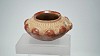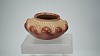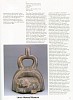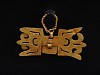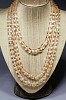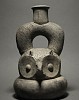
David Bernstein Pre-Columbian Art. Extensive inventory of Pre-Columbian art from South America, including ancient objects in ceramic, textiles, bronze, copper and gold. Logo

ENTER KEYWORD


OR BROWSE INVENTORY...
Country:
Show:
Media:
Price Range:
  • ABOUT
  • INVENTORY
  • GOLD
  • EXHIBITIONS
    • Past
    • See All Exhibitions >
  • PUBLICATIONS
  • NEWS
  • CONTACT
  • ENTER KEYWORD


    OR BROWSE INVENTORY...
    Country:
    Show:
    Media:
    Price Range:

Search Results

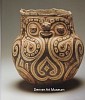
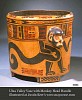
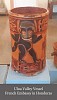
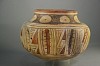
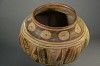
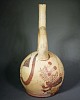
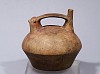
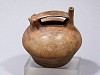
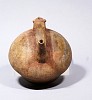
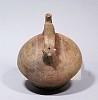
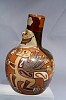
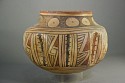
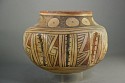
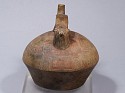
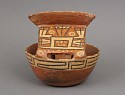
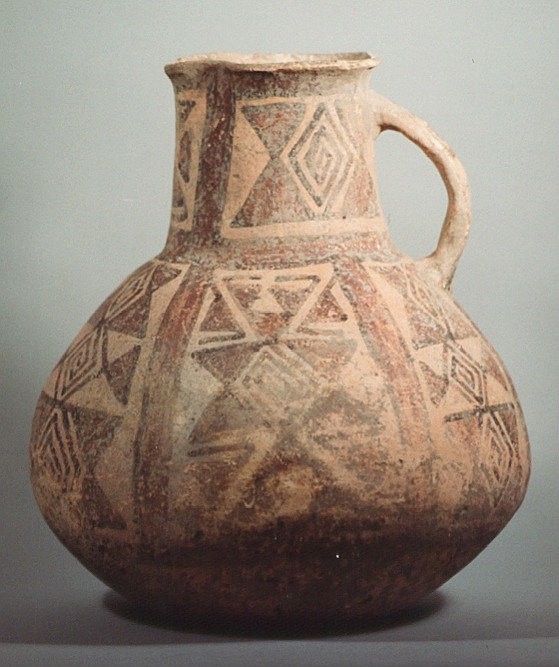
Bolivia, Bolivian Ceramic Vessel Decorated with Geometric Designs
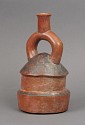
Large ceramic jug handle vessel with geometric designs of concentric diamonds in red, brown, and black slip on a pink buff ground.  Vessels with similar designs are also found in Arica, Chile and Southern Bolivia, and appear to be a regional integration style.
Period: Bolivia, Inca, c. 1440 - 1532
Media: Ceramic
Dimensions: Height 11"
94207x
Bolivia | Bolivian Ceramic Vessel Decorated with Geometric Designs | | David Bernstein Pre-Columbian Art. Extensive inventory of Pre-Columbian art from South America, including ancient objects in ceramic, textiles, bronze, copper and gold.
1 / 108

Bolivia, Bolivian Ceramic Vessel Decorated with Geometric Designs

Large ceramic jug handle vessel with geometric designs of concentric diamonds in red, brown, and black slip on a pink buff ground. Vessels with similar designs are also found in Arica, Chile and Southern Bolivia, and appear to be a regional integration style.

Period: Bolivia, Inca, c. 1440 - 1532

Media: Ceramic

Dimensions: Height 11"

94207x

  • View all works
  • PLAY
  • I N Q U I R E
  • Share
  • Print
  • More Works
I N Q U I R E Share Print
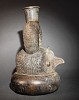
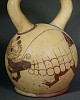
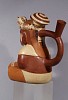
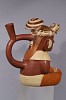
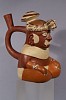
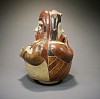
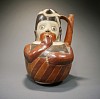
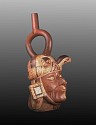
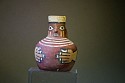
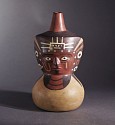
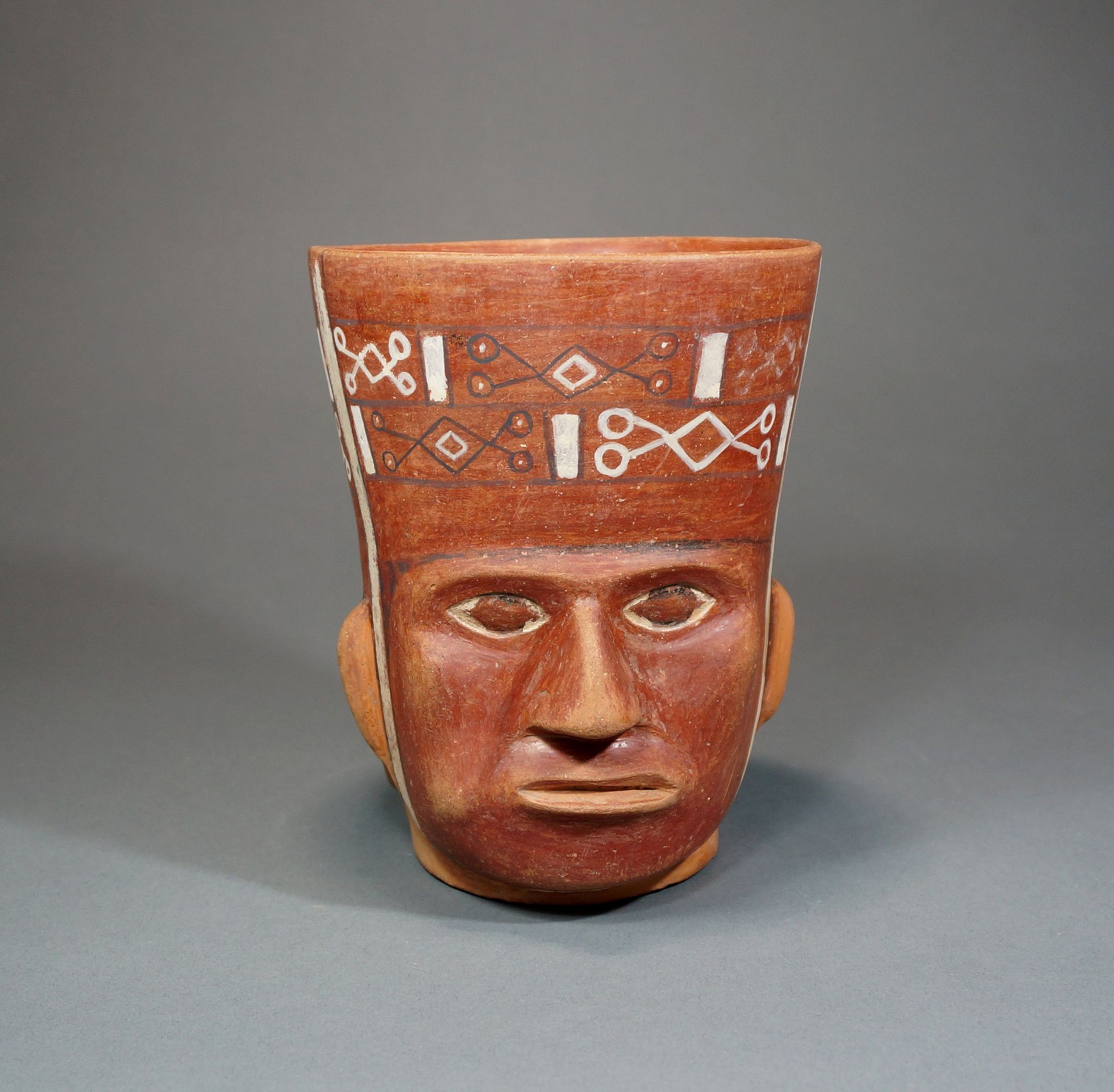
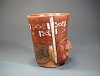
Bolivia, Tiawanaku Portrait Vessel Wearing a Woven Headpiece
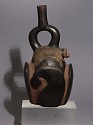
This portrait vessel has a modeled coca leaf on the left cheek.  A similar portrait vessel is illustrated in TIAWANKU, ANCESTORS OF THE INCAS, edited by Margaret Young-Sanchez (fig. 5.24).  The portrait vessels from the Tiawanku culture must have been heavily influenced by the Moche People of the coast.  Ex Collection Arthur Sackler prior to 1970.
Media: Ceramic
Dimensions: Height: 5 7/8", Diameter 4 3/4"
n2006
Bolivia | Tiawanaku Portrait Vessel Wearing a Woven Headpiece | | David Bernstein Pre-Columbian Art. Extensive inventory of Pre-Columbian art from South America, including ancient objects in ceramic, textiles, bronze, copper and gold.
2 / 108

Bolivia, Tiawanaku Portrait Vessel Wearing a Woven Headpiece

This portrait vessel has a modeled coca leaf on the left cheek. A similar portrait vessel is illustrated in TIAWANKU, ANCESTORS OF THE INCAS, edited by Margaret Young-Sanchez (fig. 5.24). The portrait vessels from the Tiawanku culture must have been heavily influenced by the Moche People of the coast. Ex Collection Arthur Sackler prior to 1970.

Media: Ceramic

Dimensions: Height: 5 7/8", Diameter 4 3/4"

n2006
  • View all works
  • PLAY
  • I N Q U I R E
  • Share
  • Print
  • More Works
I N Q U I R E Share Print
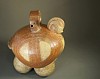
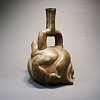
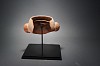
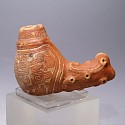
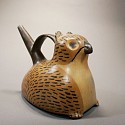
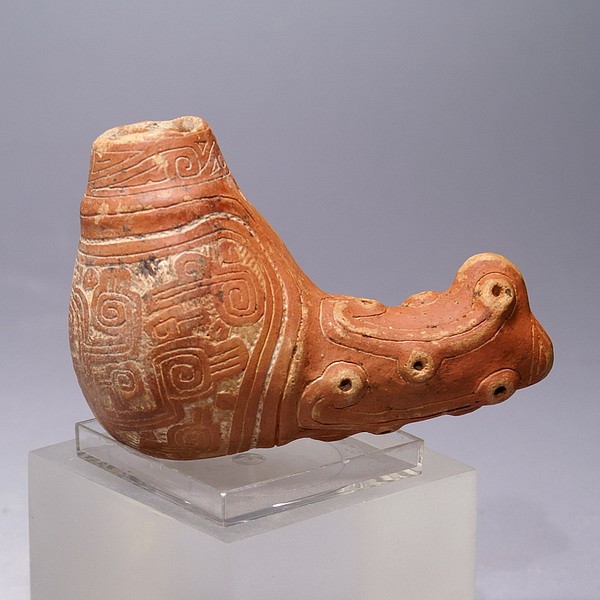
Brazil, Marajo Ceramic container in the form of a Mythical Cayman
These containers are highly valued because of the quality of artistry.  They have a hole to tie a string through, either for suspension or to attach a cover.  This vessel has a stylized Cayman's snout and finely incised designs depicting stylized birds’ heads on the chamber.  Similar vessels illustrating a Cayman's head can be found in UNKNOWN AMAZON, on page 150 and in the catalog O MUSEU PARAENSE EMILIO GOELDI, on page 134.
Period: Brazil, Marajo Island, Camutins Subphase, c. AD 400 - 800
Media: Ceramic
Dimensions: Length 4.4" x Height  3.1"
$3,800
N1056
Brazil | Marajo Ceramic container in the form of a Mythical Cayman | | David Bernstein Pre-Columbian Art. Extensive inventory of Pre-Columbian art from South America, including ancient objects in ceramic, textiles, bronze, copper and gold.
3 / 108

Brazil, Marajo Ceramic container in the form of a Mythical Cayman

These containers are highly valued because of the quality of artistry. They have a hole to tie a string through, either for suspension or to attach a cover. This vessel has a stylized Cayman's snout and finely incised designs depicting stylized birds’ heads on the chamber. Similar vessels illustrating a Cayman's head can be found in UNKNOWN AMAZON, on page 150 and in the catalog O MUSEU PARAENSE EMILIO GOELDI, on page 134.

Period: Brazil, Marajo Island, Camutins Subphase, c. AD 400 - 800

Media: Ceramic

Dimensions: Length 4.4" x Height 3.1"

$3,800

N1056
  • View all works
  • PLAY
  • I N Q U I R E
  • Share
  • Print
  • More Works
I N Q U I R E Share Print
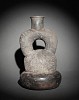
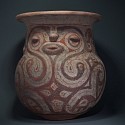
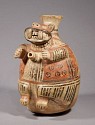
Brazil, Marajo Janus-Figure Burial Urn
The figure is wearing ear ornaments and has symmetrical serpents encircling the eyes, terminating on the body.  Below is a pentangular Venus element.  A similar vessel is illustrated in MARAJO-Ancient Ceramics from the Mouth of the Amazon, 2011, Denver,  fig 75.
Ex-Collection Jean Lions Riode Janerio, Brazil circa 1970's.
Period: Brazil, Marjo Island, c. AD 400 - 1350
Media: Ceramic
Dimensions: Height: 12 1/4"
$7,750
p1061
Brazil | Marajo Janus-Figure Burial Urn | | David Bernstein Pre-Columbian Art. Extensive inventory of Pre-Columbian art from South America, including ancient objects in ceramic, textiles, bronze, copper and gold.
4 / 108

Brazil, Marajo Janus-Figure Burial Urn

The figure is wearing ear ornaments and has symmetrical serpents encircling the eyes, terminating on the body. Below is a pentangular Venus element. A similar vessel is illustrated in MARAJO-Ancient Ceramics from the Mouth of the Amazon, 2011, Denver, fig 75.
Ex-Collection Jean Lions Riode Janerio, Brazil circa 1970's.

Period: Brazil, Marjo Island, c. AD 400 - 1350

Media: Ceramic

Dimensions: Height: 12 1/4"

$7,750

p1061

  • View all works
  • PLAY
  • I N Q U I R E
  • Share
  • Print
  • More Works
I N Q U I R E Share Print
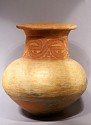
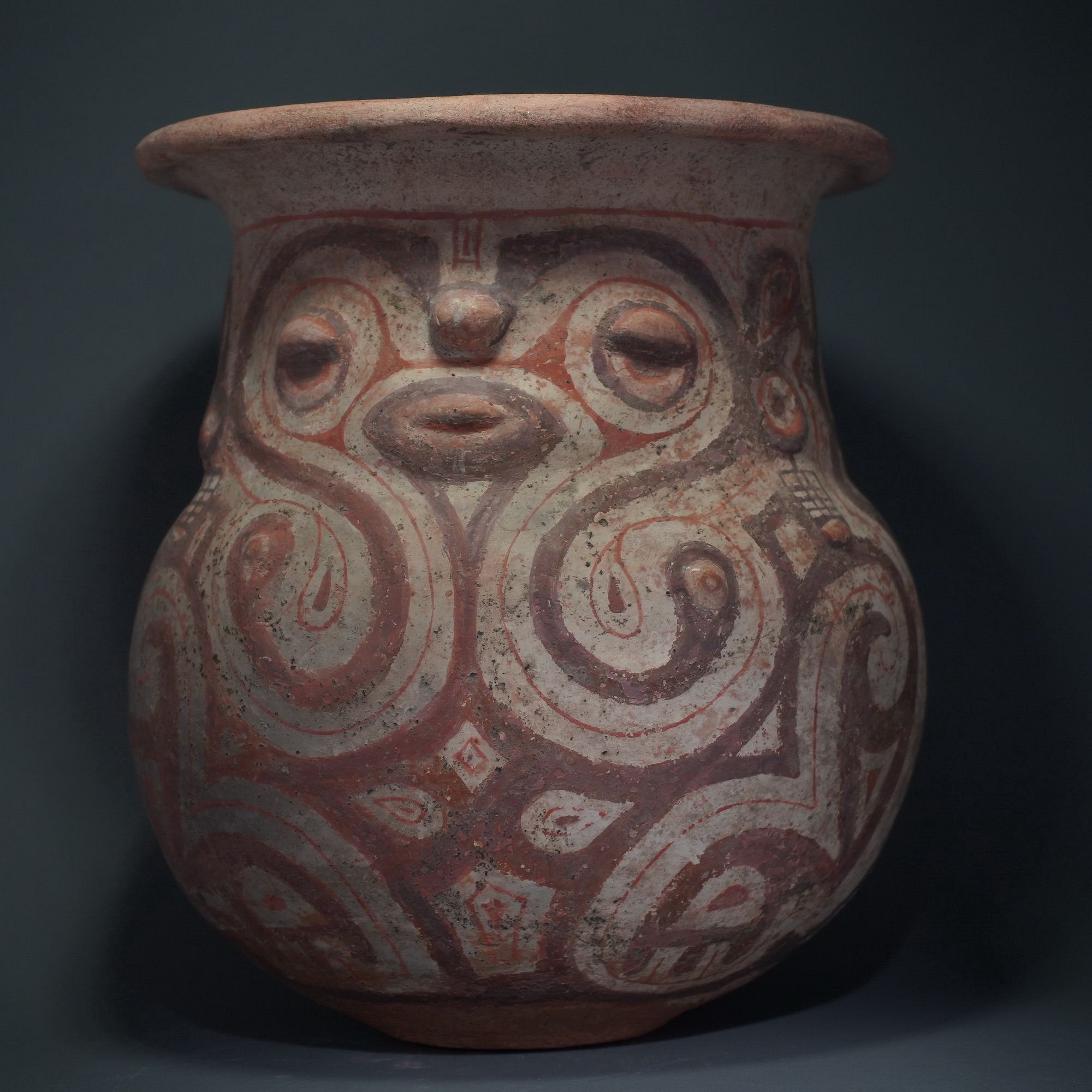
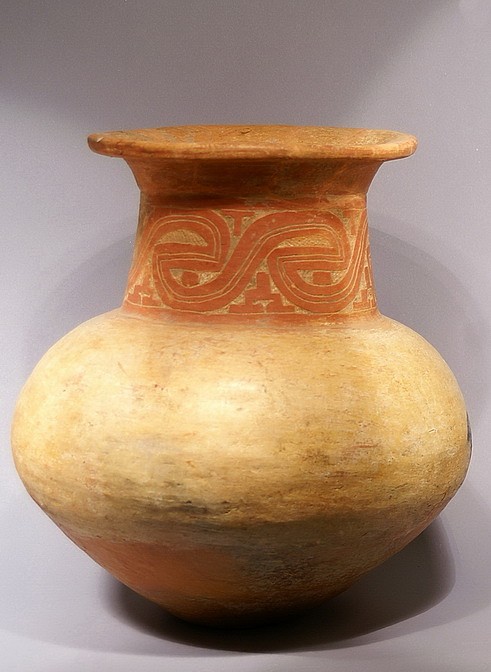
Brazil, Marajo large ceramic bichrome vessel with incised neck
This large ceremonial urn/vase is globular in form and tapers at the base. The neck is long and incised with a scroll pattern and fluted rim. The incised scroll design on the neck is a common motif in Marajoara art. Zoomorphic in character, theses scroll designs appear on the bodies of both humans and animals and on representations of clothing and furniture such as stools. Because of their similarity to painted patterns that have ritual significance in the art of remaining descendants of the culture, some interpretation of their symbolic significance can be reached. Sometimes they are referred to as "spirit" designs according to shamans who during drug induced trances report the appearance of these markings upon the bodies of ancestral spirit people. With the possible exception of certain elite groups, the Marajoara peoples tended not to decorate their common household objects.  However, they took great care to elaborate objects of ceremonial function such as funerary urns used as receptacles for the remains of the deceased. Although the actual function of this vessel is not known with certainty, it is too sophisticated in both form and decoration to have been merely utilitarian, but too small to be used as a burial urn. It is reasonable to assume, however, that it was used in a feasting ceremony. This jar has a smudge stain from the firing process on one side. Several examples of similar style and iconography are illustrated and discussed by Anna C. Roosevelt in "Moundbuilders of the Amazon: Geophysical Archaeology on Marajo Island, Brazil", San Diego, Academic Press, Inc, 1991.
Period: Brazil, Marajo Island, Camutins Subphase, c. AD 400 - 800
Media: Mixed Media
Dimensions: Height:  16"
$17,500
MM069
Brazil | Marajo large ceramic bichrome vessel with incised neck | | David Bernstein Pre-Columbian Art. Extensive inventory of Pre-Columbian art from South America, including ancient objects in ceramic, textiles, bronze, copper and gold.
5 / 108

Brazil, Marajo large ceramic bichrome vessel with incised neck

This large ceremonial urn/vase is globular in form and tapers at the base. The neck is long and incised with a scroll pattern and fluted rim. The incised scroll design on the neck is a common motif in Marajoara art. Zoomorphic in character, theses scroll designs appear on the bodies of both humans and animals and on representations of clothing and furniture such as stools. Because of their similarity to painted patterns that have ritual significance in the art of remaining descendants of the culture, some interpretation of their symbolic significance can be reached. Sometimes they are referred to as "spirit" designs according to shamans who during drug induced trances report the appearance of these markings upon the bodies of ancestral spirit people. With the possible exception of certain elite groups, the Marajoara peoples tended not to decorate their common household objects. However, they took great care to elaborate objects of ceremonial function such as funerary urns used as receptacles for the remains of the deceased. Although the actual function of this vessel is not known with certainty, it is too sophisticated in both form and decoration to have been merely utilitarian, but too small to be used as a burial urn. It is reasonable to assume, however, that it was used in a feasting ceremony. This jar has a smudge stain from the firing process on one side. Several examples of similar style and iconography are illustrated and discussed by Anna C. Roosevelt in "Moundbuilders of the Amazon: Geophysical Archaeology on Marajo Island, Brazil", San Diego, Academic Press, Inc, 1991.

Period: Brazil, Marajo Island, Camutins Subphase, c. AD 400 - 800

Media: Mixed Media

Dimensions: Height: 16"

$17,500

MM069

  • View all works
  • PLAY
  • I N Q U I R E
  • Share
  • Print
  • More Works
I N Q U I R E Share Print
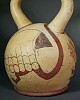
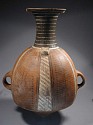
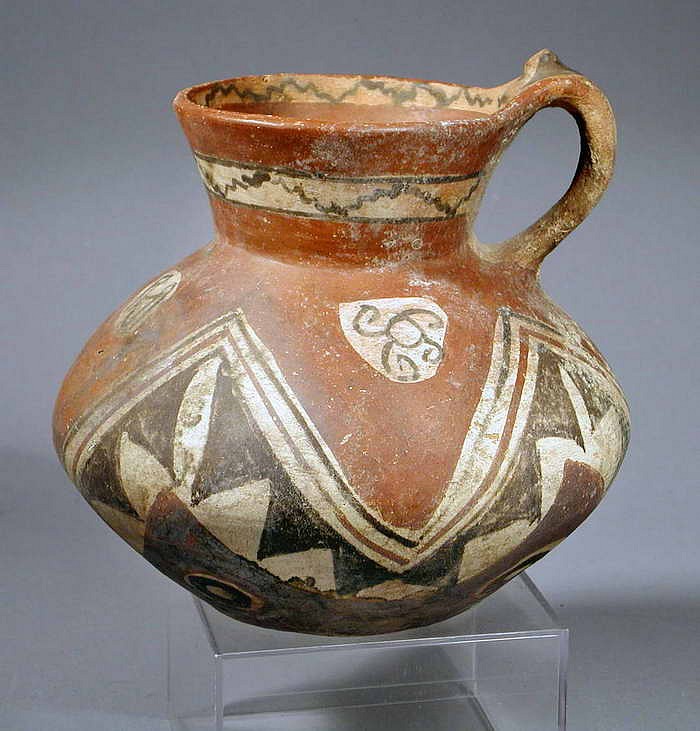
Chile, Arica / Inca Aryballus with geometric design from Chile
Although the Inca conquest of Chile lasted for a period of only seventy years until the arrival of the Spaniards, the magnitude of its aesthetic impact is undeniable. These two ceramic aryballus vessels are classic examples of that influence. Each vessel has two lug handles and a feline head knob to hold the temp line. Both are decorated in the expressively elegant geometry of the Inca. In very good condition with all original pigment intact. A similar example with a post fired cross hatching design is illustrated in Ceramics of Ancient Peru by Christopher donnan, fig 219.  Another very similar example with the diamond motif is illustrated in "Chile Indigena", Museo Arqueologico de Santiago, Chile, 1991.
Period: Chile, Arica, Inca/Late Agroceramic Period, 1470 - 1536
Media: Ceramic
Dimensions: Height:  14"
Price Upon Request
96090A
Chile | Arica / Inca Aryballus with geometric design from Chile | | David Bernstein Pre-Columbian Art. Extensive inventory of Pre-Columbian art from South America, including ancient objects in ceramic, textiles, bronze, copper and gold.
6 / 108

Chile, Arica / Inca Aryballus with geometric design from Chile

Although the Inca conquest of Chile lasted for a period of only seventy years until the arrival of the Spaniards, the magnitude of its aesthetic impact is undeniable. These two ceramic aryballus vessels are classic examples of that influence. Each vessel has two lug handles and a feline head knob to hold the temp line. Both are decorated in the expressively elegant geometry of the Inca. In very good condition with all original pigment intact. A similar example with a post fired cross hatching design is illustrated in Ceramics of Ancient Peru by Christopher donnan, fig 219. Another very similar example with the diamond motif is illustrated in "Chile Indigena", Museo Arqueologico de Santiago, Chile, 1991.

Period: Chile, Arica, Inca/Late Agroceramic Period, 1470 - 1536

Media: Ceramic

Dimensions: Height: 14"

Price Upon Request

96090A
  • View all works
  • PLAY
  • I N Q U I R E
  • Share
  • Print
  • More Works
I N Q U I R E Share Print
Chile, Arica Lug Handled Pitcher with geometric designs in black, white and red
San Miguel style white and black on red slip ground. The geometric design consists of four white circles inside a red ground, and underneath are a undulating bands of lines and triangles. Below this are black and white  concentric cirles, and  black and white bands inside and around the spout. The colors and designs are similar to a vessel illustrated in Cultures De Chile Prehistoria, Chile (1997: 196-a and d), and Excavations in Northern Chile by Junius Bird (1943: 199-jand f ). 
Period: Chile, Arica, San Miguel Phase, North Coast, c. AD 1100 - 1200
Media: Ceramic
Dimensions: Height 6 1/2" x width 8"
$1,500
M3011
Chile | Arica Lug Handled Pitcher with geometric designs in black, white and red | | David Bernstein Pre-Columbian Art. Extensive inventory of Pre-Columbian art from South America, including ancient objects in ceramic, textiles, bronze, copper and gold.
7 / 108

Chile, Arica Lug Handled Pitcher with geometric designs in black, white and red

San Miguel style white and black on red slip ground. The geometric design consists of four white circles inside a red ground, and underneath are a undulating bands of lines and triangles. Below this are black and white concentric cirles, and black and white bands inside and around the spout. The colors and designs are similar to a vessel illustrated in Cultures De Chile Prehistoria, Chile (1997: 196-a and d), and Excavations in Northern Chile by Junius Bird (1943: 199-jand f ).

Period: Chile, Arica, San Miguel Phase, North Coast, c. AD 1100 - 1200

Media: Ceramic

Dimensions: Height 6 1/2" x width 8"

$1,500

M3011

  • View all works
  • PLAY
  • I N Q U I R E
  • Share
  • Print
  • More Works
I N Q U I R E Share Print
Colombia, The Mysterious History of Pre-Colombian Gold
•SOLD What is Pre-Columbian Gold?   
The cultural period before the Spanish Conquest is known as the PRE-COLUMBIAN ERA.
Pre-Columbian gold refers to the spectacular body of objects wrought from this precious and universally valued metal, which was produced by the indigenous cultures of the Americas prior to the arrival of Christopher Columbus in 1492.
The American continent was originally populated over 17,000 years ago by people who migrated between Asia and North America across the Bering Strait land bridge.
Waves of migration following the Woolly Mammoth moved down the North American continent, through the Isthmus of Panama, ultimately reaching the southernmost tip of South America.  These early peoples established settlements in a range of diverse habitats, from wet tropical lowlands and arid deserts, to the highlands of the Andes.
 
The Sinú Culture
Overview of the Culture
The SINU people emerged in the fertile flood plains of the Caribbean lowlands of present-day northern Colombia. Collectively the various Sinú groups or communities, as well their ancestral territory, are also referred to as the GRAN ZENU or FINZENU.
This vast region of swamps, savannas, and forests surrounding the San Jorge, Nechí, Sinú, and lower Cauca rivers is fed by rain runoff and melting snows from the mountains (cordillera).
Long before the arrival of Spanish explorers and colonialists in the 1500s, the Pre-Columbian Sinú developed a highly sophisticated network of drainage and irrigation canals, earthworks, and raised fields to manage the floods that occurred seasonally in the inland deltas, and to cultivate the rich alluvial soils they yielded. 
Extending over 500,000 hectares, this was the largest contiguous area of land under cultivation in the ancient Americas, sustaining the most ingenious and complex hydraulic system ever constructed on the sub-continent.
The Sinú or Zenú tradition spans the period 200 BC–AD 1660. 
The culture flourished among the waterways and grasslands of the river flood plains between AD 500-1000, reaching its height of political influence, wealth, and agricultural production. 
Due to severe climactic and environmental changes, the Sinú began to retreat to higher uplands in the west soon thereafter, surviving there until around the time of the Spanish Conquest in the 16th century.
The works in this collection date from this later phase, circa AD 1000-1500,
They and display the artistic virtuosity of a highly complex and economically successful society.
After this period, however, Sinú civilization went into decline. Their labor was drafted for Spanish mining and enterprises, while their treasury of gold was seized, melted down, and shipped to Europe, where it helped fund the Spanish Empire, the Vatican, and even the building of the Spanish Armada.
But at its zenith, the stability and prosperity afforded by their mixed economy of agriculture and trade was reflected in Sinú art and craftsmanship, especially metallurgy.
Gold Centers and Goldsmiths
The numerous Sinú settlements supported a large community of goldsmiths who produced a wealth of gold ornamentation that shared a common style, technology, and iconography.
Important goldsmith centers were established, specializing in the mass production of nasal ornaments, false filigree ear ornaments, in addition to other characteristic ritual insignia, such as mammiform chest plaques and conical phallus covers. 
These ancient works of art have been found in tombs and burial mounds scattered throughout the Gran Zenú sphere.
Mythology and Political Power
Sinú society was hierarchical, ruled by a Lord or Cacique (or group of chieftains) whose authority was supported by the essential figure of the shaman-priest.  
Gold was associated with the sun and its golden rays and thought to be a source of sacred and celestial power for both ruler and shaman.
Gold was the source of Sinú power – used as a form of ceremonial adornment, as well as an essential medium for expressing social, religious, and ritual themes. 
Naturally, it was also inherently emblematic of rank and prestige.
Competition among the many chieftaincies for worldly and spiritual power, as well as for riches and valuable trade goods, spurred the production and acquisition of beautifully crafted gold objects.
The greater the status of this individual, the greater his wealth of gold, which was displayed not only in life, but in the afterlife. 
Craftsmen––goldsmiths, weavers, potters––represented a specialized class that was ranked above the ordinary people.  
The goldsmiths' exalted status in particular was derived from their seemingly supernatural ability to transform metal into precious, ritually significant objects that gave tangible form to symbolic and cosmological ideas. 
Iconography and Cosmology
Assemblages of gold adornment and insignia bedecked important Sinú personages––both living and dead, male and female– were intended to project their divine ancestry, elite status, power, and wealth, in this world and the afterlife. 
Being richly attired in gold, a material of spiritual essence and efficacy was a vehicle for metaphysical transformation and shamanic metamorphosis. 
Many of the animal figures represented in Sinú goldwork reinforced this theme: jaguars, water birds, crocodiles, frogs, deer, and other symbolic fauna had a mythical and symbolic role in Sinú cosmology. 
Animals that were emblematic of water and fertility were especially prominent, reflecting the Sinú peoples' environment as well as their cosmological beliefs. 
There is a conspicuous lack of emphasis on warrior themes, however, but a pronounced focus on fecundity and female symbolism on the other hand.
The most important of these water spirits was a golden crocodile––a being that is frequently represented in the ancient iconography (see cats. 42 and 43).
Since such birds flit, swim, walk and fly freely between water, land, and sky, they supplied rich metaphors for an ability to mediate between all worlds, whether nature or spirit. The symbolic relationship between birds and human beings was therefore a primary aesthetic theme for Sinú goldsmiths.
Adornment for Shamanic and Spiritual Transcendence / Symbolism of the Feminine
In addition to symbolizing solar potency, gold served to link the lower world––the earthly domain of human beings––with the upper world, that was a realm of deities. 
Figural representations—of human personages, real and imaginary creatures, or hybrid animal/human beings––seemingly reflect the Sinú vision of an ideal and primordial cosmos.
The creative energy and attention of Sinú goldsmiths was directed towards communication with these divine forces. 
This fundamentally peaceful intention stands in marked contrast to the prevailing European approach, which especially valued gold as a medium for projecting the invulnerability and strength of its warriors, as well as a conspicuous measure of wealth and power.  
These two divergent cultural concepts clashed on an epic scale when the Spanish Conquistadors arrived in the New World.
The primary role of Sinú gold, therefore, was to affirm and enhance the spiritual nature and symbolic qualities of its wearer.
Generally, the works that date to the earlier era of Sinú goldworking (AD 700-1000) tend to be more naturalistic in style and larger in size.  The latter phase of the tradition (AD1000-1400) is noted for the greater abstraction and stylization of image and form.  
 
Asiatic Origin of Pre-Columbian Gold?
Austrian archaeologist Robert Heine-Geldern presented strong evidence to suggest an Asiatic origin for pre-Columbian metallurgy in a 1954 study in which he draws strong comparisons between Chinese and Chavin gold work.  The connection between coastal China and Peru would appear to have begun around the end of the 8th century B.C. and to have continued through to the Mochica period in the 4th century B.C.  Around 333 B.C. trans-Pacific voyages of the Dongson culture of South-East Asia may have begun, led by Chinese refugees.
Heine-Geldern sites the following stylistic elements in pre-Colombian art as potential indicators of Asiatic influence:
            “Disk-topped, spiral topped, and animal-effigy-topped garment pins of the Central Andes; in needles, hand axes, star-shaped mace heads, tweezers, and the very widely recurring double S form spirals and twisted rope design ornamentation.  Other instances cited include cast filigree bells and the use of bell pendants on jewelry” (p.173).
 
Heine-Gelderen also suggests that granulation, mise-en-couleur, and the use of tumbaga (metalworking techniques to be discussed later) may have been migrated in from China.
Ancient sailors who crossed the Pacific probably took the same route as the one followed for two hundred years by Spanish galleons on their voyages from the Philippines to Mexico and Peru.
 
Similarities to Shang Dynasty Chinese Bronze 
This shamanistic aspect has an interesting analogy in ancient Chinese culture.   
Sinú metallurgy is aesthetically and technologically related to the indigenous gold working traditions of northern Colombia and the Central American cultures of Costa Rica and Panama
Similarly, Sinú goldwork greatly influenced the art of neighboring cultural traditions, including that of the Tairona people of northern Colombia and of the societies situated around the Bay of Urabá, which is located at the junction of the Central American isthmus and the continent of South America.
Yet despite a vast spatial divide and a difference of some 2500 years, Sinú goldsmithing also finds an extraordinary parallel in the development of bronze art in Shang Dynasty culture. 
This is due to a unique conjunction of factors. In both instances, the sophisticated knowledge and working of metal alloys (bronze in China, gold in Colombia) was strongly associated with archaic societies built upon the creation of irrigation canals that, in turn, facilitated intensive agriculture and trading activity. The surplus wealth generated by these activities spurred the rise of a class of specialized artisans who could be dedicated to luxury craft production rather than mere subsistence. 
Furthermore, both Sinú and Shang cultures ascribed a mystical or magical dimension to the art of metal working, producing artifacts that were not only technically and artistically complex but also imbued with shamanic significance.  
 
SINU GOLD TECHNOLOGY
The Riches of El Dorado, Empire of Gold
The abundance of gold in El Dorado, the New World, had excited the Spanish conquistadores.
While the finely wrought objects elicited admiration and awe, much of what the conquerors could plunder, seize, or trade in Colombia and elsewhere in the Americas was melted down in the 16th and 17th centuries and shipped back to Spain for the Church's and Royal coffers.
Although the Sinú region was heavily plundered, the invaders were not aware of the centuries-worth of gold buried in Sinú tombs and necropoli. 
This hidden treasure only came to light as the Sinú zone began to be developed in the late 19th century. 
Subsequently, the intensive plowing of fields and building of roads in the modern era led to the further accidental discovery of Sinú funerary mounds and cemeteries, which held burial offerings of pottery and textiles as well as goldwork.
Heather Lechtman of the Massachusetts Institute of Technology (MIT) has, done pioneering work on Pre-Columbian gold, analyzing the inventive methods of fabrication (lost-wax casting, depletion gilding, annealing, binary and ternary alloys) devised by Pre-Hispanic artisans and metal smiths.
The inventory of complex techniques employed to fashion such magnificent pieces are documented in this collection.
Gold Alloys and Tumbaga
Alluvial gold deposits are found in the river beds of streams flowing from the Andes. 
Archaeologists have identified one site in the Sinú region (Zenufana) which appears to be the most abundant source of the gold employed in their metal arts.
These deposits naturally contained a mixture of gold, silver, and copper in various proportions; small amounts of other impurities are also present in the metal.
Native metals smiths deliberately manipulated the variable components of both naturally-occurring and man-made alloys to produce a range of surface color and tonal contrast, which could be further enhanced by depletion gilding (mise-en couleur) and polishing. 
The Sinú ascribed symbolic and spiritual significance to subtle distinctions in the colors and textures of the metal, as well as to the different light-reflective properties of matte and shiny surfaces.   
The Sinu's heightened awareness to such nuances meant that even the distinctive scent that copper-based alloys emit was highly appreciated and acquired symbolic value, conjuring associations with toads, female sexuality and procreation.  
Much Sinú ornamentation is made from tumbaga, a Spanish term for a copper-enriched gold alloy (not, as is sometimes mistakenly believed, for a gold alloy of less than 20 carats).
The composition of tumbaga can vary widely, and in fact, many of the cast tumbaga ornaments in this collection that have been scientifically tested and reveal a high gold content (in some cases more than 80 percent). 
While tumbaga objects tend to be more fragile than those worked and hammered from high-grade gold (such as plaques, discs and bands), this gold-copper alloy has a lower melting point, which allows for greater refinement of detail in the casting.
This freedom stimulated the artistic imagination and creativity of the Sinú goldsmiths, who fabricated fantastical three-dimensional images of birds, amphibians, and other animals found in the wetlands, in addition to mythical creatures, anthropomorphic forms, and intricate geometric designs.
By selectively treating the tumbaga with depletion gilding, i.e. with a combination of heat and mild oxalic acids (derived from plants such as Oxalis pubescens), the metal smith could remove the copper or silver from the outer surface.  The exposed interior layer of rich gold was then burnished to produce an intensely gilded finish. 
Similarly, any silver present in the alloy could be attacked by a vegetal acid to reveal the deeper reddish color of the constituent copper.  When large amounts of copper are present, moreover, the gold alloy may display a greenish tint, which turns to malachite green when oxidized. 
(The patinas seen in pre-Columbian casting are quite different, therefore, from Shang Dynasty bronzes that have been in the ground for over 2000 years.)
The ability to control and alter an object's coloration seemingly served a metaphorical point for ancient Colombian goldsmiths, who sought color effects ranging from yellow to pink and red.
This is beautifully illustrated by a staff finial depicting a jaguar shown in cat. 95. Throughout South America the feline is an icon of shamanic transformation. Surely, the "magical" capacity to bring out the color hidden within a metal along is a dramatic and visual expression of that ubiquitous theme.  
Lost-wax Casting
Lost-wax casting––another quintessential Sinú technique––entailed a multipart process.
Firstly, the model was sculpted from clay.

The form was covered with a layer of finely powdered charcoal, then coated with beeswax and encased in another layer of heavy clay.
The object was fired so that the hot wax could flow out of tubular vents in the clay casing to be replaced with molten gold. As the metal hardened, it took on the shape of the embedded model.
Finally, the outer clay shell was cracked open, exposing the finished gold artifact to be polished or otherwise elaborated. 
The most skillful master goldsmiths had the dexterity to cast multiple adjoining figures, creating complicated items such as the striking pendant bearing forty eight ducks that is shown in cat. 69.   

The hallmark of Sinú goldwork is, undoubtedly, the use of cast or "false-filigree" decoration. 
 
 
AUTHENTICATION OF ARCHAEOLOGICAL GOLD
(From Emmerich, p.170-172).
Forgeries
The oldest known forgery of a pre-Columbian gold object is from the 17th or 18th century, of a brass eagle complete with royal crown and was found in late 1960s (plate 79 in Emmerich).
Tremendous growth in interest in archeological gold has contributed to a massive amount of forgeries.
There are two ways to prove that something has been forged; technical proof and stylistic proof. 
Technical proof includes things like spotting the wrong alloy; stylistic proof is in the design of the piece.  Often times an expert will notice a stylistic error which will in turn lead to technical testing.
 
Gold art work can be authenticated technically by several methods:

Determining whether the particular alloy was used in Pre-Columbian or contemporary times.
Determining which tools were used to create the work.
Determining whether acids were used to create an artificial patina.
Particle induced x-ray emission (companies such as CIRAM and ARCANE).
Elemental analysis.

 
Or, a true expert can authentic a piece using this type of stylistic critieria:

Incorrect glyphs.
Errors in copying from original models, which would be recognized by an expert who had seen the originals.
Mixing of stylistic elements from two separate cultures or time periods.
Pseudo-primitiveness – intentionally crafting an artwork with bad craftsmanship in an attempt to make it look primitive, when in actually the culture it is supposed to represent had high quality craftsmanship.
Unrealistic Ssylistic departure from the canon of the culture the forger is trying to imitate, in an attempt to make a piece look more rare.

 
Authentication by Robert Sonin
All of the works in the collection have been authenticated by the late Robert Sonin (1926-2011), a renowned expert on Pre-Columbian metallurgy who consulted with major museums, art dealers, conservators, and auction houses, and collaborated with institutions such as the American Museum of Natural History.  His notes are on record at the Princeton University Art Museum.


Selling Points of the Collection
 

Largest and most definitive collection of museum quality Sinú gold outside of the Gold Museum (Museo del Oro) in Bogota, Columbia.


Over 100 unique objects; combined weight of 6.6 kilos, including many high-status adornments identical to those published in reference literature.


Authenticated by an array of experts, including the late Robert Sonin, Warwick Bray, PhD, Professor Emeritus at the University of London, and renowned metallurgist Anna T. Bennett, PhD.


Provenance from before 1996 Memorandum of Understanding treaty between the US and the Government of Colombia.


Gold was considered by the Sinú as a symbolic source of power - used for ceremonial adornment, and as a medium for expression social, religious, and ritual themes.


Gold was associated with the sun and thought to be a source of celestial and sacred power by the Sinú.


Goldsmiths were considered an exalted class for their ability to transform metal in to sacred objects; a similar parallel exists in Chinese culture.


Sinú gold has many similarities with Chinese bronze work from the Shang Dynasty, including sharing a foundation of a culture built upon a network of irrigation canals, and a surplus of wealth that allowed a technically skilled artisan class to flourish.


Sinú and Shang cultures both ascribe a mystical dimension to the art of metal working, and both created works that were believed to be imbued with shamanic significance.


Colombia | The Mysterious History of Pre-Colombian Gold | 2016 | David Bernstein Pre-Columbian Art. Extensive inventory of Pre-Columbian art from South America, including ancient objects in ceramic, textiles, bronze, copper and gold.
8 / 108

Colombia, The Mysterious History of Pre-Colombian Gold

•SOLD

What is Pre-Columbian Gold?  

The cultural period before the Spanish Conquest is known as the PRE-COLUMBIAN ERA.

Pre-Columbian gold refers to the spectacular body of objects wrought from this precious and universally valued metal, which was produced by the indigenous cultures of the Americas prior to the arrival of Christopher Columbus in 1492.

The American continent was originally populated over 17,000 years ago by people who migrated between Asia and North America across the Bering Strait land bridge.

Waves of migration following the Woolly Mammoth moved down the North American continent, through the Isthmus of Panama, ultimately reaching the southernmost tip of South America.  These early peoples established settlements in a range of diverse habitats, from wet tropical lowlands and arid deserts, to the highlands of the Andes.


The Sinú Culture

Overview of the Culture

The SINU people emerged in the fertile flood plains of the Caribbean lowlands of present-day northern Colombia. Collectively the various Sinú groups or communities, as well their ancestral territory, are also referred to as the GRAN ZENU or FINZENU.

This vast region of swamps, savannas, and forests surrounding the San Jorge, Nechí, Sinú, and lower Cauca rivers is fed by rain runoff and melting snows from the mountains (cordillera).

Long before the arrival of Spanish explorers and colonialists in the 1500s, the Pre-Columbian Sinú developed a highly sophisticated network of drainage and irrigation canals, earthworks, and raised fields to manage the floods that occurred seasonally in the inland deltas, and to cultivate the rich alluvial soils they yielded. 

Extending over 500,000 hectares, this was the largest contiguous area of land under cultivation in the ancient Americas, sustaining the most ingenious and complex hydraulic system ever constructed on the sub-continent.

The Sinú or Zenú tradition spans the period 200 BC–AD 1660. 

The culture flourished among the waterways and grasslands of the river flood plains between AD 500-1000, reaching its height of political influence, wealth, and agricultural production. 

Due to severe climactic and environmental changes, the Sinú began to retreat to higher uplands in the west soon thereafter, surviving there until around the time of the Spanish Conquest in the 16th century.

The works in this collection date from this later phase, circa AD 1000-1500,

They and display the artistic virtuosity of a highly complex and economically successful society.

After this period, however, Sinú civilization went into decline. Their labor was drafted for Spanish mining and enterprises, while their treasury of gold was seized, melted down, and shipped to Europe, where it helped fund the Spanish Empire, the Vatican, and even the building of the Spanish Armada.

But at its zenith, the stability and prosperity afforded by their mixed economy of agriculture and trade was reflected in Sinú art and craftsmanship, especially metallurgy.

Gold Centers and Goldsmiths

The numerous Sinú settlements supported a large community of goldsmiths who produced a wealth of gold ornamentation that shared a common style, technology, and iconography.

Important goldsmith centers were established, specializing in the mass production of nasal ornaments, false filigree ear ornaments, in addition to other characteristic ritual insignia, such as mammiform chest plaques and conical phallus covers. 

These ancient works of art have been found in tombs and burial mounds scattered throughout the Gran Zenú sphere.

Mythology and Political Power

Sinú society was hierarchical, ruled by a Lord or Cacique (or group of chieftains) whose authority was supported by the essential figure of the shaman-priest. 

Gold was associated with the sun and its golden rays and thought to be a source of sacred and celestial power for both ruler and shaman.

Gold was the source of Sinú power – used as a form of ceremonial adornment, as well as an essential medium for expressing social, religious, and ritual themes.

Naturally, it was also inherently emblematic of rank and prestige.

Competition among the many chieftaincies for worldly and spiritual power, as well as for riches and valuable trade goods, spurred the production and acquisition of beautifully crafted gold objects.

The greater the status of this individual, the greater his wealth of gold, which was displayed not only in life, but in the afterlife. 

Craftsmen––goldsmiths, weavers, potters––represented a specialized class that was ranked above the ordinary people. 

The goldsmiths' exalted status in particular was derived from their seemingly supernatural ability to transform metal into precious, ritually significant objects that gave tangible form to symbolic and cosmological ideas.

Iconography and Cosmology

Assemblages of gold adornment and insignia bedecked important Sinú personages––both living and dead, male and female– were intended to project their divine ancestry, elite status, power, and wealth, in this world and the afterlife. 

Being richly attired in gold, a material of spiritual essence and efficacy was a vehicle for metaphysical transformation and shamanic metamorphosis. 

Many of the animal figures represented in Sinú goldwork reinforced this theme: jaguars, water birds, crocodiles, frogs, deer, and other symbolic fauna had a mythical and symbolic role in Sinú cosmology. 

Animals that were emblematic of water and fertility were especially prominent, reflecting the Sinú peoples' environment as well as their cosmological beliefs.

There is a conspicuous lack of emphasis on warrior themes, however, but a pronounced focus on fecundity and female symbolism on the other hand.

The most important of these water spirits was a golden crocodile––a being that is frequently represented in the ancient iconography (see cats. 42 and 43).

Since such birds flit, swim, walk and fly freely between water, land, and sky, they supplied rich metaphors for an ability to mediate between all worlds, whether nature or spirit. The symbolic relationship between birds and human beings was therefore a primary aesthetic theme for Sinú goldsmiths.

Adornment for Shamanic and Spiritual Transcendence / Symbolism of the Feminine

In addition to symbolizing solar potency, gold served to link the lower world––the earthly domain of human beings––with the upper world, that was a realm of deities. 

Figural representations—of human personages, real and imaginary creatures, or hybrid animal/human beings––seemingly reflect the Sinú vision of an ideal and primordial cosmos.

The creative energy and attention of Sinú goldsmiths was directed towards communication with these divine forces. 

This fundamentally peaceful intention stands in marked contrast to the prevailing European approach, which especially valued gold as a medium for projecting the invulnerability and strength of its warriors, as well as a conspicuous measure of wealth and power. 

These two divergent cultural concepts clashed on an epic scale when the Spanish Conquistadors arrived in the New World.

The primary role of Sinú gold, therefore, was to affirm and enhance the spiritual nature and symbolic qualities of its wearer.

Generally, the works that date to the earlier era of Sinú goldworking (AD 700-1000) tend to be more naturalistic in style and larger in size.  The latter phase of the tradition (AD1000-1400) is noted for the greater abstraction and stylization of image and form.  


Asiatic Origin of Pre-Columbian Gold?

Austrian archaeologist Robert Heine-Geldern presented strong evidence to suggest an Asiatic origin for pre-Columbian metallurgy in a 1954 study in which he draws strong comparisons between Chinese and Chavin gold work.  The connection between coastal China and Peru would appear to have begun around the end of the 8th century B.C. and to have continued through to the Mochica period in the 4th century B.C.  Around 333 B.C. trans-Pacific voyages of the Dongson culture of South-East Asia may have begun, led by Chinese refugees.

Heine-Geldern sites the following stylistic elements in pre-Colombian art as potential indicators of Asiatic influence:

            “Disk-topped, spiral topped, and animal-effigy-topped garment pins of the Central Andes; in needles, hand axes, star-shaped mace heads, tweezers, and the very widely recurring double S form spirals and twisted rope design ornamentation.  Other instances cited include cast filigree bells and the use of bell pendants on jewelry” (p.173).


Heine-Gelderen also suggests that granulation, mise-en-couleur, and the use of tumbaga (metalworking techniques to be discussed later) may have been migrated in from China.

Ancient sailors who crossed the Pacific probably took the same route as the one followed for two hundred years by Spanish galleons on their voyages from the Philippines to Mexico and Peru.


Similarities to Shang Dynasty Chinese Bronze

This shamanistic aspect has an interesting analogy in ancient Chinese culture.   

Sinú metallurgy is aesthetically and technologically related to the indigenous gold working traditions of northern Colombia and the Central American cultures of Costa Rica and Panama

Similarly, Sinú goldwork greatly influenced the art of neighboring cultural traditions, including that of the Tairona people of northern Colombia and of the societies situated around the Bay of Urabá, which is located at the junction of the Central American isthmus and the continent of South America.

Yet despite a vast spatial divide and a difference of some 2500 years, Sinú goldsmithing also finds an extraordinary parallel in the development of bronze art in Shang Dynasty culture.

This is due to a unique conjunction of factors. In both instances, the sophisticated knowledge and working of metal alloys (bronze in China, gold in Colombia) was strongly associated with archaic societies built upon the creation of irrigation canals that, in turn, facilitated intensive agriculture and trading activity. The surplus wealth generated by these activities spurred the rise of a class of specialized artisans who could be dedicated to luxury craft production rather than mere subsistence.

Furthermore, both Sinú and Shang cultures ascribed a mystical or magical dimension to the art of metal working, producing artifacts that were not only technically and artistically complex but also imbued with shamanic significance. 


SINU GOLD TECHNOLOGY

The Riches of El Dorado, Empire of Gold

The abundance of gold in El Dorado, the New World, had excited the Spanish conquistadores.

While the finely wrought objects elicited admiration and awe, much of what the conquerors could plunder, seize, or trade in Colombia and elsewhere in the Americas was melted down in the 16th and 17th centuries and shipped back to Spain for the Church's and Royal coffers.

Although the Sinú region was heavily plundered, the invaders were not aware of the centuries-worth of gold buried in Sinú tombs and necropoli. 

This hidden treasure only came to light as the Sinú zone began to be developed in the late 19th century. 

Subsequently, the intensive plowing of fields and building of roads in the modern era led to the further accidental discovery of Sinú funerary mounds and cemeteries, which held burial offerings of pottery and textiles as well as goldwork.

Heather Lechtman of the Massachusetts Institute of Technology (MIT) has, done pioneering work on Pre-Columbian gold, analyzing the inventive methods of fabrication (lost-wax casting, depletion gilding, annealing, binary and ternary alloys) devised by Pre-Hispanic artisans and metal smiths.

The inventory of complex techniques employed to fashion such magnificent pieces are documented in this collection.

Gold Alloys and Tumbaga

Alluvial gold deposits are found in the river beds of streams flowing from the Andes. 

Archaeologists have identified one site in the Sinú region (Zenufana) which appears to be the most abundant source of the gold employed in their metal arts.

These deposits naturally contained a mixture of gold, silver, and copper in various proportions; small amounts of other impurities are also present in the metal.

Native metals smiths deliberately manipulated the variable components of both naturally-occurring and man-made alloys to produce a range of surface color and tonal contrast, which could be further enhanced by depletion gilding (mise-en couleur) and polishing. 

The Sinú ascribed symbolic and spiritual significance to subtle distinctions in the colors and textures of the metal, as well as to the different light-reflective properties of matte and shiny surfaces.   

The Sinu's heightened awareness to such nuances meant that even the distinctive scent that copper-based alloys emit was highly appreciated and acquired symbolic value, conjuring associations with toads, female sexuality and procreation.  

Much Sinú ornamentation is made from tumbaga, a Spanish term for a copper-enriched gold alloy (not, as is sometimes mistakenly believed, for a gold alloy of less than 20 carats).

The composition of tumbaga can vary widely, and in fact, many of the cast tumbaga ornaments in this collection that have been scientifically tested and reveal a high gold content (in some cases more than 80 percent). 

While tumbaga objects tend to be more fragile than those worked and hammered from high-grade gold (such as plaques, discs and bands), this gold-copper alloy has a lower melting point, which allows for greater refinement of detail in the casting.

This freedom stimulated the artistic imagination and creativity of the Sinú goldsmiths, who fabricated fantastical three-dimensional images of birds, amphibians, and other animals found in the wetlands, in addition to mythical creatures, anthropomorphic forms, and intricate geometric designs.

By selectively treating the tumbaga with depletion gilding, i.e. with a combination of heat and mild oxalic acids (derived from plants such as Oxalis pubescens), the metal smith could remove the copper or silver from the outer surface.  The exposed interior layer of rich gold was then burnished to produce an intensely gilded finish. 

Similarly, any silver present in the alloy could be attacked by a vegetal acid to reveal the deeper reddish color of the constituent copper.  When large amounts of copper are present, moreover, the gold alloy may display a greenish tint, which turns to malachite green when oxidized. 

(The patinas seen in pre-Columbian casting are quite different, therefore, from Shang Dynasty bronzes that have been in the ground for over 2000 years.)

The ability to control and alter an object's coloration seemingly served a metaphorical point for ancient Colombian goldsmiths, who sought color effects ranging from yellow to pink and red.

This is beautifully illustrated by a staff finial depicting a jaguar shown in cat. 95. Throughout South America the feline is an icon of shamanic transformation. Surely, the "magical" capacity to bring out the color hidden within a metal along is a dramatic and visual expression of that ubiquitous theme.  

Lost-wax Casting

Lost-wax casting––another quintessential Sinú technique––entailed a multipart process.

Firstly, the model was sculpted from clay.

  • The form was covered with a layer of finely powdered charcoal, then coated with beeswax and encased in another layer of heavy clay.
  • The object was fired so that the hot wax could flow out of tubular vents in the clay casing to be replaced with molten gold. As the metal hardened, it took on the shape of the embedded model.
  • Finally, the outer clay shell was cracked open, exposing the finished gold artifact to be polished or otherwise elaborated. 
  • The most skillful master goldsmiths had the dexterity to cast multiple adjoining figures, creating complicated items such as the striking pendant bearing forty eight ducks that is shown in cat. 69.   

The hallmark of Sinú goldwork is, undoubtedly, the use of cast or "false-filigree" decoration. 


AUTHENTICATION OF ARCHAEOLOGICAL GOLD

(From Emmerich, p.170-172).

Forgeries

The oldest known forgery of a pre-Columbian gold object is from the 17th or 18th century, of a brass eagle complete with royal crown and was found in late 1960s (plate 79 in Emmerich).

Tremendous growth in interest in archeological gold has contributed to a massive amount of forgeries.

There are two ways to prove that something has been forged; technical proof and stylistic proof. 

Technical proof includes things like spotting the wrong alloy; stylistic proof is in the design of the piece.  Often times an expert will notice a stylistic error which will in turn lead to technical testing.


Gold art work can be authenticated technically by several methods:

  • Determining whether the particular alloy was used in Pre-Columbian or contemporary times.
  • Determining which tools were used to create the work.
  • Determining whether acids were used to create an artificial patina.
  • Particle induced x-ray emission (companies such as CIRAM and ARCANE).
  • Elemental analysis.


Or, a true expert can authentic a piece using this type of stylistic critieria:

  • Incorrect glyphs.
  • Errors in copying from original models, which would be recognized by an expert who had seen the originals.
  • Mixing of stylistic elements from two separate cultures or time periods.
  • Pseudo-primitiveness – intentionally crafting an artwork with bad craftsmanship in an attempt to make it look primitive, when in actually the culture it is supposed to represent had high quality craftsmanship.
  • Unrealistic Ssylistic departure from the canon of the culture the forger is trying to imitate, in an attempt to make a piece look more rare.


Authentication by Robert Sonin

All of the works in the collection have been authenticated by the late Robert Sonin (1926-2011), a renowned expert on Pre-Columbian metallurgy who consulted with major museums, art dealers, conservators, and auction houses, and collaborated with institutions such as the American Museum of Natural History.  His notes are on record at the Princeton University Art Museum.


Selling Points of the Collection


  • Largest and most definitive collection of museum quality Sinú gold outside of the Gold Museum (Museo del Oro) in Bogota, Columbia.


  • Over 100 unique objects; combined weight of 6.6 kilos, including many high-status adornments identical to those published in reference literature.


  • Authenticated by an array of experts, including the late Robert Sonin, Warwick Bray, PhD, Professor Emeritus at the University of London, and renowned metallurgist Anna T. Bennett, PhD.


  • Provenance from before 1996 Memorandum of Understanding treaty between the US and the Government of Colombia.


  • Gold was considered by the Sinú as a symbolic source of power - used for ceremonial adornment, and as a medium for expression social, religious, and ritual themes.


  • Gold was associated with the sun and thought to be a source of celestial and sacred power by the Sinú.


  • Goldsmiths were considered an exalted class for their ability to transform metal in to sacred objects; a similar parallel exists in Chinese culture.


  • Sinú gold has many similarities with Chinese bronze work from the Shang Dynasty, including sharing a foundation of a culture built upon a network of irrigation canals, and a surplus of wealth that allowed a technically skilled artisan class to flourish.


  • Sinú and Shang cultures both ascribe a mystical dimension to the art of metal working, and both created works that were believed to be imbued with shamanic significance.


  • View all works
  • PLAY
  • I N Q U I R E
  • Share
  • Print
  • More Works
I N Q U I R E Share Print
Colombia, Calima Alcarazza of a Crested Bobwhite With Rounded Body and Legs
The bobwhite has a small head with large gray eyes and is decorated with brick and buff toned slip highlights.  The crested bobwhite is a member of the partridge family and is still found in Colombia today. A similar vessel is illustrated in CALIMA AND MALAGANA ART AND ARCHAEOLOGY IN SOUTHWESTERN COLOMBIA, pg.43.
Period: Colombia, Calima, Yotoco Phase, Cauca River Valley, circa AD100-1000
Media: Ceramic
Dimensions: Height: 8"
Price Upon Request
m9009
Colombia | Calima Alcarazza of a Crested Bobwhite With Rounded Body and Legs | | David Bernstein Pre-Columbian Art. Extensive inventory of Pre-Columbian art from South America, including ancient objects in ceramic, textiles, bronze, copper and gold.
9 / 108

Colombia, Calima Alcarazza of a Crested Bobwhite With Rounded Body and Legs

The bobwhite has a small head with large gray eyes and is decorated with brick and buff toned slip highlights. The crested bobwhite is a member of the partridge family and is still found in Colombia today. A similar vessel is illustrated in CALIMA AND MALAGANA ART AND ARCHAEOLOGY IN SOUTHWESTERN COLOMBIA, pg.43.

Period: Colombia, Calima, Yotoco Phase, Cauca River Valley, circa AD100-1000

Media: Ceramic

Dimensions: Height: 8"

Price Upon Request

m9009

  • View all works
  • PLAY
  • I N Q U I R E
  • Share
  • Print
  • More Works
I N Q U I R E Share Print
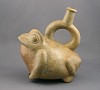
Colombia, Calima Alcarraza with Frog Relief Sculpture and Incised Geometric Designs
The Alcarazza is a style of ceramic vessel made by the Calima culture of ancient Colombia. Often they are decorated with geometric forms and occasionally can be animal effigies. They tend to be very elegantly styled. Similar examples are illustrated in "Colombia Before Colombus" by Armand Labbé (1986). These vessels were used for storing chicha beer for ceremonial occasions. The double spout allowed the liquid to pass evenly out one spout while air entered the other.
Period: Colombia, Calima, Sonso Phase, Cauca River  Valley,  circa AD1000-1500
Media: Ceramic
Dimensions: Height: 7 1/2" inches
Price Upon Request
M7113
Colombia | Calima Alcarraza with Frog Relief Sculpture and Incised Geometric Designs | | David Bernstein Pre-Columbian Art. Extensive inventory of Pre-Columbian art from South America, including ancient objects in ceramic, textiles, bronze, copper and gold.
10 / 108

Colombia, Calima Alcarraza with Frog Relief Sculpture and Incised Geometric Designs

The Alcarazza is a style of ceramic vessel made by the Calima culture of ancient Colombia. Often they are decorated with geometric forms and occasionally can be animal effigies. They tend to be very elegantly styled. Similar examples are illustrated in "Colombia Before Colombus" by Armand Labbé (1986). These vessels were used for storing chicha beer for ceremonial occasions. The double spout allowed the liquid to pass evenly out one spout while air entered the other.

Period: Colombia, Calima, Sonso Phase, Cauca River Valley, circa AD1000-1500

Media: Ceramic

Dimensions: Height: 7 1/2" inches

Price Upon Request

M7113
  • View all works
  • PLAY
  • I N Q U I R E
  • Share
  • Print
  • More Works
I N Q U I R E Share Print
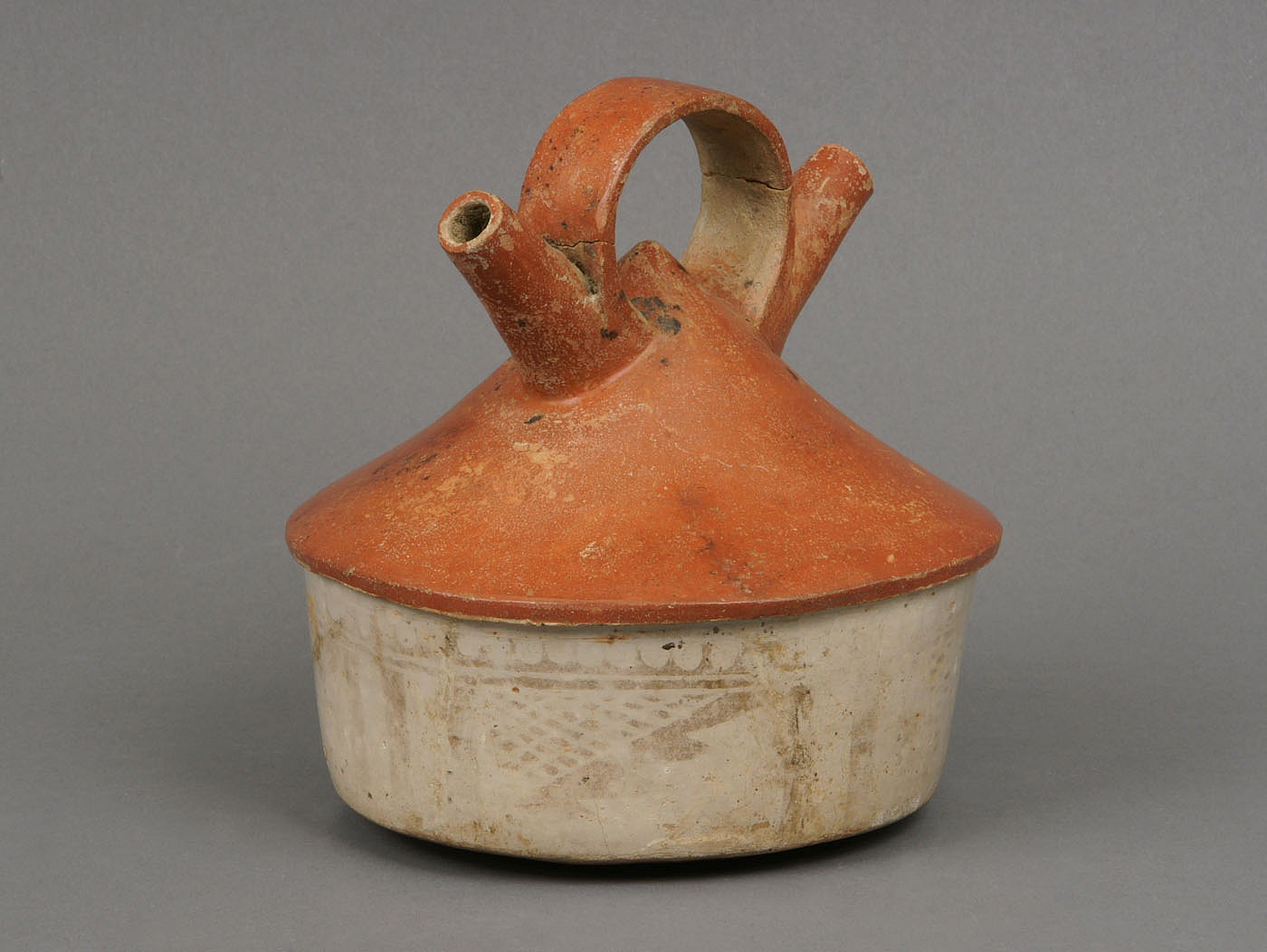
Colombia, Calima Ceramic Double Spout Vessel in Shape of a Circular  House
Simply designed, Calima conventional style, slip painted, red and white ceramic "alcarraza" with a double spout bridge handle, in the form of a round house with a peaked roof.  The creamy base retains traces of black resist geometric motifs in a lattice or net-like composition, considered to be a trademark of the Calima style (see Labbe, A."Columbian Gold and Ceramics in Antiquity", pp144-148) .
Period: Columbia, Malagana, Cauca River Valley, c. 1-500 AD
Media: Ceramic
Dimensions: Height: 6"
$4,500
MM032
Colombia | Calima Ceramic Double Spout Vessel in Shape of a Circular House | | David Bernstein Pre-Columbian Art. Extensive inventory of Pre-Columbian art from South America, including ancient objects in ceramic, textiles, bronze, copper and gold.
11 / 108

Colombia, Calima Ceramic Double Spout Vessel in Shape of a Circular House

Simply designed, Calima conventional style, slip painted, red and white ceramic "alcarraza" with a double spout bridge handle, in the form of a round house with a peaked roof. The creamy base retains traces of black resist geometric motifs in a lattice or net-like composition, considered to be a trademark of the Calima style (see Labbe, A."Columbian Gold and Ceramics in Antiquity", pp144-148) .

Period: Columbia, Malagana, Cauca River Valley, c. 1-500 AD

Media: Ceramic

Dimensions: Height: 6"

$4,500

MM032
  • View all works
  • PLAY
  • I N Q U I R E
  • Share
  • Print
  • More Works
I N Q U I R E Share Print
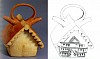
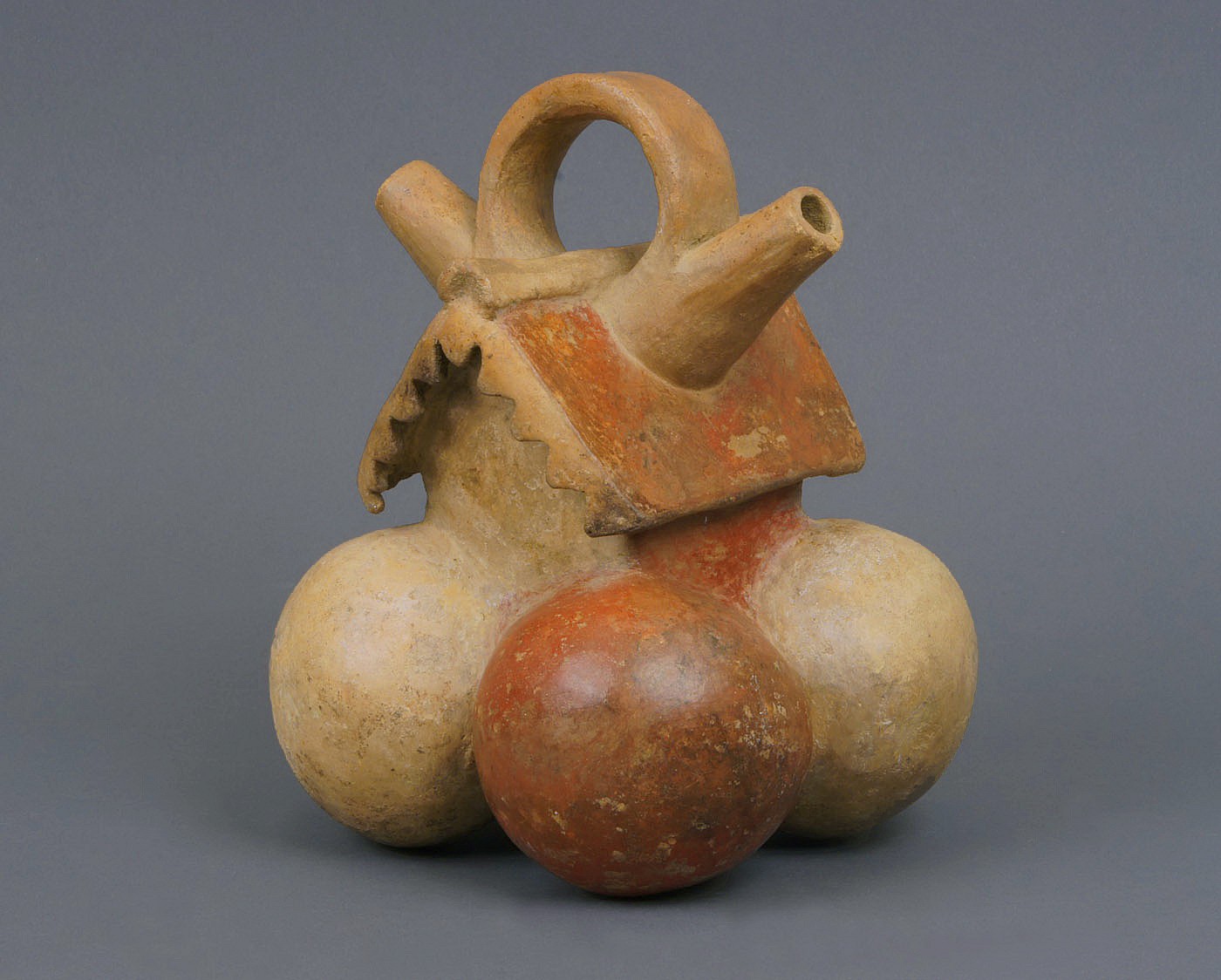
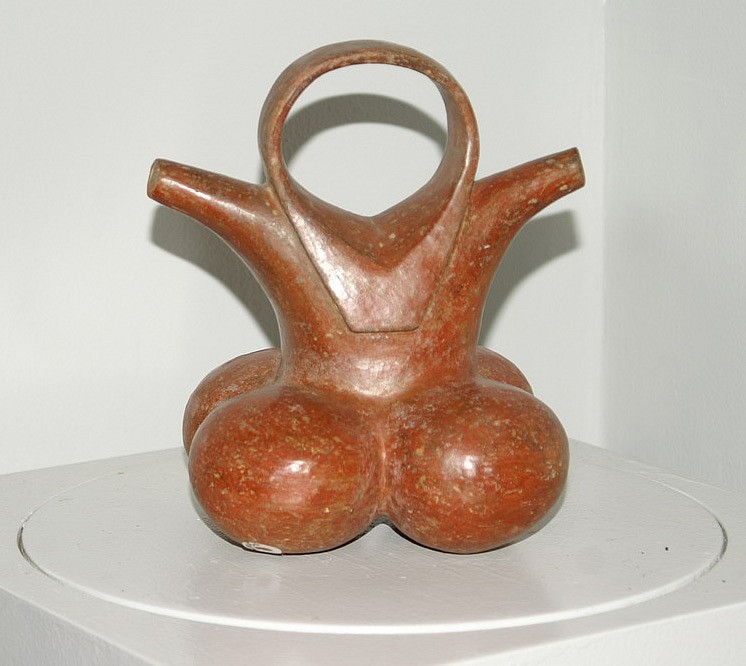
Colombia, Calima Effigy Vessel in the Form of a House
A house model resting on four globular feet. Vessels from the Calima region of Colombia, also known as alcarazzas, have a very distinct shape, typically with two spouts on the diagonal.  For more examples, see "Colombia Before Columbus" by Armand Labbe (1986: 64-95) and "Calima" by de Schrimpff, Bray et. al.  (1992: 113-118), which is where the reference drawing shown here has been taken from.   A number of alcarazzas represent houses and probably mimic the actual dwellings of ancient societies in Calima.
Period: Colombia, Calima, Yotoco Phase, Cauca River Valley, circa AD100-1000
Media: Ceramic
Dimensions: Height 8"
$3,500
99318
Colombia | Calima Effigy Vessel in the Form of a House | | David Bernstein Pre-Columbian Art. Extensive inventory of Pre-Columbian art from South America, including ancient objects in ceramic, textiles, bronze, copper and gold.
12 / 108

Colombia, Calima Effigy Vessel in the Form of a House

A house model resting on four globular feet. Vessels from the Calima region of Colombia, also known as alcarazzas, have a very distinct shape, typically with two spouts on the diagonal. For more examples, see "Colombia Before Columbus" by Armand Labbe (1986: 64-95) and "Calima" by de Schrimpff, Bray et. al. (1992: 113-118), which is where the reference drawing shown here has been taken from. A number of alcarazzas represent houses and probably mimic the actual dwellings of ancient societies in Calima.

Period: Colombia, Calima, Yotoco Phase, Cauca River Valley, circa AD100-1000

Media: Ceramic

Dimensions: Height 8"

$3,500

99318
  • View all works
  • PLAY
  • I N Q U I R E
  • Share
  • Print
  • More Works
I N Q U I R E Share Print
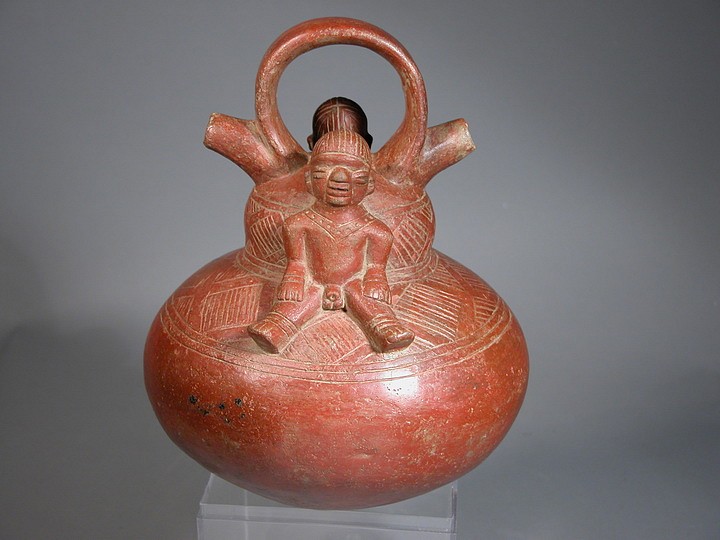
Colombia, Calima Redware Alcarazza with 4 globular sections
The Alcarazza is a style of ceramic vessel made by the Calima culture during the early Llama phase.  Often they are geometric forms and occasionally can be animal effigies. They tend to be very elegant styled vessels. Similar vessels are illustrated in "Colombia Before Columbus" by Armand Labee, Bowere Musuem, Ca.. These vessels were ceremonial Chica storing vessels. The double spout allows the liquid to pass evenly out one spout while the air enters the other.
Period: Colombia, Calima, Llama Phase, circa 800 BC-AD100
Media: Ceramic
Dimensions: Height 7 1/2"
$3,800
MM150
Colombia | Calima Redware Alcarazza with 4 globular sections | | David Bernstein Pre-Columbian Art. Extensive inventory of Pre-Columbian art from South America, including ancient objects in ceramic, textiles, bronze, copper and gold.
13 / 108

Colombia, Calima Redware Alcarazza with 4 globular sections

The Alcarazza is a style of ceramic vessel made by the Calima culture during the early Llama phase. Often they are geometric forms and occasionally can be animal effigies. They tend to be very elegant styled vessels. Similar vessels are illustrated in "Colombia Before Columbus" by Armand Labee, Bowere Musuem, Ca.. These vessels were ceremonial Chica storing vessels. The double spout allows the liquid to pass evenly out one spout while the air enters the other.

Period: Colombia, Calima, Llama Phase, circa 800 BC-AD100

Media: Ceramic

Dimensions: Height 7 1/2"

$3,800

MM150

  • View all works
  • PLAY
  • I N Q U I R E
  • Share
  • Print
  • More Works
I N Q U I R E Share Print
Colombia, Early Calima Alcarazza with male and female figures
A couple are seated back to back on an early form of this "alcarazza" vessel type, which was characteristic of Calima ceramics from Colombia. The globular body, modeled figures and incised decoration were typical of the earliest "Llama" phase of Calima pottery. Later examples of alcarazzas are less globular, with multi-chambered bodies, and vessels tend to be smaller. See Cardale de Schrimpff et. al., "Calima: Diez mil anos de historia en el suroccidente de Colombia" (1992) and Armand Labbé, "Colombia Before Columbus: The People, Culture, and Ceramic Art of Prehispanic Colombia" (1986).
Period: Colombia, Calima, Llama Phase, circa 800 BC-AD100
Media: Ceramic
Dimensions: Height 8 1/4"
$4,500
M4053
Colombia | Early Calima Alcarazza with male and female figures | | David Bernstein Pre-Columbian Art. Extensive inventory of Pre-Columbian art from South America, including ancient objects in ceramic, textiles, bronze, copper and gold.
14 / 108

Colombia, Early Calima Alcarazza with male and female figures

A couple are seated back to back on an early form of this "alcarazza" vessel type, which was characteristic of Calima ceramics from Colombia. The globular body, modeled figures and incised decoration were typical of the earliest "Llama" phase of Calima pottery. Later examples of alcarazzas are less globular, with multi-chambered bodies, and vessels tend to be smaller. See Cardale de Schrimpff et. al., "Calima: Diez mil anos de historia en el suroccidente de Colombia" (1992) and Armand Labbé, "Colombia Before Columbus: The People, Culture, and Ceramic Art of Prehispanic Colombia" (1986).

Period: Colombia, Calima, Llama Phase, circa 800 BC-AD100

Media: Ceramic

Dimensions: Height 8 1/4"

$4,500

M4053

  • View all works
  • PLAY
  • I N Q U I R E
  • Share
  • Print
  • More Works
I N Q U I R E Share Print
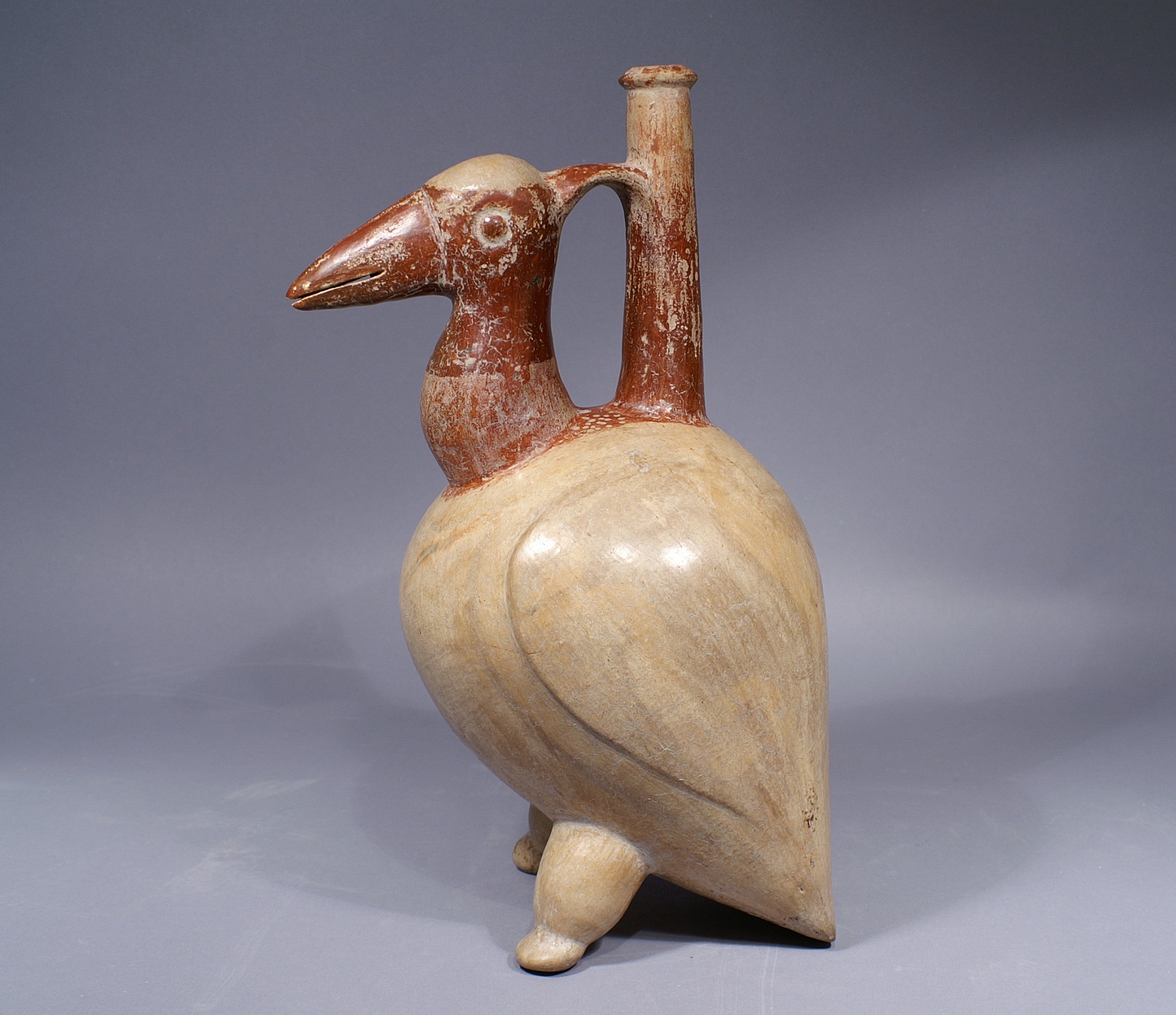
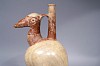
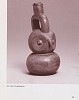
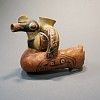
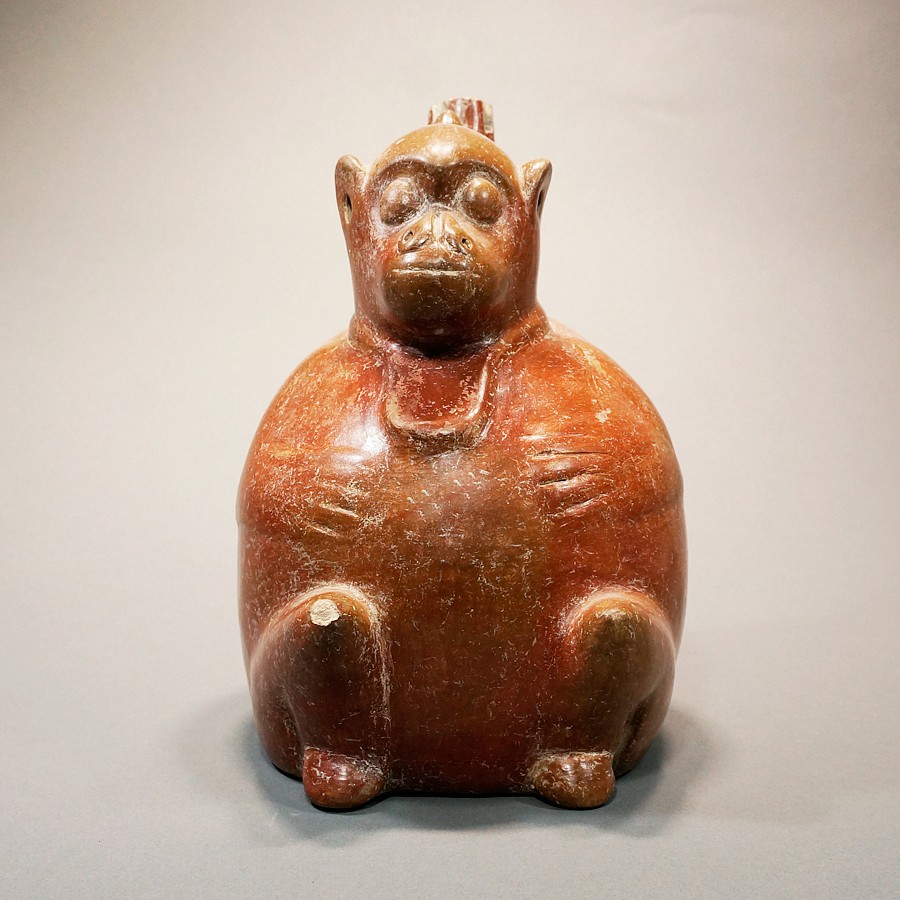
Ecuador, Chorrera Avian Effigy Spouted Vessel of a pelican
This effigy vessel represents a pelican decorated with red-brown slip on the head and neck over a buff body. The wings are softly modeled at the sides of the body, while the tail and quasi human feet support the vessel in a vertical position. Anthropomorphic effigy bottles with tall spouts are one of the hallmarks of Chorrera art, and may have been for high-status beverages for chiefs and shamans, probably alcoholic brews laced with hallucinogenic ingredients. They were also placed in tombs as offerings for the dead. The characteristic tall spout was almost certainly for the manipulation of liquid, and its slender height would have prevented spillage. A nearly identical vessel is published in Klein and Cevallos, eds., "Ecuador: The Secret Art of Precolumbian Ecuador" (2007: pl. 46). This pelican is slightly taller at 13 3/4" inches, and his head is turned 90 degrees, but the artist painted the head and feet in the same red-brown over a buff body with modeled wings.
Period: Ecuador, Chorrera, circa 500BC- AD500
Media: Ceramic
Dimensions: Height 12 1/2"
Price Upon Request
94295
Ecuador | Chorrera Avian Effigy Spouted Vessel of a pelican | | David Bernstein Pre-Columbian Art. Extensive inventory of Pre-Columbian art from South America, including ancient objects in ceramic, textiles, bronze, copper and gold.
15 / 108

Ecuador, Chorrera Avian Effigy Spouted Vessel of a pelican

This effigy vessel represents a pelican decorated with red-brown slip on the head and neck over a buff body. The wings are softly modeled at the sides of the body, while the tail and quasi human feet support the vessel in a vertical position. Anthropomorphic effigy bottles with tall spouts are one of the hallmarks of Chorrera art, and may have been for high-status beverages for chiefs and shamans, probably alcoholic brews laced with hallucinogenic ingredients. They were also placed in tombs as offerings for the dead. The characteristic tall spout was almost certainly for the manipulation of liquid, and its slender height would have prevented spillage. A nearly identical vessel is published in Klein and Cevallos, eds., "Ecuador: The Secret Art of Precolumbian Ecuador" (2007: pl. 46). This pelican is slightly taller at 13 3/4" inches, and his head is turned 90 degrees, but the artist painted the head and feet in the same red-brown over a buff body with modeled wings.

Period: Ecuador, Chorrera, circa 500BC- AD500

Media: Ceramic

Dimensions: Height 12 1/2"

Price Upon Request

94295
  • View all works
  • PLAY
  • I N Q U I R E
  • Share
  • Print
  • More Works
I N Q U I R E Share Print
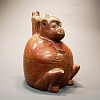
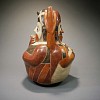
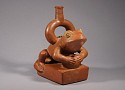
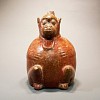
Ecuador, Chorrera Ceramic Baboon
Red brown bridge spout vessel of a baboon effigy with hands on chest and wearing a pendant. A similar example is illustrated in Valdez and Veintimilla, "Ameridian Signs: 5000 Years of Precolumbian Art in Ecuador" (1992: 54. The Chorrera culture, along with the Moche of Peru, were the only Andean societies to produce realistic ceramics at a very high level.
Period: Ecuador, Chorrera, 1000-500 BC
Media: Ceramic
Dimensions: Height 8.1/4"
$15,000
94008
Ecuador | Chorrera Ceramic Baboon | | David Bernstein Pre-Columbian Art. Extensive inventory of Pre-Columbian art from South America, including ancient objects in ceramic, textiles, bronze, copper and gold.
16 / 108

Ecuador, Chorrera Ceramic Baboon

Red brown bridge spout vessel of a baboon effigy with hands on chest and wearing a pendant. A similar example is illustrated in Valdez and Veintimilla, "Ameridian Signs: 5000 Years of Precolumbian Art in Ecuador" (1992: 54. The Chorrera culture, along with the Moche of Peru, were the only Andean societies to produce realistic ceramics at a very high level.

Period: Ecuador, Chorrera, 1000-500 BC

Media: Ceramic

Dimensions: Height 8.1/4"

$15,000

94008

  • View all works
  • PLAY
  • I N Q U I R E
  • Share
  • Print
  • More Works
I N Q U I R E Share Print
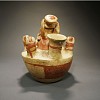
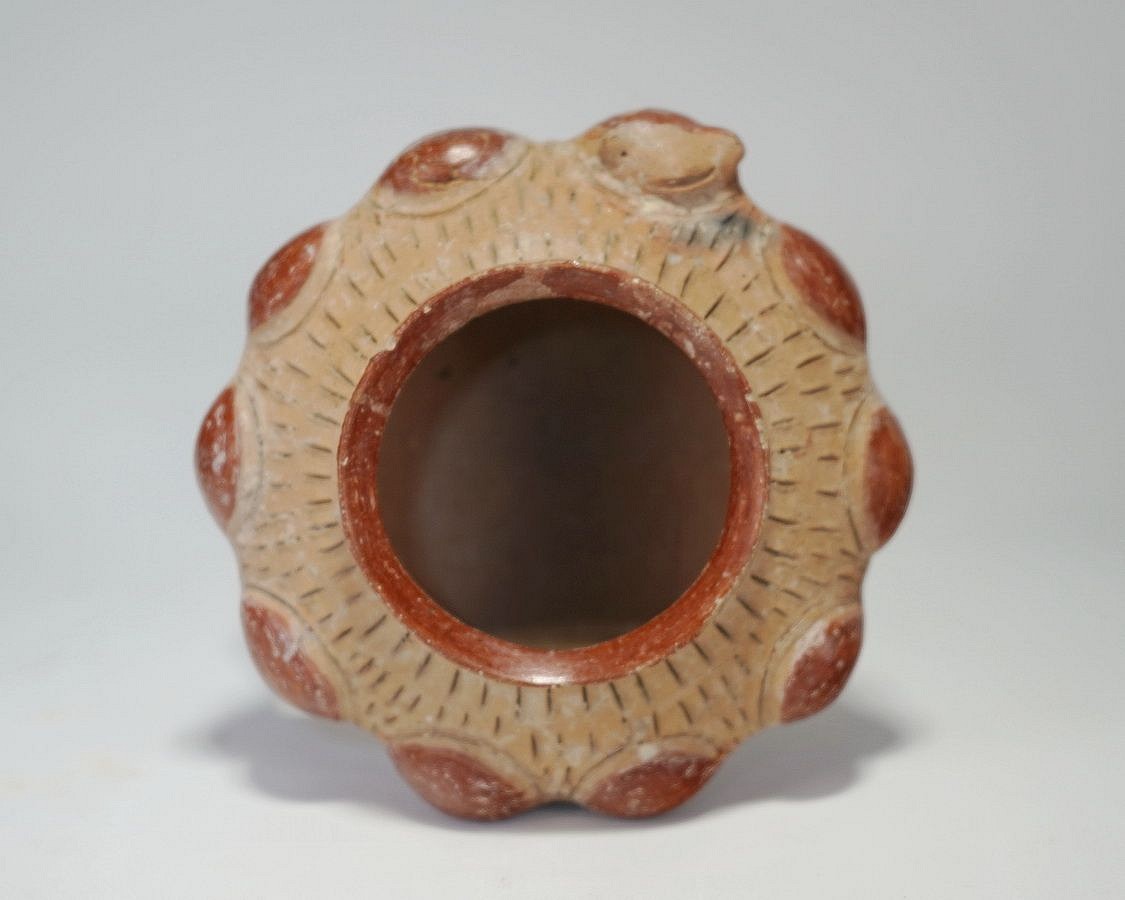
Ecuador, Classic Chorrera Miniature Bowl
This vessel is decorated with a circular ring of heads.  This style of vessel is known as a meeting themed vessel.  One head faces forward and the others appear to be in trance.  
Good condition, with archaeological patina intact.  Two minor chips.
Period: Ecuador, Chorrera, 1500 - 300 BC
Media: Ceramic
Dimensions: Height:  2 1/2" x Diameter: 4 1/2"
$1,200
M6016
Ecuador | Classic Chorrera Miniature Bowl | | David Bernstein Pre-Columbian Art. Extensive inventory of Pre-Columbian art from South America, including ancient objects in ceramic, textiles, bronze, copper and gold.
17 / 108

Ecuador, Classic Chorrera Miniature Bowl

This vessel is decorated with a circular ring of heads. This style of vessel is known as a meeting themed vessel. One head faces forward and the others appear to be in trance. Good condition, with archaeological patina intact. Two minor chips.

Period: Ecuador, Chorrera, 1500 - 300 BC

Media: Ceramic

Dimensions: Height: 2 1/2" x Diameter: 4 1/2"

$1,200

M6016
  • View all works
  • PLAY
  • I N Q U I R E
  • Share
  • Print
  • More Works
I N Q U I R E Share Print
Ecuador, Classic Chorrera Miniature Bowl
This vessel is decorated with a circular ring of heads.  This style of vessel is known as a meeting themed vessel.  One head faces forward and the others appear to be in trance.
Media: Ceramic
Dimensions: Height: 2.5" x Diameter: 4.5"
$1,500
m6106
Ecuador | Classic Chorrera Miniature Bowl | | David Bernstein Pre-Columbian Art. Extensive inventory of Pre-Columbian art from South America, including ancient objects in ceramic, textiles, bronze, copper and gold.
18 / 108

Ecuador, Classic Chorrera Miniature Bowl

This vessel is decorated with a circular ring of heads. This style of vessel is known as a meeting themed vessel. One head faces forward and the others appear to be in trance.

Media: Ceramic

Dimensions: Height: 2.5" x Diameter: 4.5"

$1,500

m6106
  • View all works
  • PLAY
  • I N Q U I R E
  • Share
  • Print
  • More Works
I N Q U I R E Share Print
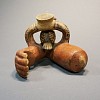
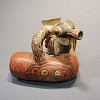
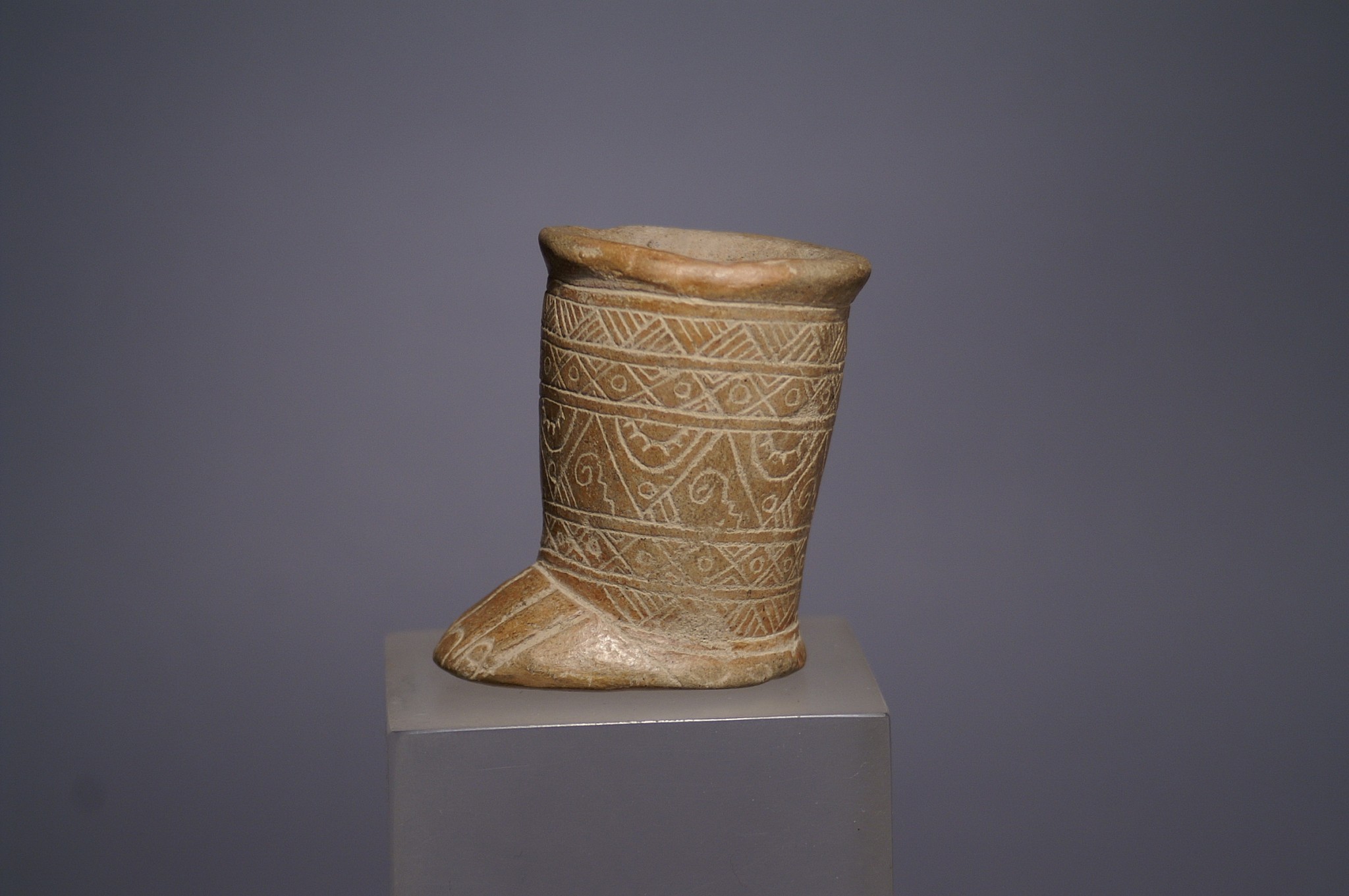
Ecuador, Monteno incised ceramic container in the form of a  foot with suspension hole
This is typical of a  lime container from the Monteno region and decorated with 4 bands of geometric designs.  A similar votive foot  vessel is illustrated in Amerindian Signs item 141
Period: Ecuador, Monteno North Coast, circa AD700-1534
Media: Ceramic
Dimensions: Height 2 3/4"
$950
N1049
Ecuador | Monteno incised ceramic container in the form of a foot with suspension hole | | David Bernstein Pre-Columbian Art. Extensive inventory of Pre-Columbian art from South America, including ancient objects in ceramic, textiles, bronze, copper and gold.
19 / 108

Ecuador, Monteno incised ceramic container in the form of a foot with suspension hole

This is typical of a lime container from the Monteno region and decorated with 4 bands of geometric designs. A similar votive foot vessel is illustrated in Amerindian Signs item 141

Period: Ecuador, Monteno North Coast, circa AD700-1534

Media: Ceramic

Dimensions: Height 2 3/4"

$950

N1049
  • View all works
  • PLAY
  • I N Q U I R E
  • Share
  • Print
  • More Works
I N Q U I R E Share Print
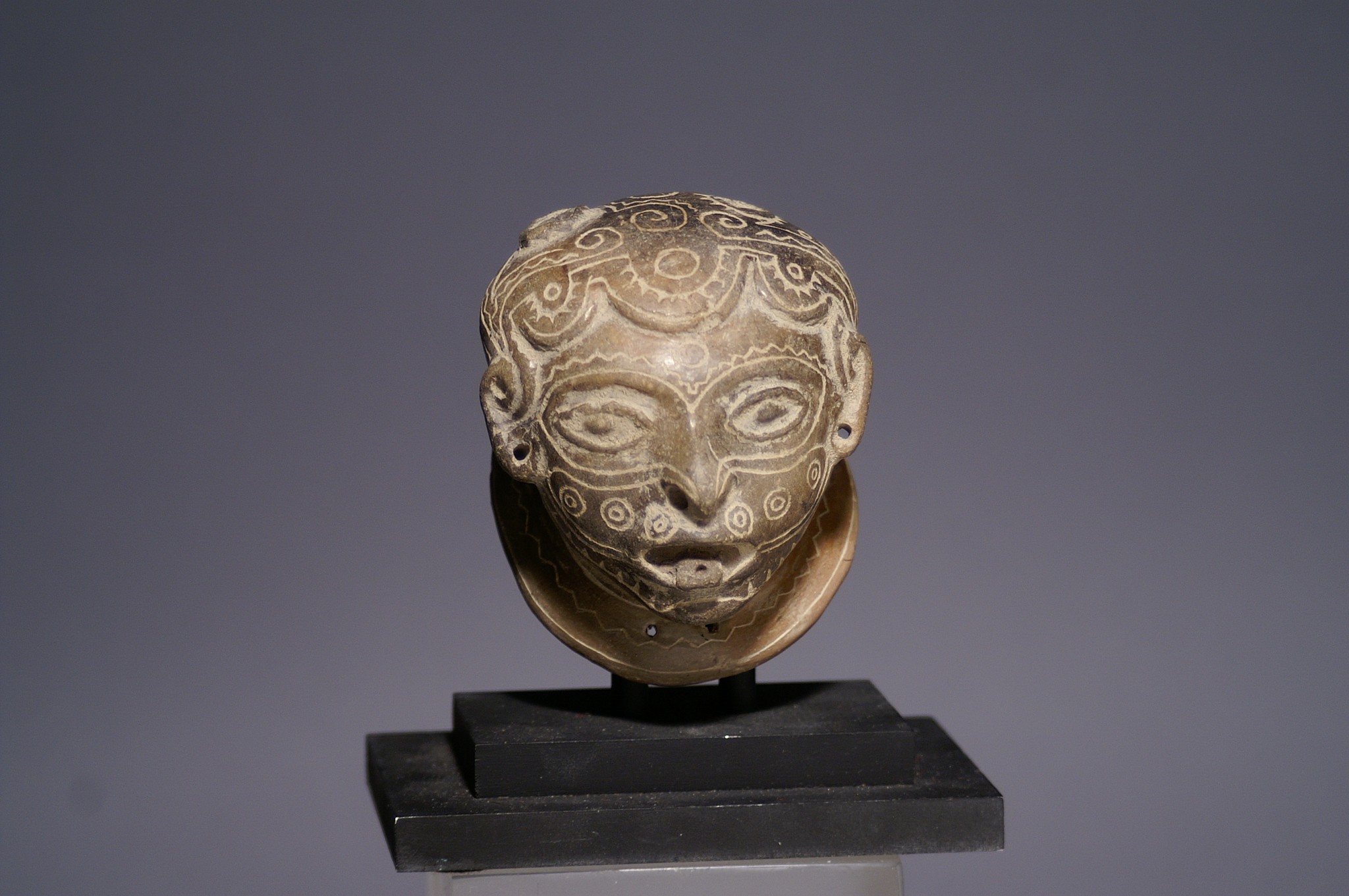
Ecuador, Monteno incised ceramic container in the form of a head with tattoos all over
This is typical of a  lime container from the Monteno region and decorated with 4 bands of geometric designs.  A similar votive foot  vessel is illustrated in Amerindian Signs item 141
Period: Ecuador, Monteno North Coast, circa AD700-1534
Media: Ceramic
Dimensions: Height 2 3/4"
$1,100
N1050
Ecuador | Monteno incised ceramic container in the form of a head with tattoos all over | | David Bernstein Pre-Columbian Art. Extensive inventory of Pre-Columbian art from South America, including ancient objects in ceramic, textiles, bronze, copper and gold.
20 / 108

Ecuador, Monteno incised ceramic container in the form of a head with tattoos all over

This is typical of a lime container from the Monteno region and decorated with 4 bands of geometric designs. A similar votive foot vessel is illustrated in Amerindian Signs item 141

Period: Ecuador, Monteno North Coast, circa AD700-1534

Media: Ceramic

Dimensions: Height 2 3/4"

$1,100

N1050
  • View all works
  • PLAY
  • I N Q U I R E
  • Share
  • Print
  • More Works
I N Q U I R E Share Print
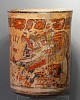
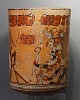
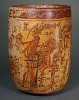
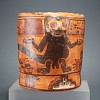
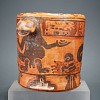
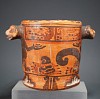
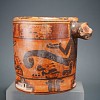
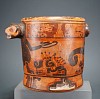
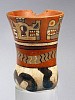
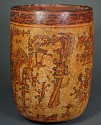
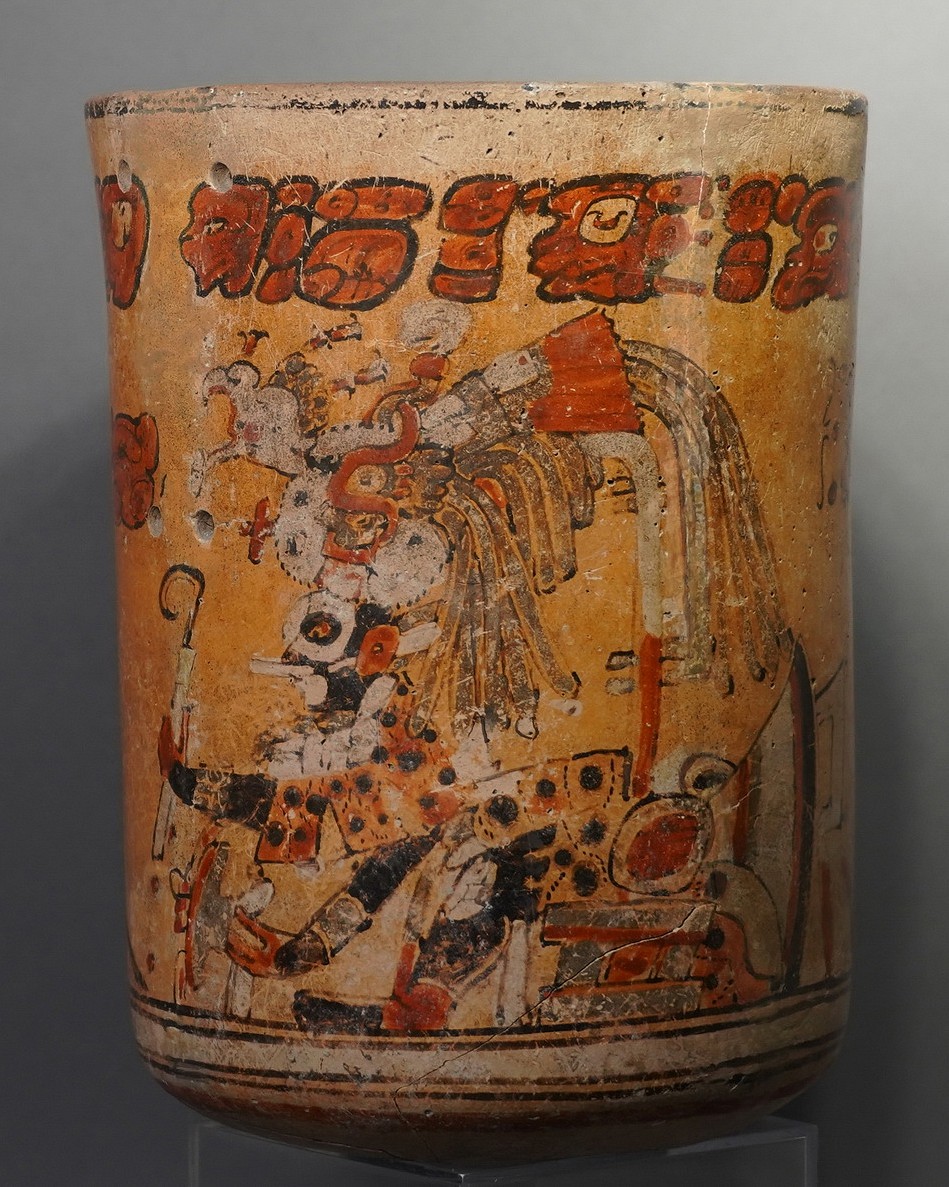
Guatemala, Mayan Polychrome Ceramic Cylinder Vessel with Ruler and Otherworld Serpent Deity
This compelling Mayan painted cylinder depicts a ruler, or cacique, enthroned in the jaws of the Serpent Deity from the otherworld. The top register of the vessel contains the Primary Standard Sequence - a sequence of characters identified by scholar Michael Coe in The Maya Scribe and His World in 1973.  These glyphs are repeated in a similar formation on many vessels and are thought to be associated with Mayan myth and ritual.  The Mayans believed that human souls were required as a sacrifice to propel the eternal wheel of cosmic order, and that the sacrificed souls would live beyond the death of the body.  Fierce anthropomorphized serpent figures, such as the one depicted here, were employed by the Mayans to represent the archetypal forces of death and sacrifice.
Scholar Justin Kerr (mayavase.com) lists this cylinder as being affiliated with the term Och Chan Yopat, which means "the storm god enters the sky."  This phrase is also found on a Mayan frieze that in Guatamala, described by Rachel Newer in The Smithsonian Magazine on August 9, 2013.  This phrase describes the terrible, formidable nature of the cacique as well as the serpent god.  The vase is painted in broad, sweeping lines of motion, using vibrant red blocks and aggressive black lines that weave in and out and morph from curving to linear. Acquired in Tokyo, Japan, prior to 1970.
Kerr database #K937 (mayavase.com).
Period: Guatamala, Mayan, c. AD 400 - 800
Media: Ceramic
Dimensions: Height: 7 7/8" x Diameter: 5 3/4"
Price Upon Request
N5022
Guatemala | Mayan Polychrome Ceramic Cylinder Vessel with Ruler and Otherworld Serpent Deity | | David Bernstein Pre-Columbian Art. Extensive inventory of Pre-Columbian art from South America, including ancient objects in ceramic, textiles, bronze, copper and gold.
21 / 108

Guatemala, Mayan Polychrome Ceramic Cylinder Vessel with Ruler and Otherworld Serpent Deity

This compelling Mayan painted cylinder depicts a ruler, or cacique, enthroned in the jaws of the Serpent Deity from the otherworld. The top register of the vessel contains the Primary Standard Sequence - a sequence of characters identified by scholar Michael Coe in The Maya Scribe and His World in 1973. These glyphs are repeated in a similar formation on many vessels and are thought to be associated with Mayan myth and ritual. The Mayans believed that human souls were required as a sacrifice to propel the eternal wheel of cosmic order, and that the sacrificed souls would live beyond the death of the body. Fierce anthropomorphized serpent figures, such as the one depicted here, were employed by the Mayans to represent the archetypal forces of death and sacrifice.
Scholar Justin Kerr (mayavase.com) lists this cylinder as being affiliated with the term Och Chan Yopat, which means "the storm god enters the sky." This phrase is also found on a Mayan frieze that in Guatamala, described by Rachel Newer in The Smithsonian Magazine on August 9, 2013. This phrase describes the terrible, formidable nature of the cacique as well as the serpent god. The vase is painted in broad, sweeping lines of motion, using vibrant red blocks and aggressive black lines that weave in and out and morph from curving to linear. Acquired in Tokyo, Japan, prior to 1970.
Kerr database #K937 (mayavase.com).

Period: Guatamala, Mayan, c. AD 400 - 800

Media: Ceramic

Dimensions: Height: 7 7/8" x Diameter: 5 3/4"

Price Upon Request

N5022

  • View all works
  • PLAY
  • I N Q U I R E
  • Share
  • Print
  • More Works
I N Q U I R E Share Print
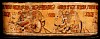
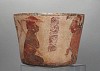
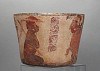
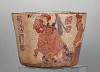
Guatemala, Mayan Polychrome Dish with Two Priests in the Motul de San Jose Style
This painted ceramic dish depicts two scenes.  The first scene features two seated figures facing each other, separated by three glyphs.  In this scene, the figure at right holds a staff and wears an elaborate headdress, while the figure at left wears a jaguar kilt and is making a gesture of resignation.   The second scene depicts three figures, including a surrendering prisoner presenting himself to his captor, who is joined by a member of his entourage.  Bishop Diego de Landa, c. 1524 - 1579, described the trope of captors and prisoners in Mayan art, referring to the “sign of resignation or humility before a conqueror or superior person.”  This vessel also depicts  a shaman wearing a black mask, who appears to be painting the glyphs and narrating the story.  The glyphs on both sides of the vessel likely provide the names of the characters in the story.
This vessel was acquired from Gallery Hana in Tokyo, Japan, prior to 1970. 
Period: Guatemala, Mayan, Petan, Late Classic  c. AD 700 - 800
Media: Ceramic
Dimensions: Height: 4"
Price Upon Request
n5025
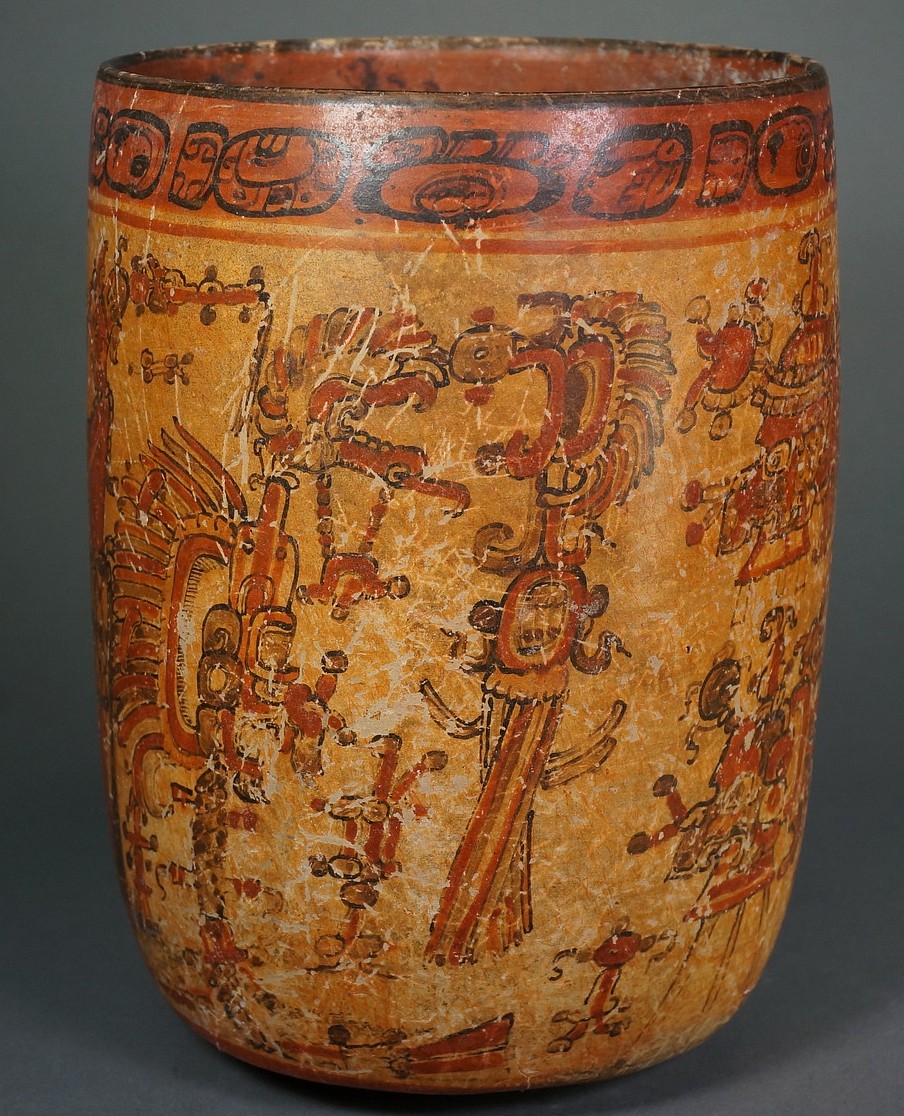
Guatemala | Mayan Polychrome Dish with Two Priests in the Motul de San Jose Style | | David Bernstein Pre-Columbian Art. Extensive inventory of Pre-Columbian art from South America, including ancient objects in ceramic, textiles, bronze, copper and gold.
22 / 108

Guatemala, Mayan Polychrome Dish with Two Priests in the Motul de San Jose Style

This painted ceramic dish depicts two scenes. The first scene features two seated figures facing each other, separated by three glyphs. In this scene, the figure at right holds a staff and wears an elaborate headdress, while the figure at left wears a jaguar kilt and is making a gesture of resignation. The second scene depicts three figures, including a surrendering prisoner presenting himself to his captor, who is joined by a member of his entourage. Bishop Diego de Landa, c. 1524 - 1579, described the trope of captors and prisoners in Mayan art, referring to the “sign of resignation or humility before a conqueror or superior person.” This vessel also depicts a shaman wearing a black mask, who appears to be painting the glyphs and narrating the story. The glyphs on both sides of the vessel likely provide the names of the characters in the story.
This vessel was acquired from Gallery Hana in Tokyo, Japan, prior to 1970.

Period: Guatemala, Mayan, Petan, Late Classic c. AD 700 - 800

Media: Ceramic

Dimensions: Height: 4"

Price Upon Request

n5025
  • View all works
  • PLAY
  • I N Q U I R E
  • Share
  • Print
  • More Works
I N Q U I R E Share Print
Guatemala, Mayan Tepeu 1 Style Mayan Painted Cylinder With Complex Palace Theme
This Tepeu 1 Style cylindrical vessel features complex iconography and a hieroglyphic inscription under the rim.  There are two young, idealized male lords who likely represent Maize gods, as well as isolated floating motifs which are common in Mayan art.  Deity heads with long snouts appear in front of the lords, possibly representing headdresses or possibly representing actual deities.  The sets of three lines at the bottoms may represent stands or tripods for the masks.  This vessel was reported on by Dr. Nicholas Hellmuth and exhibited at the MIHO Museum in Osaka in July of 2011.  See Hellmuth's Late Classic (Tepeu 2) Vases: Throne Scenes essay for reference. Vases with Hieroglyphic Inscriptions Formerly in the collection of Hiroshi Miura, Tokyo, Japan, prior to 1969.
Period: Guatemala, El Peten Mayan, c. AD 650- 950
Media: Ceramic
Dimensions: Height: 7 1/2" x Diameter: 5 1/4" inches
$12,500
N5026
Guatemala | Mayan Tepeu 1 Style Mayan Painted Cylinder With Complex Palace Theme | | David Bernstein Pre-Columbian Art. Extensive inventory of Pre-Columbian art from South America, including ancient objects in ceramic, textiles, bronze, copper and gold.
23 / 108

Guatemala, Mayan Tepeu 1 Style Mayan Painted Cylinder With Complex Palace Theme

This Tepeu 1 Style cylindrical vessel features complex iconography and a hieroglyphic inscription under the rim. There are two young, idealized male lords who likely represent Maize gods, as well as isolated floating motifs which are common in Mayan art. Deity heads with long snouts appear in front of the lords, possibly representing headdresses or possibly representing actual deities. The sets of three lines at the bottoms may represent stands or tripods for the masks. This vessel was reported on by Dr. Nicholas Hellmuth and exhibited at the MIHO Museum in Osaka in July of 2011. See Hellmuth's Late Classic (Tepeu 2) Vases: Throne Scenes essay for reference. Vases with Hieroglyphic Inscriptions Formerly in the collection of Hiroshi Miura, Tokyo, Japan, prior to 1969.

Period: Guatemala, El Peten Mayan, c. AD 650- 950

Media: Ceramic

Dimensions: Height: 7 1/2" x Diameter: 5 1/4" inches

$12,500

N5026
  • View all works
  • PLAY
  • I N Q U I R E
  • Share
  • Print
  • More Works
I N Q U I R E Share Print
Guatemala, Mayan Tepeu 2 Polychrome Dish with "Fat Cacique" and Victim
This painted ceramic features 5 figures.  In one scene, a staffbearer oversees another figure with a jaguar kilt who is making a gesture of resignation.   The second scene depicts three figures, including a surrendering victim presenting himself to his captor, who is joined by a member of his entourage.  The captor is a recognizable in the Mayan lexicon idenfied by scholars Jason Kerr and Nicolas Hellmuth as "The Fat Cacique."
Bishop Diego de Landa, c. 1524 - 1579, also described this trope of captors and prisoners in Mayan art, referring to the victim's posture as a “sign of resignation or humility before a conqueror or superior person.”  This vessel also depicts a scribe wearing a black mask, who appears to be painting the glyphs and narrating the story.  The glyphs on both sides of the vessel likely provide the names of the characters in the story.  This vessel was acquired from Gallery Hana in Tokyo, Japan, prior to 1970. This vase is illustrated in Dr. Nicholas Hellmuth's book, Mayan Vases, in chapter Chapter 10: Tepeu 2 Vases- Throne Scenes. 
Guatamala, Mayan, Petan, Late Classic, c. AD 700 - 800 AD
Media: Ceramic
Dimensions: Height: 4"
$8,500
n5025
Guatemala | Mayan Tepeu 2 Polychrome Dish with "Fat Cacique" and Victim | | David Bernstein Pre-Columbian Art. Extensive inventory of Pre-Columbian art from South America, including ancient objects in ceramic, textiles, bronze, copper and gold.
24 / 108

Guatemala, Mayan Tepeu 2 Polychrome Dish with "Fat Cacique" and Victim

This painted ceramic features 5 figures. In one scene, a staffbearer oversees another figure with a jaguar kilt who is making a gesture of resignation. The second scene depicts three figures, including a surrendering victim presenting himself to his captor, who is joined by a member of his entourage. The captor is a recognizable in the Mayan lexicon idenfied by scholars Jason Kerr and Nicolas Hellmuth as "The Fat Cacique." Bishop Diego de Landa, c. 1524 - 1579, also described this trope of captors and prisoners in Mayan art, referring to the victim's posture as a “sign of resignation or humility before a conqueror or superior person.” This vessel also depicts a scribe wearing a black mask, who appears to be painting the glyphs and narrating the story. The glyphs on both sides of the vessel likely provide the names of the characters in the story. This vessel was acquired from Gallery Hana in Tokyo, Japan, prior to 1970. This vase is illustrated in Dr. Nicholas Hellmuth's book, Mayan Vases, in chapter Chapter 10: Tepeu 2 Vases- Throne Scenes.
Guatamala, Mayan, Petan, Late Classic, c. AD 700 - 800 AD

Media: Ceramic

Dimensions: Height: 4"

$8,500

n5025
  • View all works
  • PLAY
  • I N Q U I R E
  • Share
  • Print
  • More Works
I N Q U I R E Share Print
Honduras, Mayan Ulua Valley Ceramic Vessel with Protruding Monkey Head Handles
This is an excellent example of a painted  Mayan ceramic vessel from Honduras, Late Phase. It is decorated with two bold monkeys with large tails.  There is a band of glyphs around the top edge of the vessel, and glyphs separating the monkeys below.  The  monkeys'  heads are cleverly sculpted in three dimensions to form the handles.  The bottom of the vase is painted to resemble a classic Ulua Valley marble vase.  This the finest known example of a Mayan vase depicting a monkey from the Mayan region of Honduras.  A similar vase is illustrated in the Mayavase.com website, reference number 5668. Formerly in the Eisenberg estate in CT, prior 1980.
Period: Honduras, Late Classic Maya, c. AD 700 - 900
Media: Ceramic
Dimensions: Height: 5 3/4" (14.6cm) x Diameter: 4 7/8 (12.5cm)
Price Upon Request
P3050
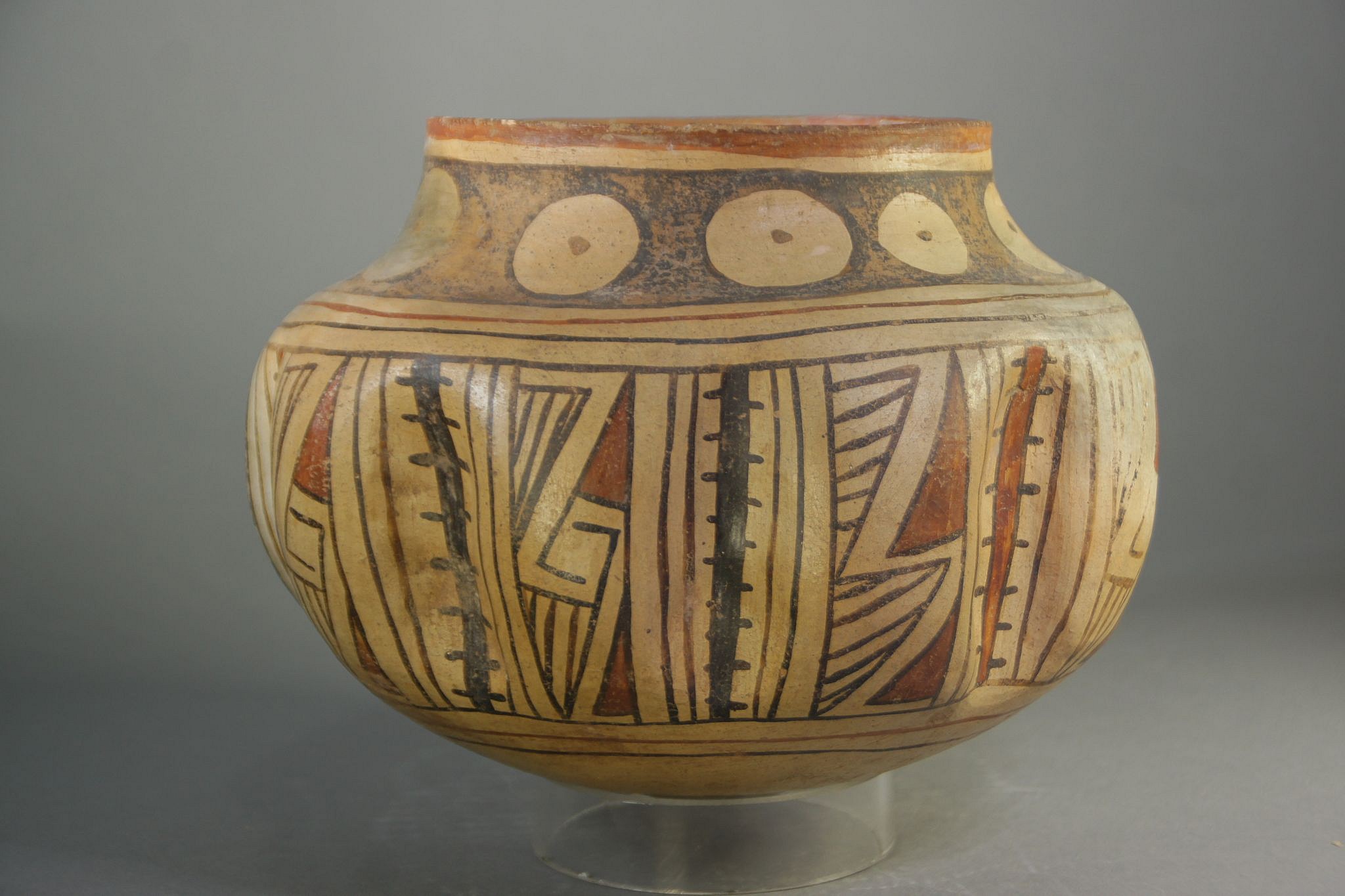
Honduras | Mayan Ulua Valley Ceramic Vessel with Protruding Monkey Head Handles | | David Bernstein Pre-Columbian Art. Extensive inventory of Pre-Columbian art from South America, including ancient objects in ceramic, textiles, bronze, copper and gold.
25 / 108

Honduras, Mayan Ulua Valley Ceramic Vessel with Protruding Monkey Head Handles

This is an excellent example of a painted Mayan ceramic vessel from Honduras, Late Phase. It is decorated with two bold monkeys with large tails. There is a band of glyphs around the top edge of the vessel, and glyphs separating the monkeys below. The monkeys' heads are cleverly sculpted in three dimensions to form the handles. The bottom of the vase is painted to resemble a classic Ulua Valley marble vase. This the finest known example of a Mayan vase depicting a monkey from the Mayan region of Honduras. A similar vase is illustrated in the Mayavase.com website, reference number 5668. Formerly in the Eisenberg estate in CT, prior 1980.

Period: Honduras, Late Classic Maya, c. AD 700 - 900

Media: Ceramic

Dimensions: Height: 5 3/4" (14.6cm) x Diameter: 4 7/8 (12.5cm)

Price Upon Request

P3050
  • View all works
  • PLAY
  • I N Q U I R E
  • Share
  • Print
  • More Works
I N Q U I R E Share Print
Mexico, Casas Grande Fluted Ceramic Vessel with Geometric Designs
This unusual ceramic bowl has nine fluted sections separated by symbolic cacti imagery.  The bowl is painted with red and black geometric designs on a beige ground.  On the bottom are three large concentric black lines.  It has a tapered neck that is decorated with nine beige circles on a black ground.  Each circle has a central black dot, which believe symbolizes an aerial view of a cactus.  This vessel originates from Casas Grande, a site located in the Mexican state of Chihuahua, along the Casas Grande River and South of the US Puebloan ruins.  A good reference is “Casa Grandes and the Ceramic Art of the Ancient Southwest” by Richard Townsend, published by the Art Institute of Chicago.
The bowl is in good condition with one crack on the bottom restored and a small hole on one of the fluted sections.
Period: Mexico, Casas Grande Classic Period  c. AD 1250 - 1475
Media: Ceramic
Dimensions: H. 6" x W. 8"
Price Upon Request
n6012
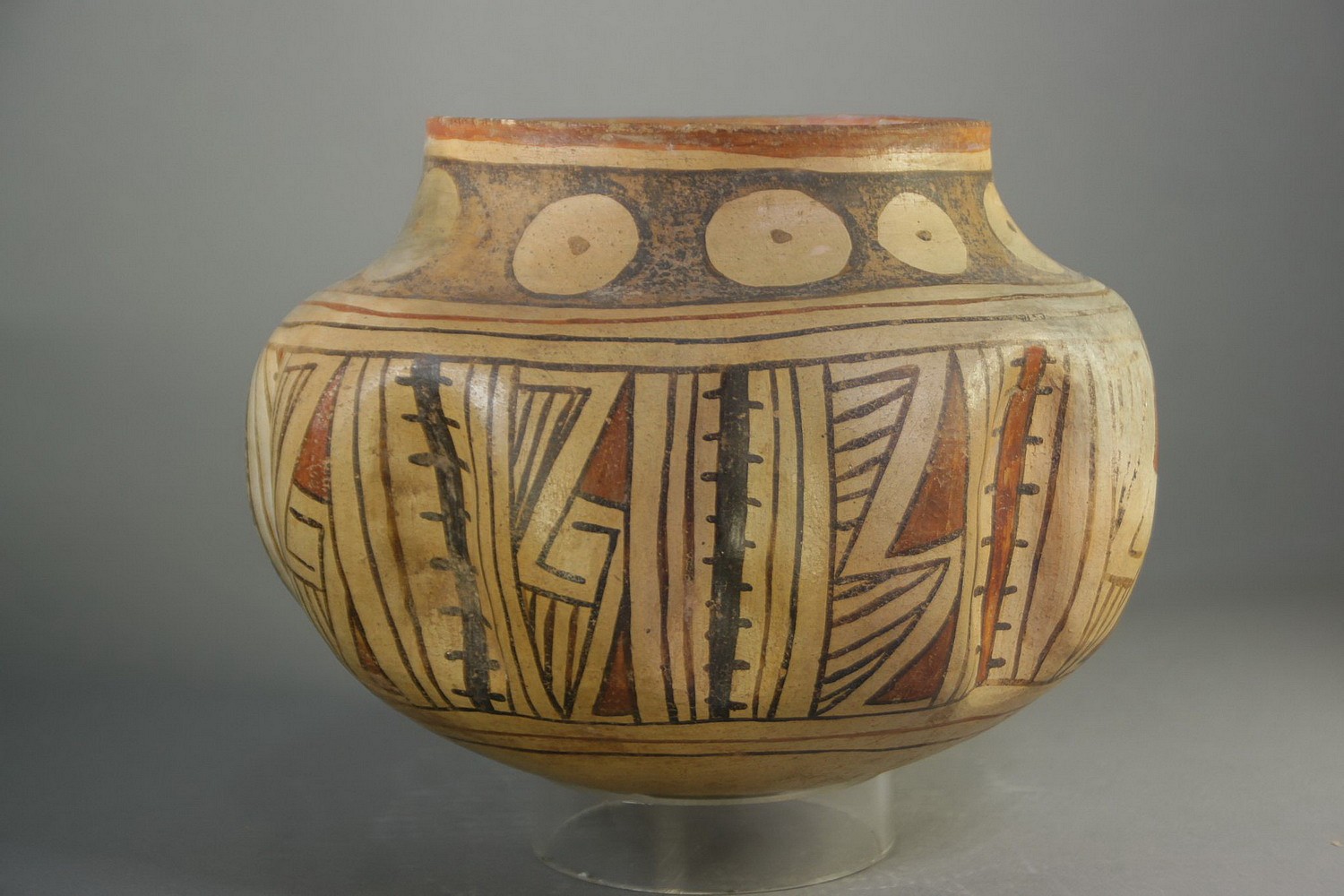
Mexico | Casas Grande Fluted Ceramic Vessel with Geometric Designs | | David Bernstein Pre-Columbian Art. Extensive inventory of Pre-Columbian art from South America, including ancient objects in ceramic, textiles, bronze, copper and gold.
26 / 108

Mexico, Casas Grande Fluted Ceramic Vessel with Geometric Designs

This unusual ceramic bowl has nine fluted sections separated by symbolic cacti imagery. The bowl is painted with red and black geometric designs on a beige ground. On the bottom are three large concentric black lines. It has a tapered neck that is decorated with nine beige circles on a black ground. Each circle has a central black dot, which believe symbolizes an aerial view of a cactus. This vessel originates from Casas Grande, a site located in the Mexican state of Chihuahua, along the Casas Grande River and South of the US Puebloan ruins. A good reference is “Casa Grandes and the Ceramic Art of the Ancient Southwest” by Richard Townsend, published by the Art Institute of Chicago.
The bowl is in good condition with one crack on the bottom restored and a small hole on one of the fluted sections.

Period: Mexico, Casas Grande Classic Period c. AD 1250 - 1475

Media: Ceramic

Dimensions: H. 6" x W. 8"

Price Upon Request

n6012
  • View all works
  • PLAY
  • I N Q U I R E
  • Share
  • Print
  • More Works
I N Q U I R E Share Print
Mexico, Casas Grande Gadrooned Ceramic Vessel with Geometric Designs
This unusual ceramic bowl has nine fluted sections separated by symbolic cacti imagery.  The bowl is painted with red and black geometric designs on a beige ground.  On the bottom are three large concentric black lines.  It has a tapered neck that is decorated with nine beige circles on a black ground.  Each circle has a central black dot, which symbolizes an aerial view of a cactus.  This vessel originates from Casas Grande, a site located in the Mexican state of Chihuahua, along the Casas Grande River and South of the US Puebloan ruins.  A good reference is “Casas Grandes and the Ceramic Art of the Ancient Southwest” by Richard Townsend, published by the Art Institute of Chicago.  The bowl is in good condition with one crack on the bottom restored and a small hole on one of the fluted sections.
All parts original.
Period: Mexico, Casas Grande Classic Period  c. AD 1250 - 1475
Media: Ceramic
Dimensions: H. 6" x W. 8"
$2,900
n2046
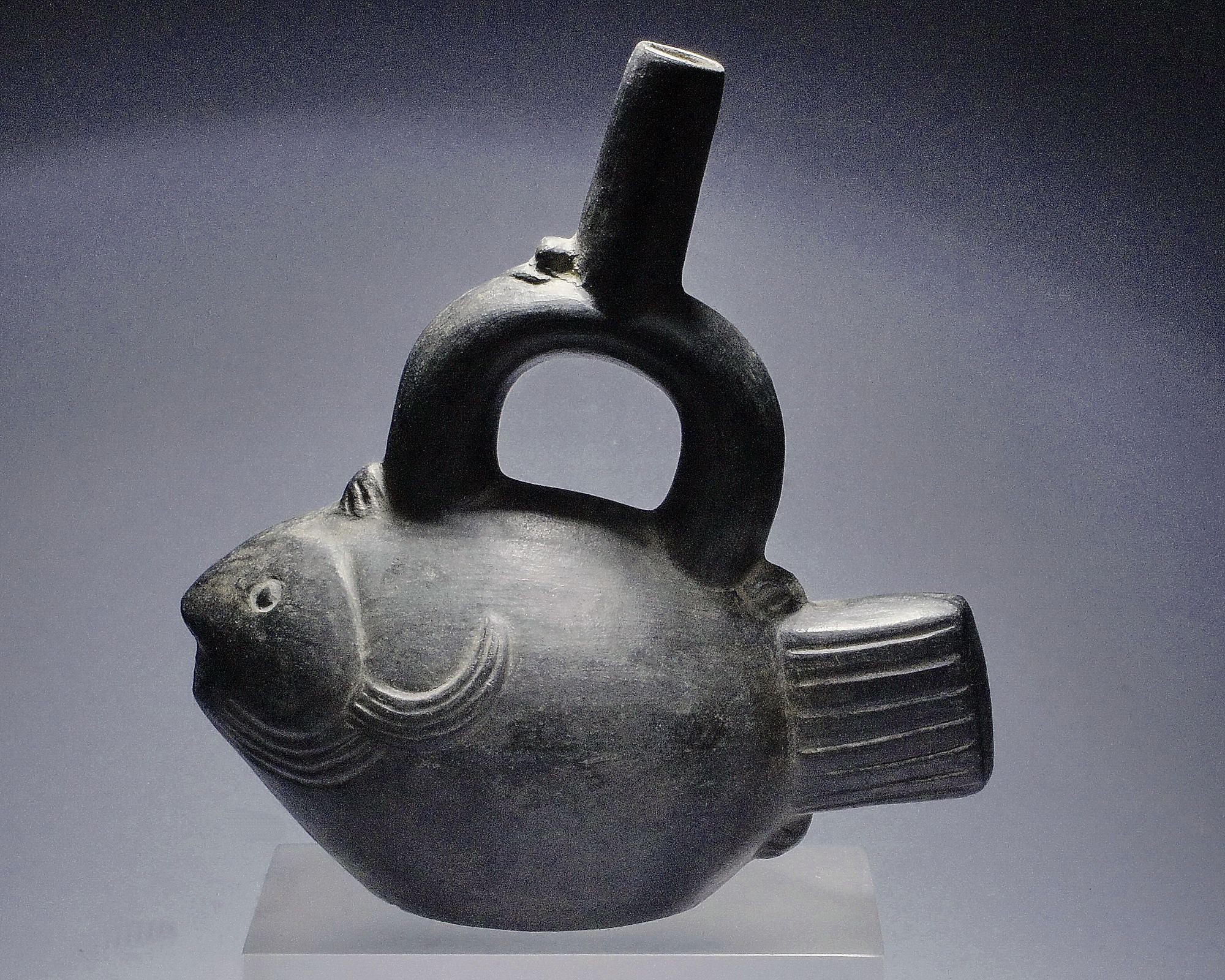
Mexico | Casas Grande Gadrooned Ceramic Vessel with Geometric Designs | | David Bernstein Pre-Columbian Art. Extensive inventory of Pre-Columbian art from South America, including ancient objects in ceramic, textiles, bronze, copper and gold.
27 / 108

Mexico, Casas Grande Gadrooned Ceramic Vessel with Geometric Designs

This unusual ceramic bowl has nine fluted sections separated by symbolic cacti imagery. The bowl is painted with red and black geometric designs on a beige ground. On the bottom are three large concentric black lines. It has a tapered neck that is decorated with nine beige circles on a black ground. Each circle has a central black dot, which symbolizes an aerial view of a cactus. This vessel originates from Casas Grande, a site located in the Mexican state of Chihuahua, along the Casas Grande River and South of the US Puebloan ruins. A good reference is “Casas Grandes and the Ceramic Art of the Ancient Southwest” by Richard Townsend, published by the Art Institute of Chicago. The bowl is in good condition with one crack on the bottom restored and a small hole on one of the fluted sections. All parts original.

Period: Mexico, Casas Grande Classic Period c. AD 1250 - 1475

Media: Ceramic

Dimensions: H. 6" x W. 8"

$2,900

n2046

  • View all works
  • PLAY
  • I N Q U I R E
  • Share
  • Print
  • More Works
I N Q U I R E Share Print
Peru, Blackware Vessel in The Form of a Bonito
This fish is identifiable as a bonito by its pointed mouth and teeth.  In the same family as tuna, but smaller, the bonito is one of the most abundant fish in north coastal Peru.
Period: Peru, Lambayeque, North Coast, c. AD 500 - 1100
Media: Ceramic
Dimensions: Length: 8" x Height: 8 1/4"
$1,500
n2016
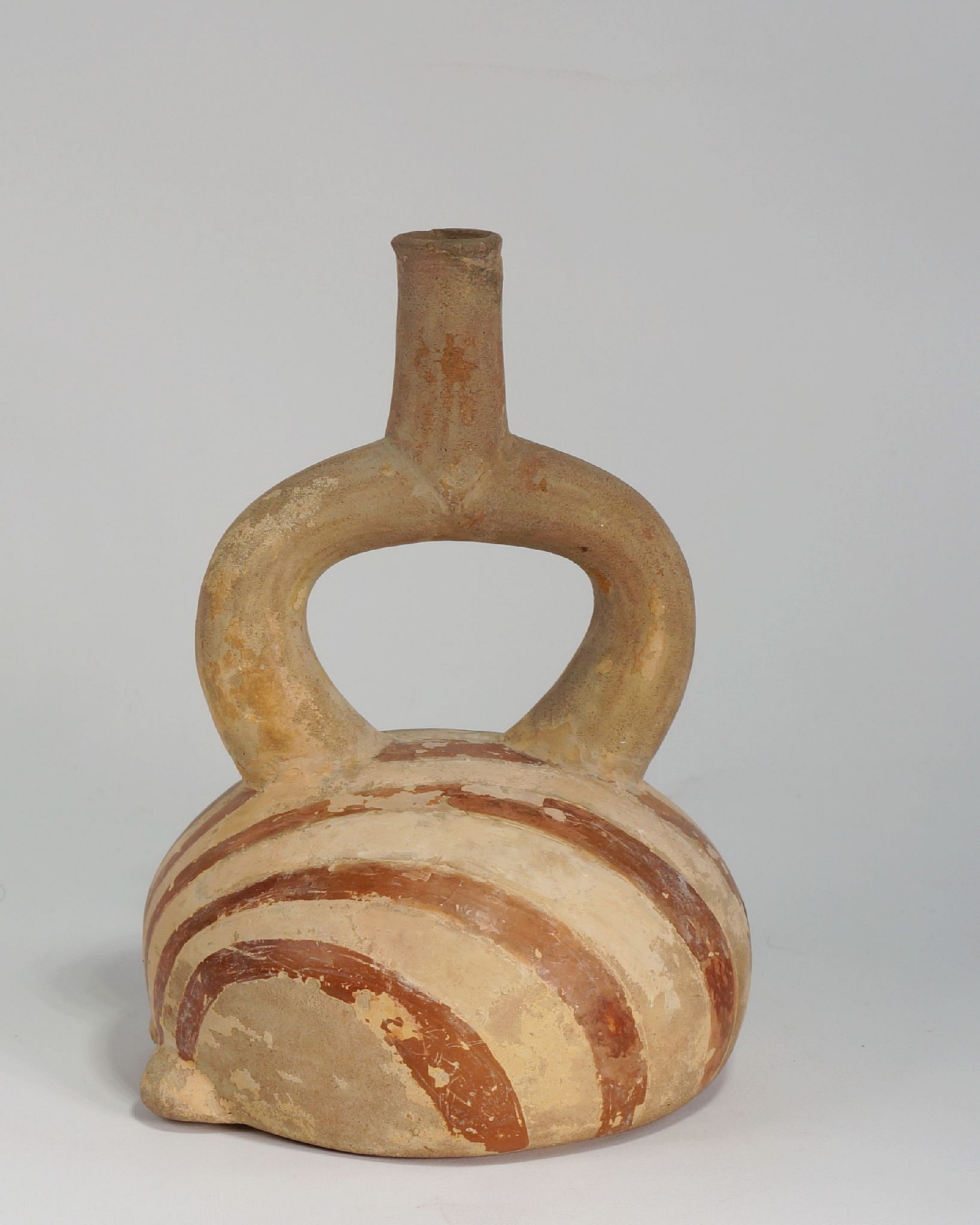
Peru | Blackware Vessel in The Form of a Bonito | 59 | David Bernstein Pre-Columbian Art. Extensive inventory of Pre-Columbian art from South America, including ancient objects in ceramic, textiles, bronze, copper and gold.
28 / 108

Peru, Blackware Vessel in The Form of a Bonito

This fish is identifiable as a bonito by its pointed mouth and teeth. In the same family as tuna, but smaller, the bonito is one of the most abundant fish in north coastal Peru.

Period: Peru, Lambayeque, North Coast, c. AD 500 - 1100

Media: Ceramic

Dimensions: Length: 8" x Height: 8 1/4"

$1,500

n2016
  • View all works
  • PLAY
  • I N Q U I R E
  • Share
  • Print
  • More Works
I N Q U I R E Share Print
Peru, Stirrup Spout Vessel Depicting a Scallop
This elegant vessel is modeled after the Argopectin purpuratus (the Peruvian calico scallop).  It is decorated with swirling painted stripes in brown slip on a cream ground and is a typical example of Moche realism.  During El Niño events, bivalves proliferate along the coast; scallops are the most abundant species.  The bivalves, in turn, attract octopi, which feed almost exclusively on these mollusks.  Octopi are a frequent theme in Moche art.  A similar example of a stirrup spout vessel in the form of a bivalve shell is illustrated in The Spirit of Ancient Peru: Treasures from the Museo Arqueologico Rafael Larco Herrera, edited by Kathleen Berrin (1997: fig. 41).
Period: Peru, Moche II, North Coast, c. AD 200 - 350
Media: Ceramic
Dimensions: Height 7"
Price Upon Request
95065
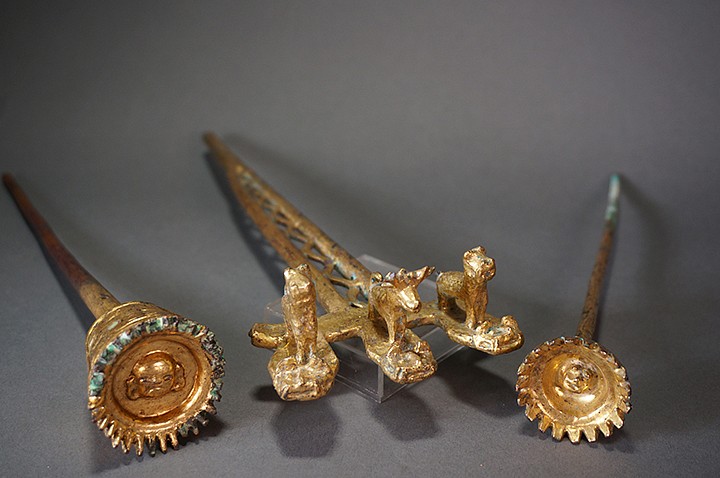
Peru | Stirrup Spout Vessel Depicting a Scallop | 46 | David Bernstein Pre-Columbian Art. Extensive inventory of Pre-Columbian art from South America, including ancient objects in ceramic, textiles, bronze, copper and gold.
29 / 108

Peru, Stirrup Spout Vessel Depicting a Scallop

This elegant vessel is modeled after the Argopectin purpuratus (the Peruvian calico scallop). It is decorated with swirling painted stripes in brown slip on a cream ground and is a typical example of Moche realism. During El Niño events, bivalves proliferate along the coast; scallops are the most abundant species. The bivalves, in turn, attract octopi, which feed almost exclusively on these mollusks. Octopi are a frequent theme in Moche art. A similar example of a stirrup spout vessel in the form of a bivalve shell is illustrated in The Spirit of Ancient Peru: Treasures from the Museo Arqueologico Rafael Larco Herrera, edited by Kathleen Berrin (1997: fig. 41).

Period: Peru, Moche II, North Coast, c. AD 200 - 350

Media: Ceramic

Dimensions: Height 7"

Price Upon Request

95065
  • View all works
  • PLAY
  • I N Q U I R E
  • Share
  • Print
  • More Works
I N Q U I R E Share Print
Peru, A Rare Recuay Gilt Scepter
This scepter is very rare with an unusual motif of three animals standing on three flayed feline skins.  The central animal is a deer flanked by an unknown four-legged animal. The shaft of the scepter has two channels attached by a series of triangular soldered stock.  Each channel has a suspension hole towards the top.  This scepter must have belonged to a high status individual as its manufacture is very elaborate and technically sophisticated. Only one other known similar Recuay scepter is illustrated in Kultur Von Peru by Max Schmidt, pg. 392.  The accompanying two tupus with decorated tops (longer and shorter) each have a different motif.

The longer tupu is decorated with a band of four stooping animals in low relief, each with a serpent emanating from its head.  The inside of the the longer tupu’s upper cup is decorated with a frowning face, perhaps a mask.  This is one of the largest known intact tupus.  The smaller tupu has a rich gilt surface and is decorated with a band of two face masks.  Inside the upper cup of the small tupu is the head of the same animal flanking the deer on the scepter.  Both tupus have finials that are decorated with both an outside band and an inside head.  The larger one has a band of 3 double headed serpents with a fox head inside.  The smaller one has a band of a double-headed arched feline and a face inside. 

Four tupus excavated at Pashash, the earliest known Recuay site, are illustrated in The Art and Archaeology of PSAHASH by Terence Grieder, figs. 114-117, and fig. 7. These tupus were originally sold by Alan Lapiner in the early 1970s  along with a classic Recuay vessel of a lord flanked by arched felines on each side. 

Period: Peru, Recuay, North Highlands, c. 300 BC - AD 700
Media: Metal
Dimensions: Scepter Length 9" x Width  3"Longer Tupu Length 8 ½ x diameter 1 ½”Shorter tupu: Length: 7 ½” x diameter 1"
Price Upon Request
M3023
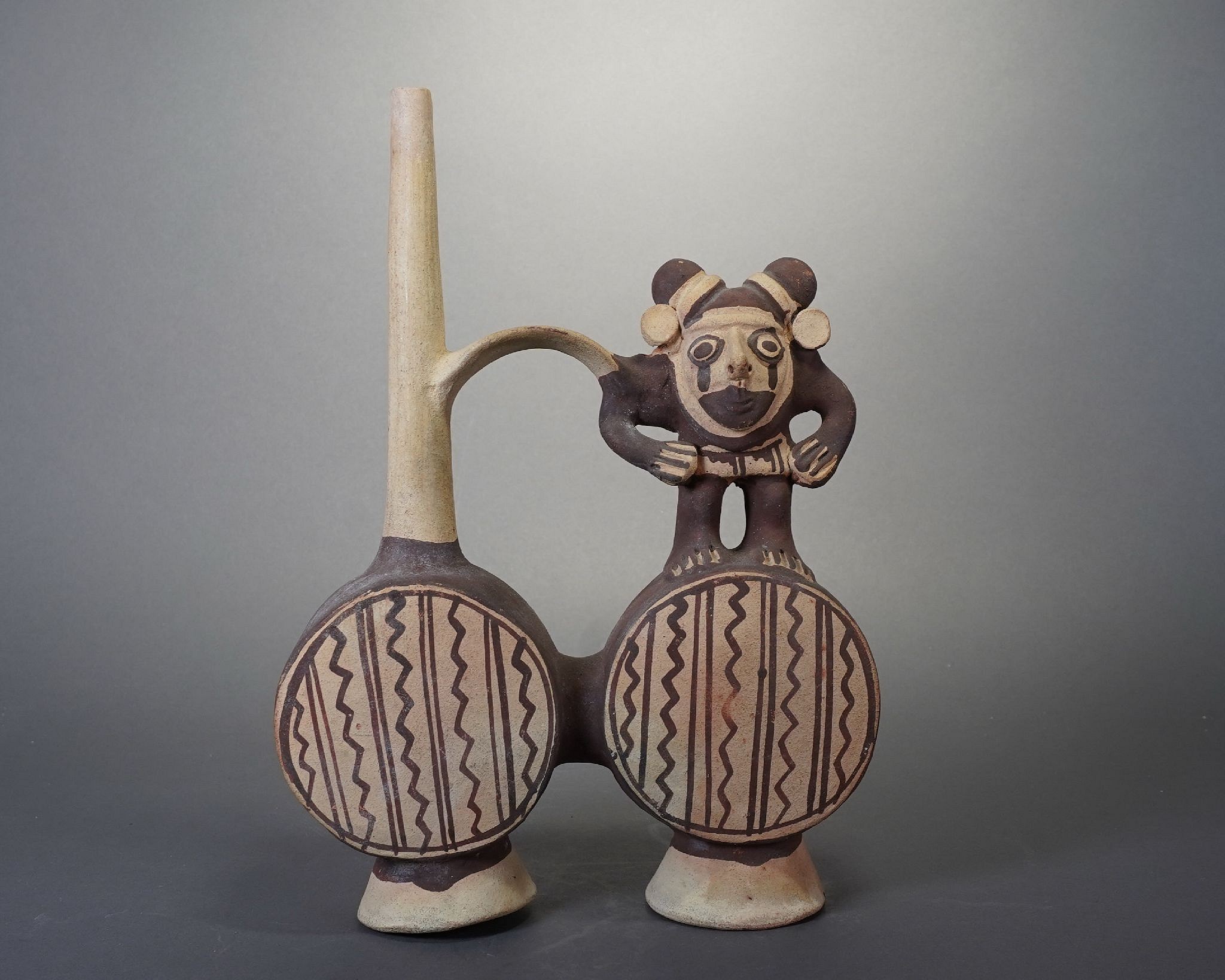
Peru | A Rare Recuay Gilt Scepter | | David Bernstein Pre-Columbian Art. Extensive inventory of Pre-Columbian art from South America, including ancient objects in ceramic, textiles, bronze, copper and gold.
30 / 108

Peru, A Rare Recuay Gilt Scepter

This scepter is very rare with an unusual motif of three animals standing on three flayed feline skins. The central animal is a deer flanked by an unknown four-legged animal. The shaft of the scepter has two channels attached by a series of triangular soldered stock. Each channel has a suspension hole towards the top. This scepter must have belonged to a high status individual as its manufacture is very elaborate and technically sophisticated. Only one other known similar Recuay scepter is illustrated in Kultur Von Peru by Max Schmidt, pg. 392. The accompanying two tupus with decorated tops (longer and shorter) each have a different motif.

The longer tupu is decorated with a band of four stooping animals in low relief, each with a serpent emanating from its head. The inside of the the longer tupu’s upper cup is decorated with a frowning face, perhaps a mask. This is one of the largest known intact tupus. The smaller tupu has a rich gilt surface and is decorated with a band of two face masks. Inside the upper cup of the small tupu is the head of the same animal flanking the deer on the scepter. Both tupus have finials that are decorated with both an outside band and an inside head. The larger one has a band of 3 double headed serpents with a fox head inside. The smaller one has a band of a double-headed arched feline and a face inside.

Four tupus excavated at Pashash, the earliest known Recuay site, are illustrated in The Art and Archaeology of PSAHASH by Terence Grieder, figs. 114-117, and fig. 7. These tupus were originally sold by Alan Lapiner in the early 1970s along with a classic Recuay vessel of a lord flanked by arched felines on each side.

Period: Peru, Recuay, North Highlands, c. 300 BC - AD 700

Media: Metal

Dimensions: Scepter Length 9" x Width 3"
Longer Tupu Length 8 ½ x diameter 1 ½”
Shorter tupu: Length: 7 ½” x diameter 1"

Price Upon Request

M3023
  • View all works
  • PLAY
  • I N Q U I R E
  • Share
  • Print
  • More Works
I N Q U I R E Share Print
Peru, Cajamarca Low Orangeware Bowls with Coiled Serpent
This bowl has an orange and white spotted coiled serpent motif and a footed base.  The Cajamarca culture has a long role in Peruvian pre-history going back to Chavin times until 1532 when the Inca king Atahualpa was killed by Pizarro.  Today there still exists a beautiful cut stone "Inca Bath" of warm mineral water that was enjoyed by Inca nobility.  A similar style of ancient plate from Cajamarca is in the Museum at Cajamarca.  The orange and white slip decoration demonstrates the high artistic control that the Cajamarca artisans had over the medium.  A great deal of control over the firing process was required to prevent the orange slip from turning brown
Period: Peru, Cajamarca, North Highlands, c. AD 1000 - 1400
Media: Ceramic
Dimensions: Diameter: 10 inches.
Price Upon Request
97111a
Peru | Cajamarca Low Orangeware Bowls with Coiled Serpent | | David Bernstein Pre-Columbian Art. Extensive inventory of Pre-Columbian art from South America, including ancient objects in ceramic, textiles, bronze, copper and gold.
31 / 108

Peru, Cajamarca Low Orangeware Bowls with Coiled Serpent

This bowl has an orange and white spotted coiled serpent motif and a footed base. The Cajamarca culture has a long role in Peruvian pre-history going back to Chavin times until 1532 when the Inca king Atahualpa was killed by Pizarro. Today there still exists a beautiful cut stone "Inca Bath" of warm mineral water that was enjoyed by Inca nobility. A similar style of ancient plate from Cajamarca is in the Museum at Cajamarca. The orange and white slip decoration demonstrates the high artistic control that the Cajamarca artisans had over the medium. A great deal of control over the firing process was required to prevent the orange slip from turning brown

Period: Peru, Cajamarca, North Highlands, c. AD 1000 - 1400

Media: Ceramic

Dimensions: Diameter: 10 inches.

Price Upon Request

97111a

  • View all works
  • PLAY
  • I N Q U I R E
  • Share
  • Print
  • More Works
I N Q U I R E Share Print
Peru, Chancay Double-Chambered Whistling Vessel with Animal Impersonator
The Chancay people were known for their ceramic workshops, where series of similar items were produced in groups.  This bridge-spout vessel has two chambers and is painted with alternating straight and wavy lines.  The figure sitting atop the vessel is an Animal Impersonator of a monkey.  “Animal Impersonator” is a term used by Pre-Colombian scholars to refer to a shaman who dresses as a certain animal to embody the mythological characteristics associated with that animal.  Monkeys, who dwell at the top of the forest canopy in the Amazon, are associated with ancestral secrets in Andean mythology.  This shaman has a hairstyle arranged in two coils to resemble monkey ears, as well as white ear spools.  He is hunched over and holds a weaving in his arms. 
This vessel may have been used to pour a psychoactive brew as part of a shamanic rite.   When brew was poured, the air moved from one chamber to the other, creating a whistling sound.  The tone of the whistle was created by the specific shape of the resonance cavity.  Whistling sounds would have enhanced the shamanic ritual.  According to author Daniel K. Stat’s article Ancient Sounds: The Whistling Vessels of Peru, “the psycho-acoustical effects appear to be created by low frequencies or difference tones, or possibly the interaction of harmonic principles, which are produced when several vessels from a specific culture are played simultaneously.”  
This vessel would also have been intended for its owner for use in the afterlife. 
Period: Peru, Chancay, Central Coast, c. 900 - 1300
Media: Ceramic
Dimensions: Height: 10 1/2" x Width: 7"
$1,400
n9047
Peru | Chancay Double-Chambered Whistling Vessel with Animal Impersonator | | David Bernstein Pre-Columbian Art. Extensive inventory of Pre-Columbian art from South America, including ancient objects in ceramic, textiles, bronze, copper and gold.
32 / 108

Peru, Chancay Double-Chambered Whistling Vessel with Animal Impersonator

The Chancay people were known for their ceramic workshops, where series of similar items were produced in groups. This bridge-spout vessel has two chambers and is painted with alternating straight and wavy lines. The figure sitting atop the vessel is an Animal Impersonator of a monkey. “Animal Impersonator” is a term used by Pre-Colombian scholars to refer to a shaman who dresses as a certain animal to embody the mythological characteristics associated with that animal. Monkeys, who dwell at the top of the forest canopy in the Amazon, are associated with ancestral secrets in Andean mythology. This shaman has a hairstyle arranged in two coils to resemble monkey ears, as well as white ear spools. He is hunched over and holds a weaving in his arms.
This vessel may have been used to pour a psychoactive brew as part of a shamanic rite. When brew was poured, the air moved from one chamber to the other, creating a whistling sound. The tone of the whistle was created by the specific shape of the resonance cavity. Whistling sounds would have enhanced the shamanic ritual. According to author Daniel K. Stat’s article Ancient Sounds: The Whistling Vessels of Peru, “the psycho-acoustical effects appear to be created by low frequencies or difference tones, or possibly the interaction of harmonic principles, which are produced when several vessels from a specific culture are played simultaneously.”
This vessel would also have been intended for its owner for use in the afterlife.

Period: Peru, Chancay, Central Coast, c. 900 - 1300

Media: Ceramic

Dimensions: Height: 10 1/2" x Width: 7"

$1,400

n9047

  • View all works
  • PLAY
  • I N Q U I R E
  • Share
  • Print
  • More Works
I N Q U I R E Share Print
Peru, Chancay House with Seated Man in Two Room Interior
This ceramic piece represents the interior of a house. The inside is divided into two alcoves.  One alcove is enclosed on three sides, with a crosshatch pattern on the exterior, and the other is open to expose a seated man facing outward. He sits with an open vessel in front of him.  The two outside walls are higher than the ones inside.
Period: Peru, Chancay, Central Coast, c. AD 1100 - 1430
Media: Ceramic
Dimensions: Length, 7 2/8 in, width 4 12/16 in, height 4 in.
Price Upon Request
92237
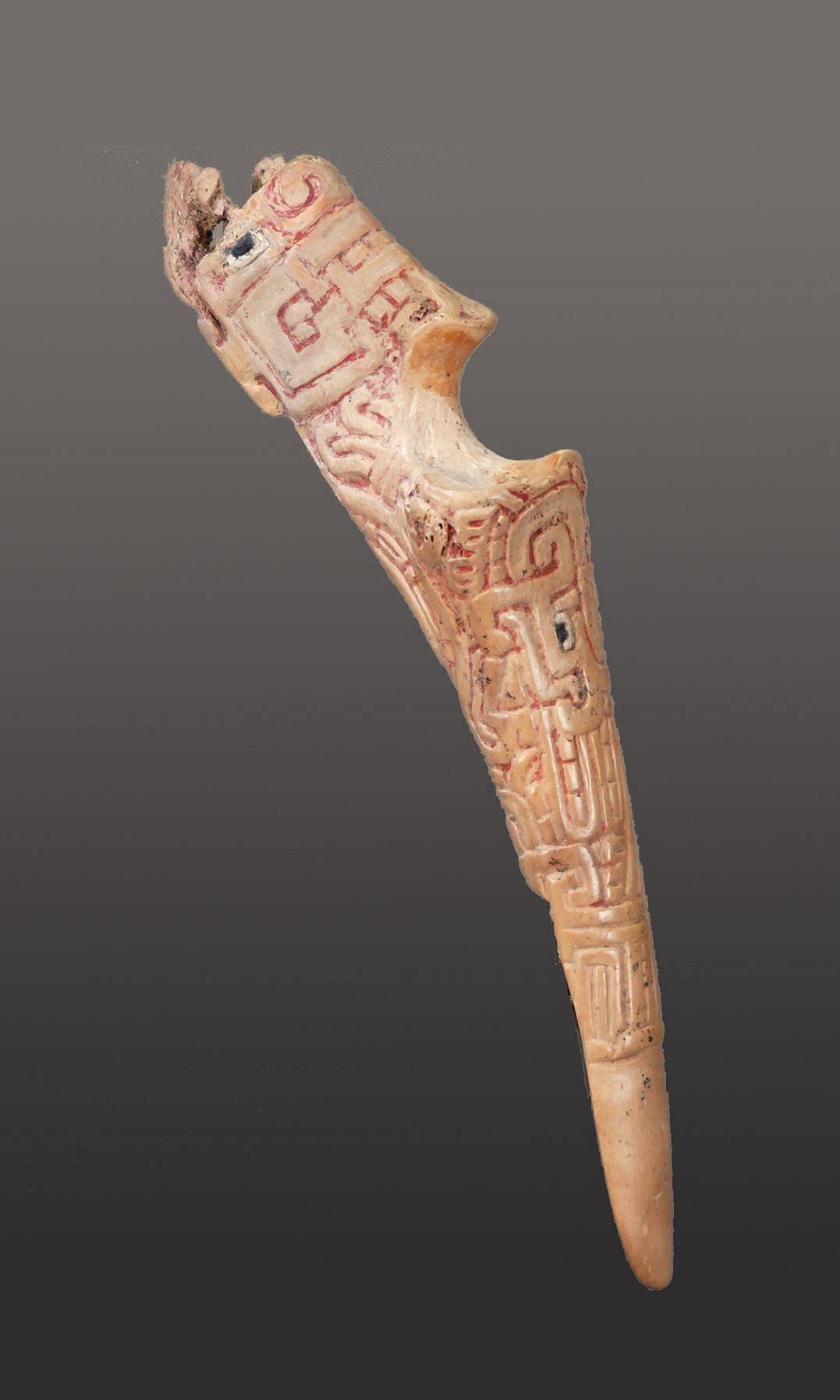
Peru | Chancay House with Seated Man in Two Room Interior | | David Bernstein Pre-Columbian Art. Extensive inventory of Pre-Columbian art from South America, including ancient objects in ceramic, textiles, bronze, copper and gold.
33 / 108

Peru, Chancay House with Seated Man in Two Room Interior

This ceramic piece represents the interior of a house. The inside is divided into two alcoves. One alcove is enclosed on three sides, with a crosshatch pattern on the exterior, and the other is open to expose a seated man facing outward. He sits with an open vessel in front of him. The two outside walls are higher than the ones inside.

Period: Peru, Chancay, Central Coast, c. AD 1100 - 1430

Media: Ceramic

Dimensions: Length, 7 2/8 in, width 4 12/16 in, height 4 in.

Price Upon Request

92237
  • View all works
  • PLAY
  • I N Q U I R E
  • Share
  • Print
  • More Works
I N Q U I R E Share Print
Peru, Chavin Carved Bone Spatula with Incised Morphed Faces
The bone is highly polished all over.  The primary figure is a monster with a large mouth, snarly nose, and shell inlaid eye on each side.  The body is carved with abstracted motifs.  On the lower front side is a profile of the monster's head with a large mouth opening into the bone's joint.  A similar example is illustrated in THE INKA EMPIRE AND ITS ANDEAN ORIGINS- pl.30 and is also on exhibit at the American Museum of Natural History, NY.
Period: Peru, Chavin, Cupisnique, Late Phase, North Coast, c. 700 - 400 BC
Media: Bone
Dimensions: Length: 6 1/4" x Wifth at shoulder 1 1/4"
$6,000
94149
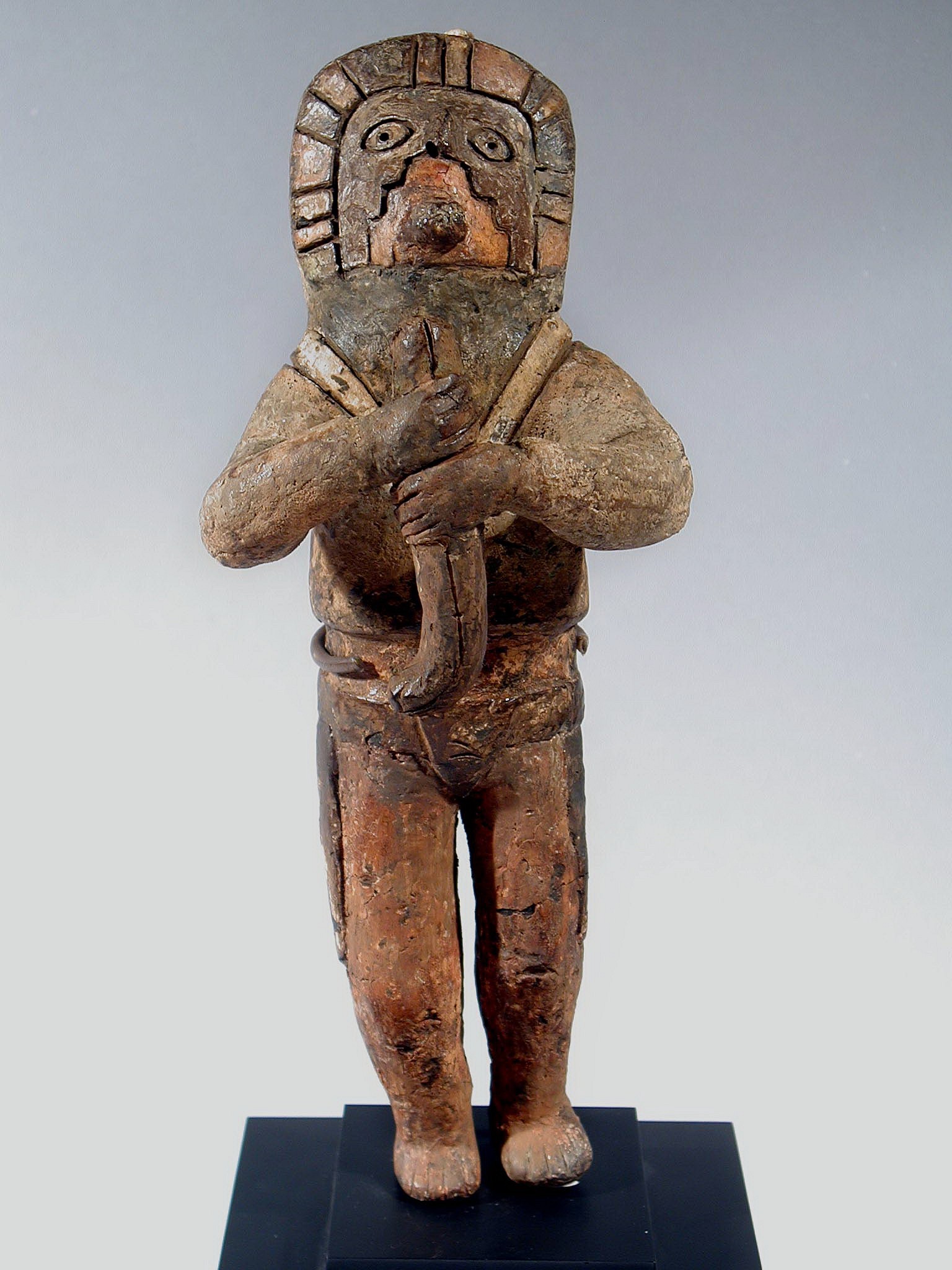
Peru | Chavin Carved Bone Spatula with Incised Morphed Faces | | David Bernstein Pre-Columbian Art. Extensive inventory of Pre-Columbian art from South America, including ancient objects in ceramic, textiles, bronze, copper and gold.
34 / 108

Peru, Chavin Carved Bone Spatula with Incised Morphed Faces

The bone is highly polished all over. The primary figure is a monster with a large mouth, snarly nose, and shell inlaid eye on each side. The body is carved with abstracted motifs. On the lower front side is a profile of the monster's head with a large mouth opening into the bone's joint. A similar example is illustrated in THE INKA EMPIRE AND ITS ANDEAN ORIGINS- pl.30 and is also on exhibit at the American Museum of Natural History, NY.

Period: Peru, Chavin, Cupisnique, Late Phase, North Coast, c. 700 - 400 BC

Media: Bone

Dimensions: Length: 6 1/4" x Wifth at shoulder 1 1/4"

$6,000

94149
  • View all works
  • PLAY
  • I N Q U I R E
  • Share
  • Print
  • More Works
I N Q U I R E Share Print
Peru, Chavin carved wood effigy of a shaman
Carved wooden effigy of a standing shaman holding a flute or serpent in front.  The shaman has puckered lips as if he is whistling and appears in a trance like state.  He is wearing a headdress, v neck tunic and belt with two long devices hanging down along the outside of each leg.  On the back of the belt is a "U" shaped device of unknown use.  From the top of the head emeniates a bone tube which has been broken.   A similar shaman's face is illustrated in PRECOLUMBIAN ART OF SOUTH AMERICA by Alan Lapiner fig. 13.    Wooden effigy figures are extremely rare and do not survive well.   The left leg was broken off and re-attached and the evidence of age was apparent.
Period: Late Chavin, North coast Peru 700-400 B.C.
Media: Wood
Dimensions: Height 9.1/2"
Price Upon Request
95057
Peru | Chavin carved wood effigy of a shaman | | David Bernstein Pre-Columbian Art. Extensive inventory of Pre-Columbian art from South America, including ancient objects in ceramic, textiles, bronze, copper and gold.
35 / 108

Peru, Chavin carved wood effigy of a shaman

Carved wooden effigy of a standing shaman holding a flute or serpent in front. The shaman has puckered lips as if he is whistling and appears in a trance like state. He is wearing a headdress, v neck tunic and belt with two long devices hanging down along the outside of each leg. On the back of the belt is a "U" shaped device of unknown use. From the top of the head emeniates a bone tube which has been broken. A similar shaman's face is illustrated in PRECOLUMBIAN ART OF SOUTH AMERICA by Alan Lapiner fig. 13. Wooden effigy figures are extremely rare and do not survive well. The left leg was broken off and re-attached and the evidence of age was apparent.

Period: Late Chavin, North coast Peru 700-400 B.C.

Media: Wood

Dimensions: Height 9.1/2"

Price Upon Request

95057

  • View all works
  • PLAY
  • I N Q U I R E
  • Share
  • Print
  • More Works
I N Q U I R E Share Print
Peru, Chavin Ceramic Depicting a Recumbant Jaguar With San Pedro Cactus
On each side of the vessel there is a jaguar lying outside of a structure which is possibly a cave or a temple.  A San Pedro Cactus is aside a Strombus shell; both have strong symbolic meaning for the Chavin feline cult. As the largest and the most -feared terrestrial carnivore in the Amazon, the jaguar serves as a natural symbol of raw aggression.  Chavin shamans respected the jaguar for its nocturnal hunting skills and its ability to swim and climb into the forest, ruling earth, water and sky as their domain.   Literary references of the same motif appear in The British Museum, The American Museum of Natural History, The Munson-Proctor Institute in Utica, and The Larco Herrera Collection at the Museo Nacional de Antropologia y Arqueologia in Lima.
Period: Peru, Chavï­n, Cupisnique, Middle Phase, North Coast, circa 1200-800BC
Media: Ceramic
Dimensions: Height 10 3/4"
Price Upon Request
n2059
Peru | Chavin Ceramic Depicting a Recumbant Jaguar With San Pedro Cactus | | David Bernstein Pre-Columbian Art. Extensive inventory of Pre-Columbian art from South America, including ancient objects in ceramic, textiles, bronze, copper and gold.
36 / 108

Peru, Chavin Ceramic Depicting a Recumbant Jaguar With San Pedro Cactus

On each side of the vessel there is a jaguar lying outside of a structure which is possibly a cave or a temple. A San Pedro Cactus is aside a Strombus shell; both have strong symbolic meaning for the Chavin feline cult. As the largest and the most -feared terrestrial carnivore in the Amazon, the jaguar serves as a natural symbol of raw aggression. Chavin shamans respected the jaguar for its nocturnal hunting skills and its ability to swim and climb into the forest, ruling earth, water and sky as their domain. Literary references of the same motif appear in The British Museum, The American Museum of Natural History, The Munson-Proctor Institute in Utica, and The Larco Herrera Collection at the Museo Nacional de Antropologia y Arqueologia in Lima.

Period: Peru, Chavï­n, Cupisnique, Middle Phase, North Coast, circa 1200-800BC

Media: Ceramic

Dimensions: Height 10 3/4"

Price Upon Request

n2059

  • View all works
  • PLAY
  • I N Q U I R E
  • Share
  • Print
  • More Works
I N Q U I R E Share Print
Peru, Chavin Cupisnique Style of a  San Pedro Cactus
Vessel with long body, long spout, and concentric circular ornaments. Similar examples to be found in "Chavin Perus Geheimnisvoller Anden-Tempel" on page 285, and 359. Vessels like these were not usually made to destroy but to serve as vehicles for transporting the Chavin Cult.  The surface area is highly burnished and original.
The vessel is large for its type.
Period: Peru, Chavï­n, Cupisnique, Middle Phase, North Coast, circa 1200-800BC
Media: Ceramic
Dimensions: Height 13"
Price Upon Request
n2058
Peru | Chavin Cupisnique Style of a San Pedro Cactus | | David Bernstein Pre-Columbian Art. Extensive inventory of Pre-Columbian art from South America, including ancient objects in ceramic, textiles, bronze, copper and gold.
37 / 108

Peru, Chavin Cupisnique Style of a San Pedro Cactus

Vessel with long body, long spout, and concentric circular ornaments. Similar examples to be found in "Chavin Perus Geheimnisvoller Anden-Tempel" on page 285, and 359. Vessels like these were not usually made to destroy but to serve as vehicles for transporting the Chavin Cult. The surface area is highly burnished and original. The vessel is large for its type.

Period: Peru, Chavï­n, Cupisnique, Middle Phase, North Coast, circa 1200-800BC

Media: Ceramic

Dimensions: Height 13"

Price Upon Request

n2058

  • View all works
  • PLAY
  • I N Q U I R E
  • Share
  • Print
  • More Works
I N Q U I R E Share Print
Peru, Chavin Cupisnique Style Stirrup spout Vessel Decorated with a Harpy Eagle.
Period: Peru, Chavï­n, Cupisnique, Middle Phase, North Coast, circa 1200-800BC
Media: Ceramic
Dimensions: Height: 8"
Price Upon Request
n2067
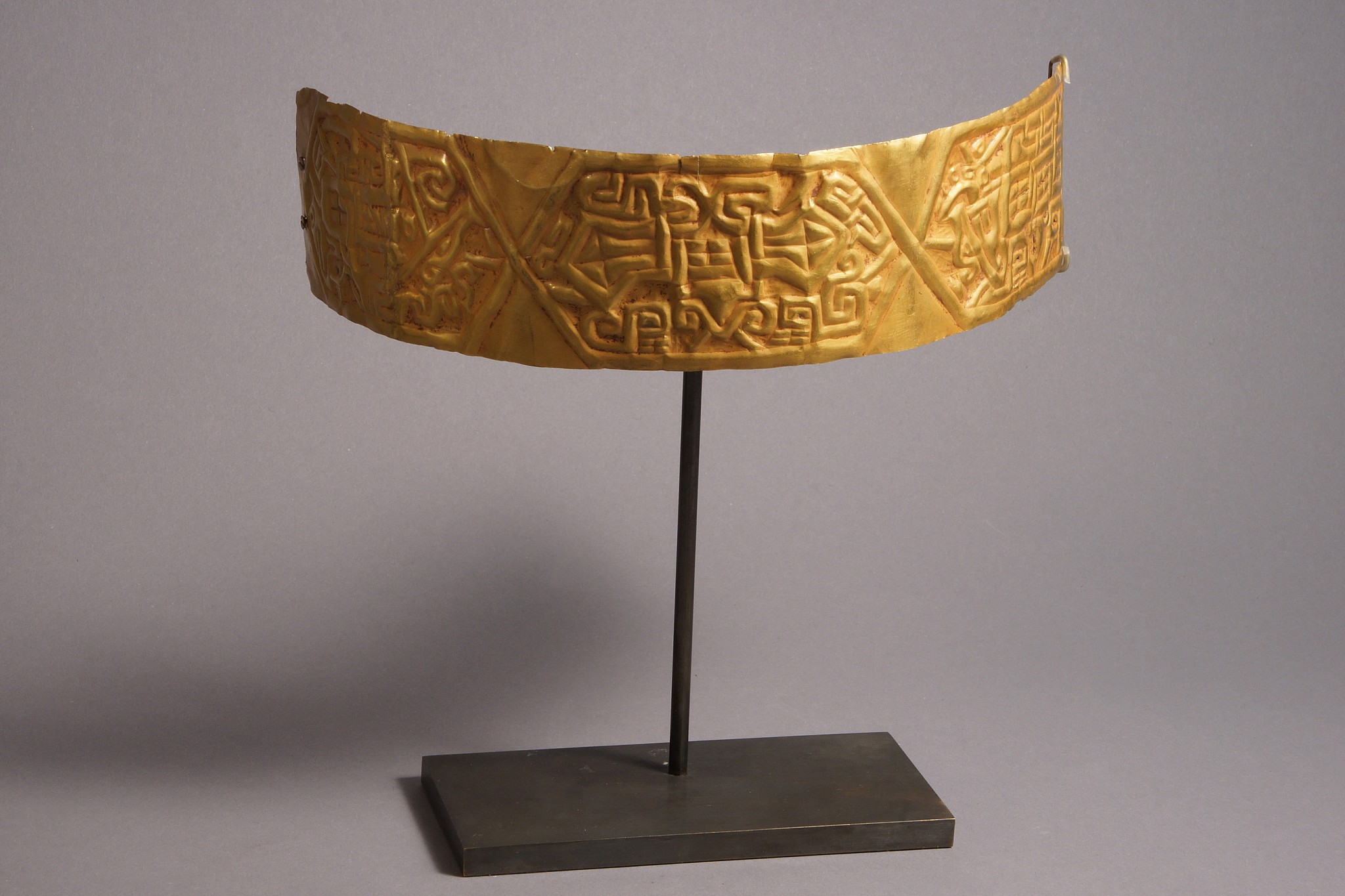
Peru | Chavin Cupisnique Style Stirrup spout Vessel Decorated with a Harpy Eagle. | | David Bernstein Pre-Columbian Art. Extensive inventory of Pre-Columbian art from South America, including ancient objects in ceramic, textiles, bronze, copper and gold.
38 / 108

Peru, Chavin Cupisnique Style Stirrup spout Vessel Decorated with a Harpy Eagle.

Period: Peru, Chavï­n, Cupisnique, Middle Phase, North Coast, circa 1200-800BC

Media: Ceramic

Dimensions: Height: 8"

Price Upon Request

n2067

  • View all works
  • PLAY
  • I N Q U I R E
  • Share
  • Print
  • More Works
I N Q U I R E Share Print
Peru, Chavin Gold Crown With Embossed Design
Chavin artists hammered gold sheets over wooden molds to make crowns and pectorals for the ruling elite. This crown was cut down and repaired in antiquity, but it originally had two profile faces on the sides and two frontal images of the feline deity so often seen in Chavin art. A cuff from the same grave lot is on display at the Houston Museum of Fine Arts with faces separated by diagonal designs. This crown is published in Jose Antonio Lavalle "Oro Del Antiguo Peru" (1992: pl. 10). Samuel K. Lothrop was the first  scholar to analyze gold crowns and plaques that came from two tomb lots in Chongoyape, "Gold Artifacts of Chavin Style" (American Antiquity 1951, 3: 226 - 240). His work and other tomb finds are reviewed by Richar L. Burger in "Chavin and The Origins of Andean Civilization" (1992: 204 - 206) A number of crowns similar to this one are known to have come from these tombs, which also yielded gold cuffs, ear spools, nose pendants, chest plaques and tweezers. Examined and approved by Robert Sonin and Henri Reichlin in 1976. Ex-collection Marcel Ebnother, Switzerland.
Period: Peru, Chavin, North Coast Peru, Late Initial Period, circa 1200-200BC
Media: Metal
Dimensions: Length 11. 1/2"  x Height 2"
Price Upon Request
M6075
Peru | Chavin Gold Crown With Embossed Design | | David Bernstein Pre-Columbian Art. Extensive inventory of Pre-Columbian art from South America, including ancient objects in ceramic, textiles, bronze, copper and gold.
39 / 108

Peru, Chavin Gold Crown With Embossed Design

Chavin artists hammered gold sheets over wooden molds to make crowns and pectorals for the ruling elite. This crown was cut down and repaired in antiquity, but it originally had two profile faces on the sides and two frontal images of the feline deity so often seen in Chavin art. A cuff from the same grave lot is on display at the Houston Museum of Fine Arts with faces separated by diagonal designs. This crown is published in Jose Antonio Lavalle "Oro Del Antiguo Peru" (1992: pl. 10). Samuel K. Lothrop was the first scholar to analyze gold crowns and plaques that came from two tomb lots in Chongoyape, "Gold Artifacts of Chavin Style" (American Antiquity 1951, 3: 226 - 240). His work and other tomb finds are reviewed by Richar L. Burger in "Chavin and The Origins of Andean Civilization" (1992: 204 - 206) A number of crowns similar to this one are known to have come from these tombs, which also yielded gold cuffs, ear spools, nose pendants, chest plaques and tweezers. Examined and approved by Robert Sonin and Henri Reichlin in 1976. Ex-collection Marcel Ebnother, Switzerland.

Period: Peru, Chavin, North Coast Peru, Late Initial Period, circa 1200-200BC

Media: Metal

Dimensions: Length 11. 1/2" x Height 2"

Price Upon Request

M6075

  • View all works
  • PLAY
  • I N Q U I R E
  • Share
  • Print
  • More Works
I N Q U I R E Share Print
Peru, Chavin Gold Pin with Simple Twisted and Hammered Diamond Design
This unusual diamond-shaped pin was made from one flat sheet that was hammered and twisted.
Period: Peru, Chavin, North Coast, c. 200  - 500 BC
Media: Metal
Dimensions: Length: 5 1/8" x  Weight: 3.1 grams.
$1,200
N5041
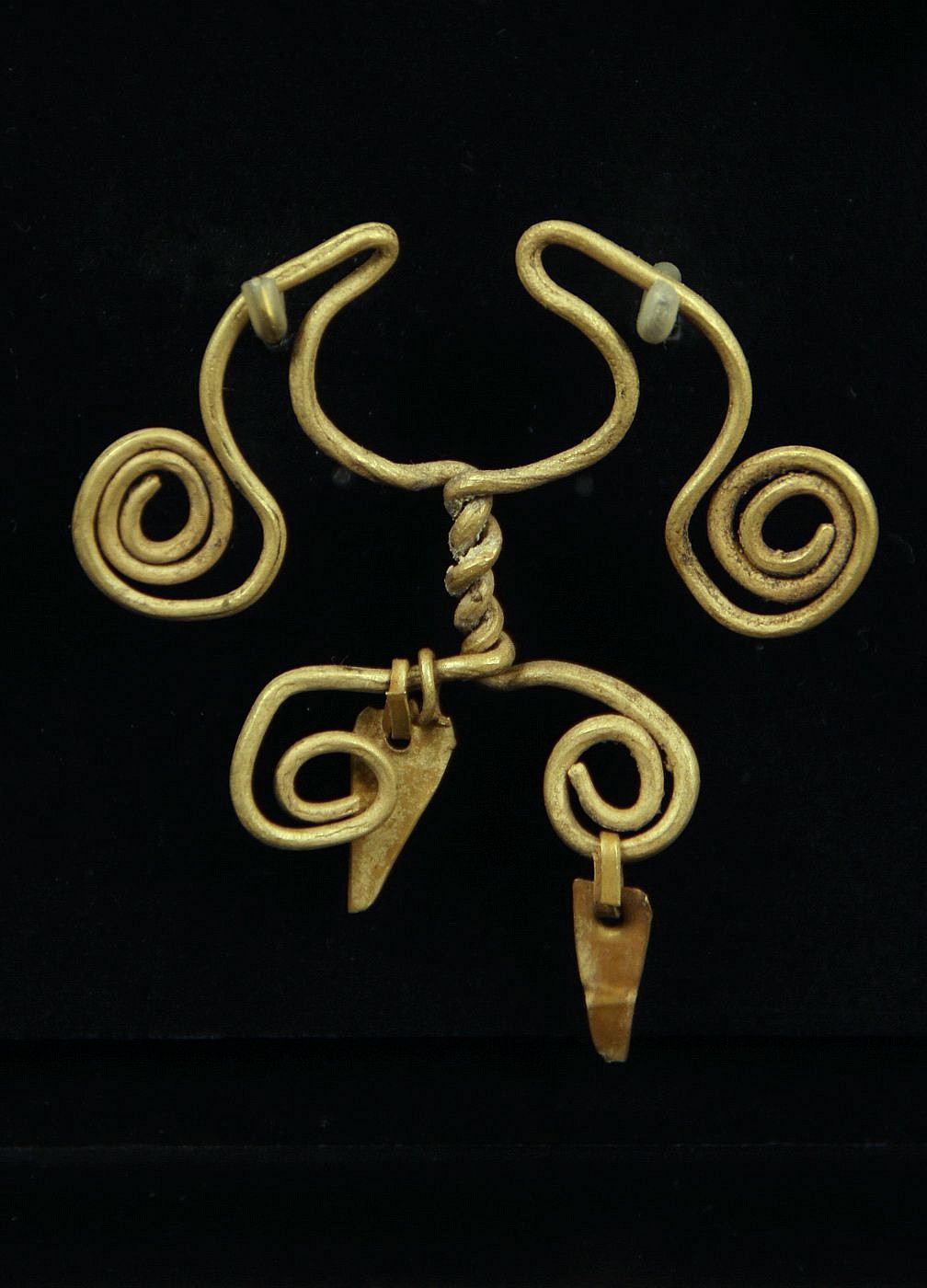
Peru | Chavin Gold Pin with Simple Twisted and Hammered Diamond Design | | David Bernstein Pre-Columbian Art. Extensive inventory of Pre-Columbian art from South America, including ancient objects in ceramic, textiles, bronze, copper and gold.
40 / 108

Peru, Chavin Gold Pin with Simple Twisted and Hammered Diamond Design

This unusual diamond-shaped pin was made from one flat sheet that was hammered and twisted.

Period: Peru, Chavin, North Coast, c. 200 - 500 BC

Media: Metal

Dimensions: Length: 5 1/8" x Weight: 3.1 grams.

$1,200

N5041

  • View all works
  • PLAY
  • I N Q U I R E
  • Share
  • Print
  • More Works
I N Q U I R E Share Print
Peru, Chavin Gold Spiral Nose Ring with Two Twisted Wires and Two Dangles
This wire nose ring was made of one hammered sheet of gold, folded on itself, and cut.   The ornament was hammered and coiled with the original suspended dangles.

Period: Peru, Chavin, North Coast, c. 1500 - 400 BC
Media: Metal
Dimensions: Height:1 1/4"   Weight: 4.8 grams
$2,100
94222
Peru | Chavin Gold Spiral Nose Ring with Two Twisted Wires and Two Dangles | | David Bernstein Pre-Columbian Art. Extensive inventory of Pre-Columbian art from South America, including ancient objects in ceramic, textiles, bronze, copper and gold.
41 / 108

Peru, Chavin Gold Spiral Nose Ring with Two Twisted Wires and Two Dangles

This wire nose ring was made of one hammered sheet of gold, folded on itself, and cut. The ornament was hammered and coiled with the original suspended dangles.

Period: Peru, Chavin, North Coast, c. 1500 - 400 BC

Media: Metal

Dimensions: Height:1 1/4" Weight: 4.8 grams

$2,100

94222

  • View all works
  • PLAY
  • I N Q U I R E
  • Share
  • Print
  • More Works
I N Q U I R E Share Print
Peru, Chavin Pair of Gold Ear Ornaments and a Gold Nose Ornament with double chevron
The pair of gold ornaments, each with a double headed serpent with cut-out facial details, suspended by a twisted wire loop, and a suspension plaque dangleA gold nose ornament with cutout design and a central suspension plaque. The single nose ornament has a cut-out design sign in an abstract avian face or that of opposing chevrons, suspended by a twisted gold wire loop. pl. 15.
Period: Peru circa 500-300AD
Media: Metal
Dimensions: Widths 1 1/2 inches each; Width 1 3/4 inches
Price Upon Request
94157
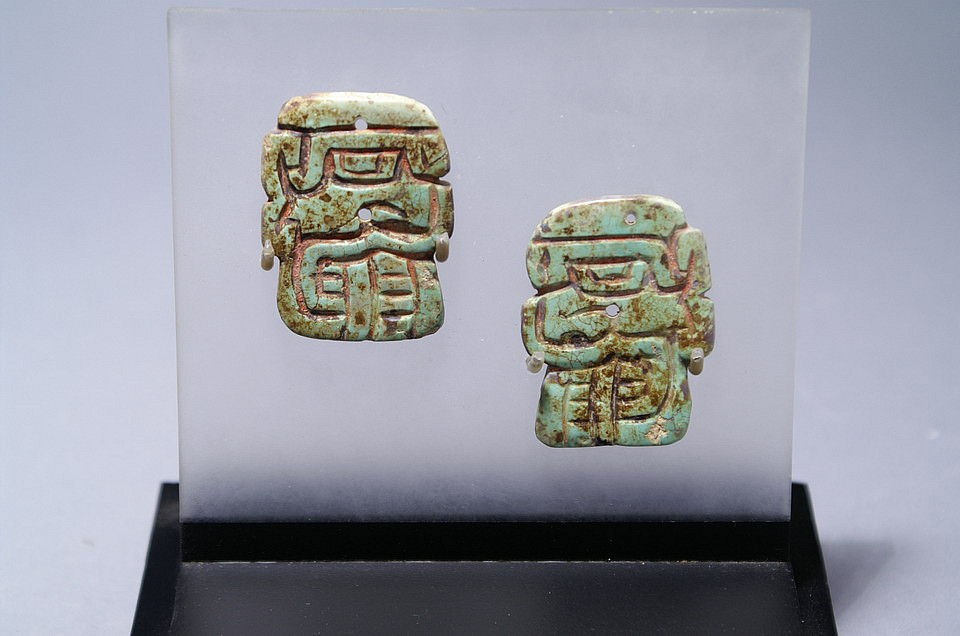
Peru | Chavin Pair of Gold Ear Ornaments and a Gold Nose Ornament with double chevron | | David Bernstein Pre-Columbian Art. Extensive inventory of Pre-Columbian art from South America, including ancient objects in ceramic, textiles, bronze, copper and gold.
42 / 108

Peru, Chavin Pair of Gold Ear Ornaments and a Gold Nose Ornament with double chevron

The pair of gold ornaments, each with a double headed serpent with cut-out facial details, suspended by a twisted wire loop, and a suspension plaque dangleA gold nose ornament with cutout design and a central suspension plaque. The single nose ornament has a cut-out design sign in an abstract avian face or that of opposing chevrons, suspended by a twisted gold wire loop. pl. 15.

Period: Peru circa 500-300AD

Media: Metal

Dimensions: Widths 1 1/2 inches each; Width 1 3/4 inches

Price Upon Request

94157

  • View all works
  • PLAY
  • I N Q U I R E
  • Share
  • Print
  • More Works
I N Q U I R E Share Print
Peru, Chavin pair of Turquoise Plaques with Profile Faces
These faces could be trophy heads.  There are two small drill holes center arranged vertically.  It’s quite rare to find carved turquoise when most are made of shell.  These may have been use as pendants to a textile.   There is an abundance of manganese patina on the front.
Period: Peru, Chavin, Middle Phase, c. 1000 - 700 BC
Media: Stone
Dimensions: Height: 1 1/2" x Width 1 3/4"
$2,900
98046
Peru | Chavin pair of Turquoise Plaques with Profile Faces | | David Bernstein Pre-Columbian Art. Extensive inventory of Pre-Columbian art from South America, including ancient objects in ceramic, textiles, bronze, copper and gold.
43 / 108

Peru, Chavin pair of Turquoise Plaques with Profile Faces

These faces could be trophy heads. There are two small drill holes center arranged vertically. It’s quite rare to find carved turquoise when most are made of shell. These may have been use as pendants to a textile. There is an abundance of manganese patina on the front.

Period: Peru, Chavin, Middle Phase, c. 1000 - 700 BC

Media: Stone

Dimensions: Height: 1 1/2" x Width 1 3/4"

$2,900

98046

  • View all works
  • PLAY
  • I N Q U I R E
  • Share
  • Print
  • More Works
I N Q U I R E Share Print
Peru, Chavin Rock Quartz Crystal 24" Necklace
Bi-conically drilled rock quartz crystal necklace with traces of cinnabar. The beads are graduated in size from approximately 9.22 mm to 11.17 mm. They were purchased between 1975 and 1985.
Period: Peru, Chavin, North Coast, circa 400-500BC
Media: Stone
Dimensions: Length: 24" inches
Price Upon Request
94049
Peru | Chavin Rock Quartz Crystal 24" Necklace | | David Bernstein Pre-Columbian Art. Extensive inventory of Pre-Columbian art from South America, including ancient objects in ceramic, textiles, bronze, copper and gold.
44 / 108

Peru, Chavin Rock Quartz Crystal 24" Necklace

Bi-conically drilled rock quartz crystal necklace with traces of cinnabar. The beads are graduated in size from approximately 9.22 mm to 11.17 mm. They were purchased between 1975 and 1985.

Period: Peru, Chavin, North Coast, circa 400-500BC

Media: Stone

Dimensions: Length: 24" inches

Price Upon Request

94049
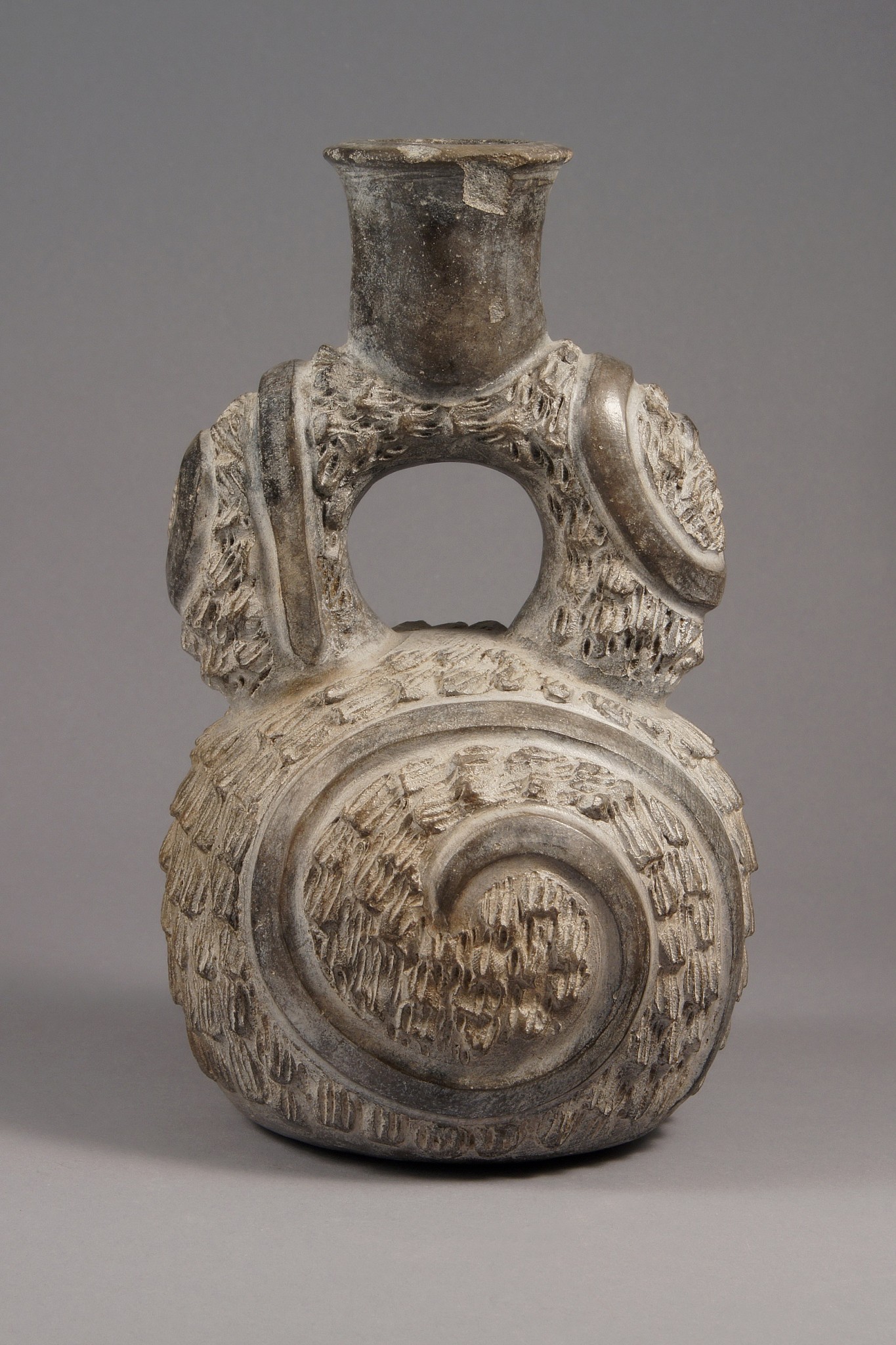
  • View all works
  • PLAY
  • I N Q U I R E
  • Share
  • Print
  • More Works
I N Q U I R E Share Print
Peru, Chavin Stirrup Spout Portrait Vessel with Red Face and White Tears
There are few published,  authenticated, Chavin ceramic portrait heads and this is the only known one of its kind with post -fire red and white pigment.  The face has an unusually sensitive expression and delicately incised black and white tears that radiate outwards.  There is a similar Chavin portrait vessel in the Linden Museum- Stuttgardt.  Another Chavin portrait in the Larco collection and illustrated in THE SPIRIT OF ANCIENT PERU (pg.81) also has similar facial features:  small ears, slanted eyes, small nose and thin lips - but in addition also has wrinkles.  Author Richard Burger identifies this portrait as an elderly person. It is possible that the red-faced portrait is also a depiction of the same person that the Cupisnique people may have revered.
Period: Peru, Chavï­n, Cupisnique, Late Phase, North Coast, circa 700-400BC
Media: Ceramic
Dimensions: Height 12 3/8" x  Width 8"
Price Upon Request
n2108
Peru | Chavin Stirrup Spout Portrait Vessel with Red Face and White Tears | | David Bernstein Pre-Columbian Art. Extensive inventory of Pre-Columbian art from South America, including ancient objects in ceramic, textiles, bronze, copper and gold.
45 / 108

Peru, Chavin Stirrup Spout Portrait Vessel with Red Face and White Tears

There are few published, authenticated, Chavin ceramic portrait heads and this is the only known one of its kind with post -fire red and white pigment. The face has an unusually sensitive expression and delicately incised black and white tears that radiate outwards. There is a similar Chavin portrait vessel in the Linden Museum- Stuttgardt. Another Chavin portrait in the Larco collection and illustrated in THE SPIRIT OF ANCIENT PERU (pg.81) also has similar facial features: small ears, slanted eyes, small nose and thin lips - but in addition also has wrinkles. Author Richard Burger identifies this portrait as an elderly person. It is possible that the red-faced portrait is also a depiction of the same person that the Cupisnique people may have revered.

Period: Peru, Chavï­n, Cupisnique, Late Phase, North Coast, circa 700-400BC

Media: Ceramic

Dimensions: Height 12 3/8" x Width 8"

Price Upon Request

n2108

  • View all works
  • PLAY
  • I N Q U I R E
  • Share
  • Print
  • More Works
I N Q U I R E Share Print
Peru, Chavin Stirrup Spout Vessel
This is an early and characteristic vessel from Cupisnique in the north coast of Peru, including the spiral design and comb texturing.  A similar one is illustated in Donnan, "Ceramics of Ancient Peru" (1992: 29).
Period: Peru, Chavin, Cupisnique - North Coast of Peru, 1400-500 BC
Media: Ceramic
Dimensions: Height 9"
Price Upon Request
M5044
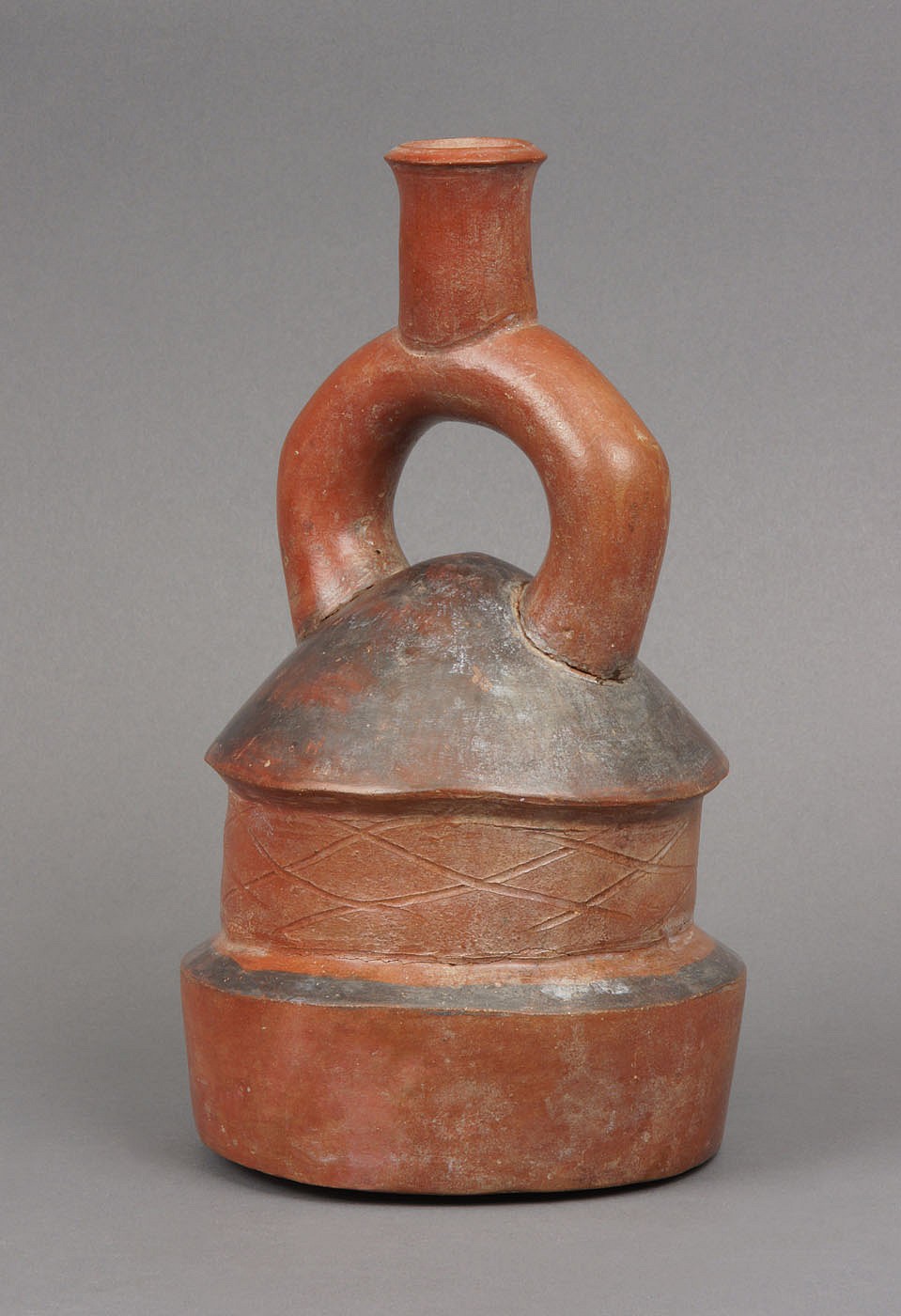
Peru | Chavin Stirrup Spout Vessel | | David Bernstein Pre-Columbian Art. Extensive inventory of Pre-Columbian art from South America, including ancient objects in ceramic, textiles, bronze, copper and gold.
46 / 108

Peru, Chavin Stirrup Spout Vessel

This is an early and characteristic vessel from Cupisnique in the north coast of Peru, including the spiral design and comb texturing. A similar one is illustated in Donnan, "Ceramics of Ancient Peru" (1992: 29).

Period: Peru, Chavin, Cupisnique - North Coast of Peru, 1400-500 BC

Media: Ceramic

Dimensions: Height 9"

Price Upon Request

M5044
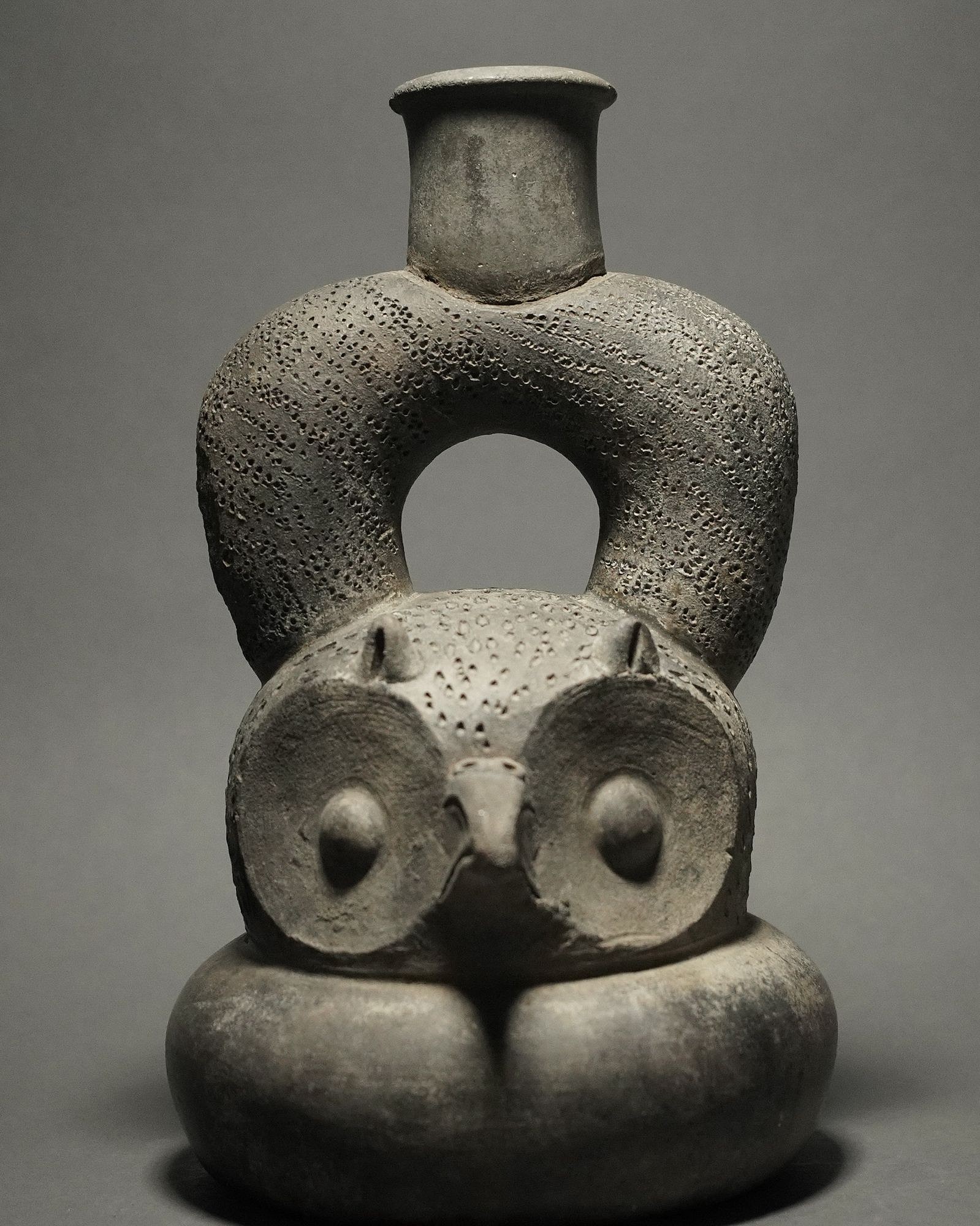
  • View all works
  • PLAY
  • I N Q U I R E
  • Share
  • Print
  • More Works
I N Q U I R E Share Print
Peru, Chavin Stirrup Spout Vessel in the Form of a House
An unusual architectural motif of a round house which could have been a temple or ceremonial center.  Round stone burial towers are found in the early Tiwanaku culture.  This may have been what they were seeing and influenced their designs in Boliva.
Period: Chavin, North Coast Peru, c. 700-400 B.C.
Media: Ceramic
Dimensions: H. 9 in.
$7,500
92082
Peru | Chavin Stirrup Spout Vessel in the Form of a House | | David Bernstein Pre-Columbian Art. Extensive inventory of Pre-Columbian art from South America, including ancient objects in ceramic, textiles, bronze, copper and gold.
47 / 108

Peru, Chavin Stirrup Spout Vessel in the Form of a House

An unusual architectural motif of a round house which could have been a temple or ceremonial center. Round stone burial towers are found in the early Tiwanaku culture. This may have been what they were seeing and influenced their designs in Boliva.

Period: Chavin, North Coast Peru, c. 700-400 B.C.

Media: Ceramic

Dimensions: H. 9 in.

$7,500

92082

  • View all works
  • PLAY
  • I N Q U I R E
  • Share
  • Print
  • More Works
I N Q U I R E Share Print
Peru, Chavin Stirrup Spout Vessel in the Form of an Owl's Head
Owls were revered by Peruvians because of their 180-degree vision, silent flight, and strong claws.  Owls were often seen as magical and it was believed that they could transform into shamans.  A similar vessel is illustrated in CERAMICS OF ANCIENT PERU by Christopher Donnan in plate 33 on page 28.  Ex-collection Dr. Edmund Bourke, Yonkers, NY, prior to 1980s.
Period: Peru, Chavin, Cupisnique, Late Phase, North Coast, c.900 - 200BC
Media: Ceramic
Dimensions: Height: 91/2" x Diameter at base: 5 1/2"
$6,750
p2015
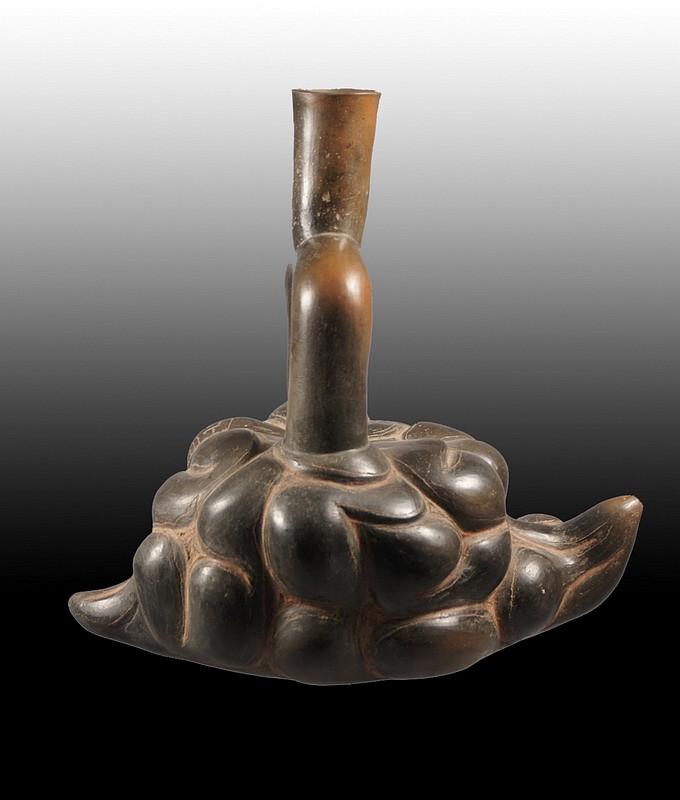
Peru | Chavin Stirrup Spout Vessel in the Form of an Owl's Head | | David Bernstein Pre-Columbian Art. Extensive inventory of Pre-Columbian art from South America, including ancient objects in ceramic, textiles, bronze, copper and gold.
48 / 108

Peru, Chavin Stirrup Spout Vessel in the Form of an Owl's Head

Owls were revered by Peruvians because of their 180-degree vision, silent flight, and strong claws. Owls were often seen as magical and it was believed that they could transform into shamans. A similar vessel is illustrated in CERAMICS OF ANCIENT PERU by Christopher Donnan in plate 33 on page 28. Ex-collection Dr. Edmund Bourke, Yonkers, NY, prior to 1980s.

Period: Peru, Chavin, Cupisnique, Late Phase, North Coast, c.900 - 200BC

Media: Ceramic

Dimensions: Height: 91/2" x Diameter at base: 5 1/2"

$6,750

p2015
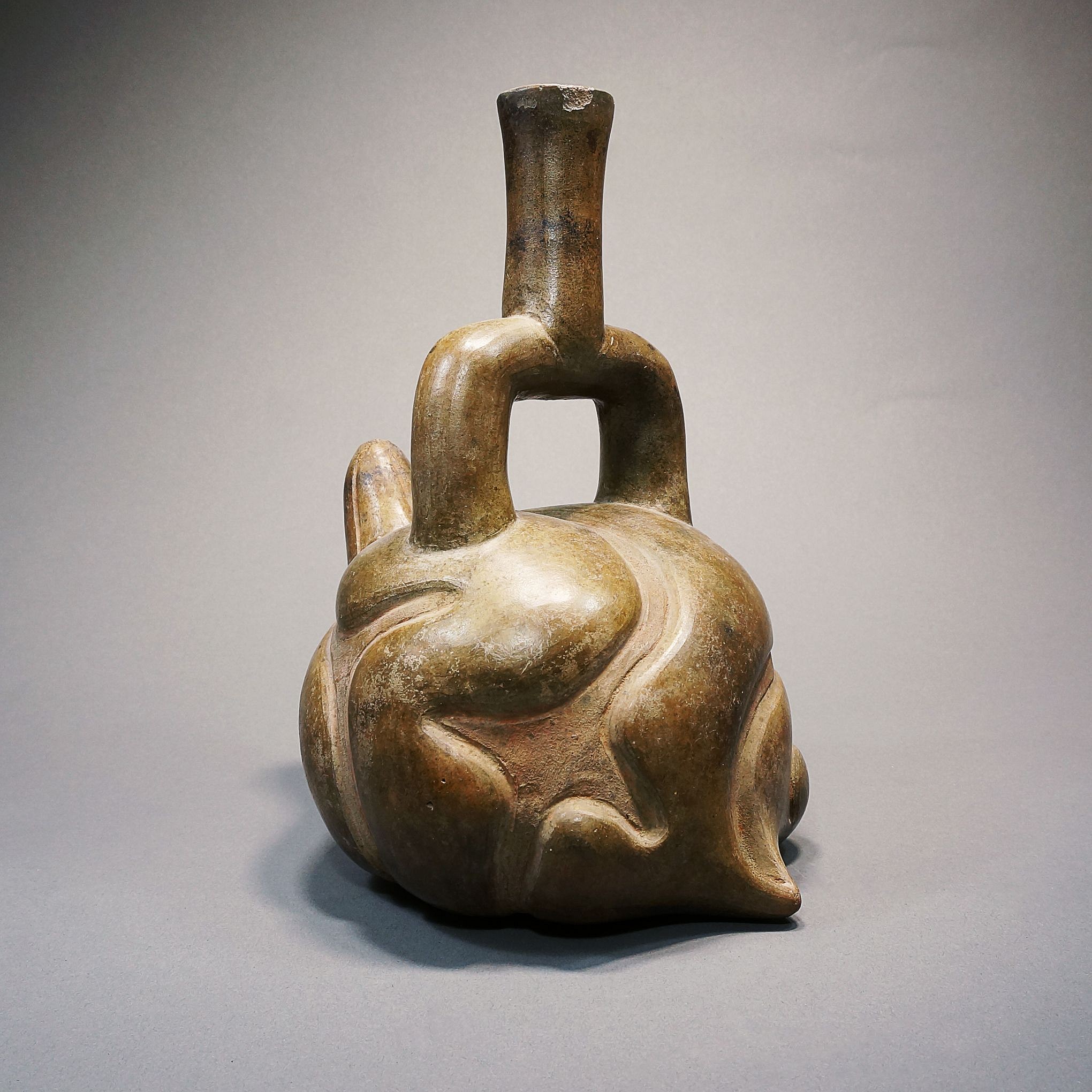
  • View all works
  • PLAY
  • I N Q U I R E
  • Share
  • Print
  • More Works
I N Q U I R E Share Print
Peru, Chavin Stirrup Spout Vessel in the form of the Pijuayo Fruit
This Chavin Stirrup Spout Vessel has been shaped to mimic a ripe branch of Pijuayo (Peach Palm)  fruits. Each individual fruit is red and semi-circular. It was mainly eaten after boiling in salt water for two hours, and has the taste and texture of a chestnut. Ancient Peruvians placed high value on the fruits and vegetables that surrounded them. To express this admiration of the transcendence that the plants in their daily life had, they often made works of art in tribute to them and the gods that made them. Similar fruit inspired vessels to this one are found in "Plantas Alimenticias en el Antiguo Peru" from pages 145 - 160; 1985. The peach palm was especially revered for its hard wood, which was used to carve spears. (The Ethnobotany of Pre-Columbian Peru pg. 28,1961).
Period: Peru, Chavï­n, Cupisnique, Late Phase, North Coast, circa 700-400BC
Media: Ceramic
Dimensions: Length: 10"  Height: 9"
Price Upon Request
n2096
Peru | Chavin Stirrup Spout Vessel in the form of the Pijuayo Fruit | | David Bernstein Pre-Columbian Art. Extensive inventory of Pre-Columbian art from South America, including ancient objects in ceramic, textiles, bronze, copper and gold.
49 / 108

Peru, Chavin Stirrup Spout Vessel in the form of the Pijuayo Fruit

This Chavin Stirrup Spout Vessel has been shaped to mimic a ripe branch of Pijuayo (Peach Palm) fruits. Each individual fruit is red and semi-circular. It was mainly eaten after boiling in salt water for two hours, and has the taste and texture of a chestnut. Ancient Peruvians placed high value on the fruits and vegetables that surrounded them. To express this admiration of the transcendence that the plants in their daily life had, they often made works of art in tribute to them and the gods that made them. Similar fruit inspired vessels to this one are found in "Plantas Alimenticias en el Antiguo Peru" from pages 145 - 160; 1985. The peach palm was especially revered for its hard wood, which was used to carve spears. (The Ethnobotany of Pre-Columbian Peru pg. 28,1961).

Period: Peru, Chavï­n, Cupisnique, Late Phase, North Coast, circa 700-400BC

Media: Ceramic

Dimensions: Length: 10" Height: 9"

Price Upon Request

n2096

  • View all works
  • PLAY
  • I N Q U I R E
  • Share
  • Print
  • More Works
I N Q U I R E Share Print
Peru, Chavin Tembladera Style Stirrup Spout Brownware Vessel in the form of an Abstract Animal
Period: Peru, Chavï­n, Cupisnique, Middle Phase, North Coast, circa 1200-800BC
Media: Ceramic
Dimensions: Height 9 1/4"
$8,500
n2056
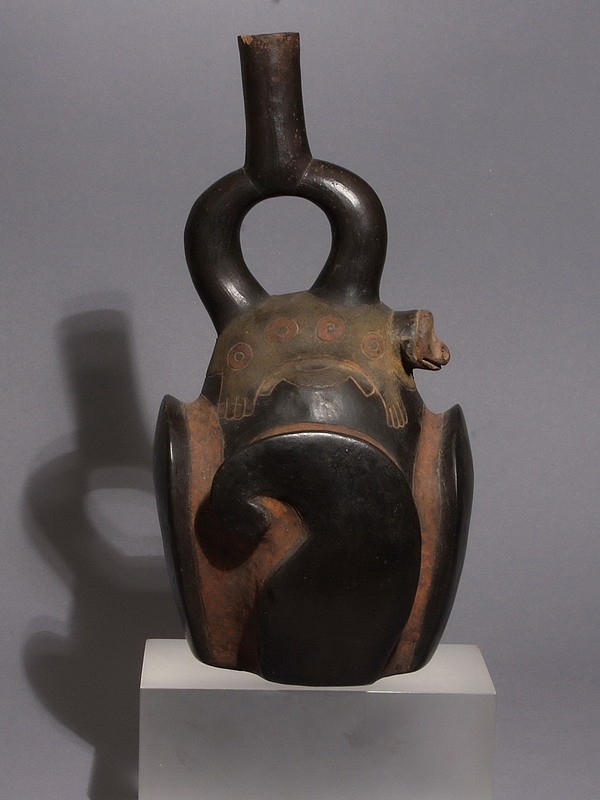
Peru | Chavin Tembladera Style Stirrup Spout Brownware Vessel in the form of an Abstract Animal | | David Bernstein Pre-Columbian Art. Extensive inventory of Pre-Columbian art from South America, including ancient objects in ceramic, textiles, bronze, copper and gold.
50 / 108

Peru, Chavin Tembladera Style Stirrup Spout Brownware Vessel in the form of an Abstract Animal

Period: Peru, Chavï­n, Cupisnique, Middle Phase, North Coast, circa 1200-800BC

Media: Ceramic

Dimensions: Height 9 1/4"

$8,500

n2056
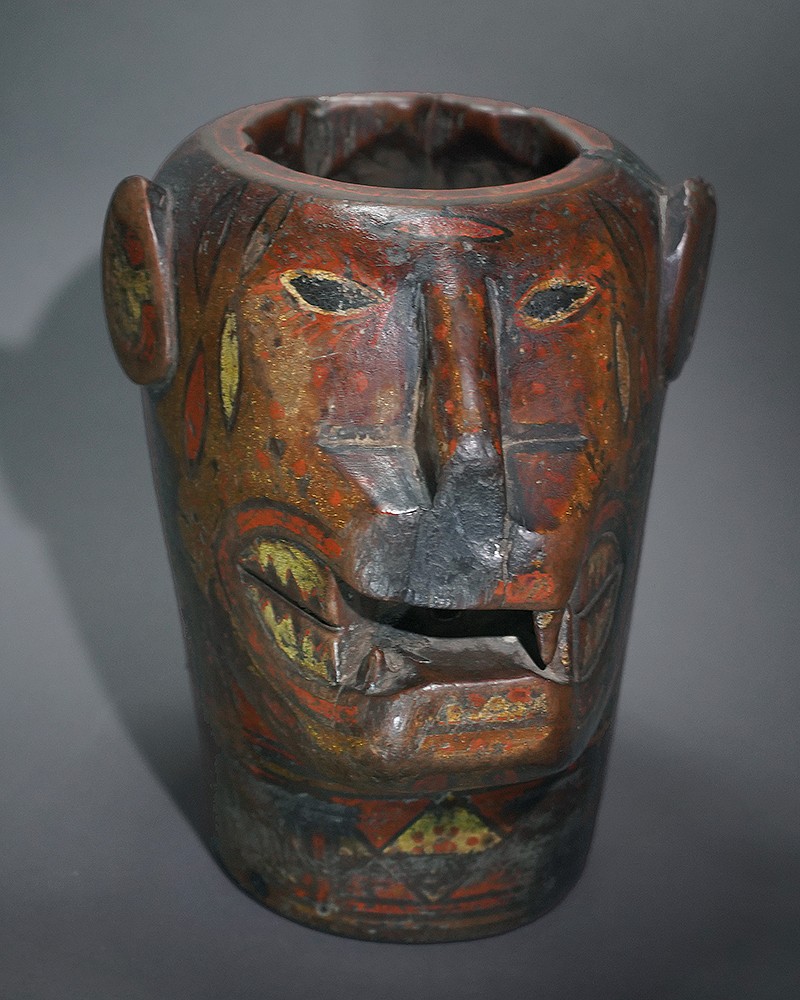
  • View all works
  • PLAY
  • I N Q U I R E
  • Share
  • Print
  • More Works
I N Q U I R E Share Print
Peru, Chavin Tembladera Style Stirrup Spout Vessel Decorated with Sea Lion Deity
The animal appears to a splayed sea lion with flippers.   The animal deity at the top is in a protective posture, as if birthing or protecting its young.   All four sides are decorated with a wave-like element in high relief
Period: Peru, Chavï­n, Cupisnique, Middle Phase, North Coast, circa 1200-800BC
Media: Ceramic
Dimensions: Height 9 1/4"
Price Upon Request
n2055
Peru | Chavin Tembladera Style Stirrup Spout Vessel Decorated with Sea Lion Deity | | David Bernstein Pre-Columbian Art. Extensive inventory of Pre-Columbian art from South America, including ancient objects in ceramic, textiles, bronze, copper and gold.
51 / 108

Peru, Chavin Tembladera Style Stirrup Spout Vessel Decorated with Sea Lion Deity

The animal appears to a splayed sea lion with flippers. The animal deity at the top is in a protective posture, as if birthing or protecting its young. All four sides are decorated with a wave-like element in high relief

Period: Peru, Chavï­n, Cupisnique, Middle Phase, North Coast, circa 1200-800BC

Media: Ceramic

Dimensions: Height 9 1/4"

Price Upon Request

n2055

  • View all works
  • PLAY
  • I N Q U I R E
  • Share
  • Print
  • More Works
I N Q U I R E Share Print
Peru, Colonial Kero in the Form of a Feline Head
Originally the Inca used these carved vessels for ceremonial and festive occasions.  This tradition lasted through the late 18th Century.   Shaped keros were introduced in the Colonial period and their design is limited to 3 specific types of animal motifs: alpaca, llama, feline.  They were also made to resemble Inca lords.   Keros were made in pairs; and the pair to this Kero is at the Yale Peabody Museum and is illustrated in “Machu Picchu: Unveiling the Mystery of the Incas” on p.212.  The vessel may represent an ocelot rather than a jaguar or puma because of the pelage markings, which indicate that it represents a tropical forest feline.  The back of the kero is carved and painted with a scene depicting a battle scene between Inca troops and tropical forest warriors known as the Chunchus - the last group that the Inca conquered.  The waxy colored inlay pigments, known as mopa-mopa, came from Pasto, Colombia and the carved wood is mainly from the Escallonia genus of shrubs and trees.  A similar kero is illustrated in “MACHU PICCHU: Unveiling the Mystery of the Incas,” on pg. 212.  This kero was formerly in the collection of Nelson Rockefeller and was sold at Sotheby's on November 5, 1980, in lot 75.
Period: Peru, Colonial, c. Late 17th Century/Early 18th Century
Media: Wood
Dimensions: Height: 8 3/4"  Widest point on top: 6".
Price Upon Request
n8014
Peru | Colonial Kero in the Form of a Feline Head | | David Bernstein Pre-Columbian Art. Extensive inventory of Pre-Columbian art from South America, including ancient objects in ceramic, textiles, bronze, copper and gold.
52 / 108

Peru, Colonial Kero in the Form of a Feline Head

Originally the Inca used these carved vessels for ceremonial and festive occasions. This tradition lasted through the late 18th Century. Shaped keros were introduced in the Colonial period and their design is limited to 3 specific types of animal motifs: alpaca, llama, feline. They were also made to resemble Inca lords. Keros were made in pairs; and the pair to this Kero is at the Yale Peabody Museum and is illustrated in “Machu Picchu: Unveiling the Mystery of the Incas” on p.212. The vessel may represent an ocelot rather than a jaguar or puma because of the pelage markings, which indicate that it represents a tropical forest feline. The back of the kero is carved and painted with a scene depicting a battle scene between Inca troops and tropical forest warriors known as the Chunchus - the last group that the Inca conquered. The waxy colored inlay pigments, known as mopa-mopa, came from Pasto, Colombia and the carved wood is mainly from the Escallonia genus of shrubs and trees. A similar kero is illustrated in “MACHU PICCHU: Unveiling the Mystery of the Incas,” on pg. 212. This kero was formerly in the collection of Nelson Rockefeller and was sold at Sotheby's on November 5, 1980, in lot 75.

Period: Peru, Colonial, c. Late 17th Century/Early 18th Century

Media: Wood

Dimensions: Height: 8 3/4" Widest point on top: 6".

Price Upon Request

n8014

  • View all works
  • PLAY
  • I N Q U I R E
  • Share
  • Print
  • More Works
I N Q U I R E Share Print
Peru, Colonial Qero with floral motifs in registers
Decorated in five registers with flowers, the pair to this vessel is in the Museo Inka, Universadid Nacional del Cuzco and illustrated in Ochoa et. al. "Qeros: Arte Inka en vasos ceremoniales" (1998: 267). Some were made in pairs, particularly in the Colonial period. Qeros were festive drinking cups that Inca rulers, governors and other state officials used in ceremonies, and they were often gifted from one lord to another. Hans Monheim collection - Aachen Germany  since 1950's.
Period: Peru, Inca, Colonial Period, circa AD1600-1800
Media: Wood
Dimensions: Height  6 1/2: x Width: 5 " across the top
Price Upon Request
M4044
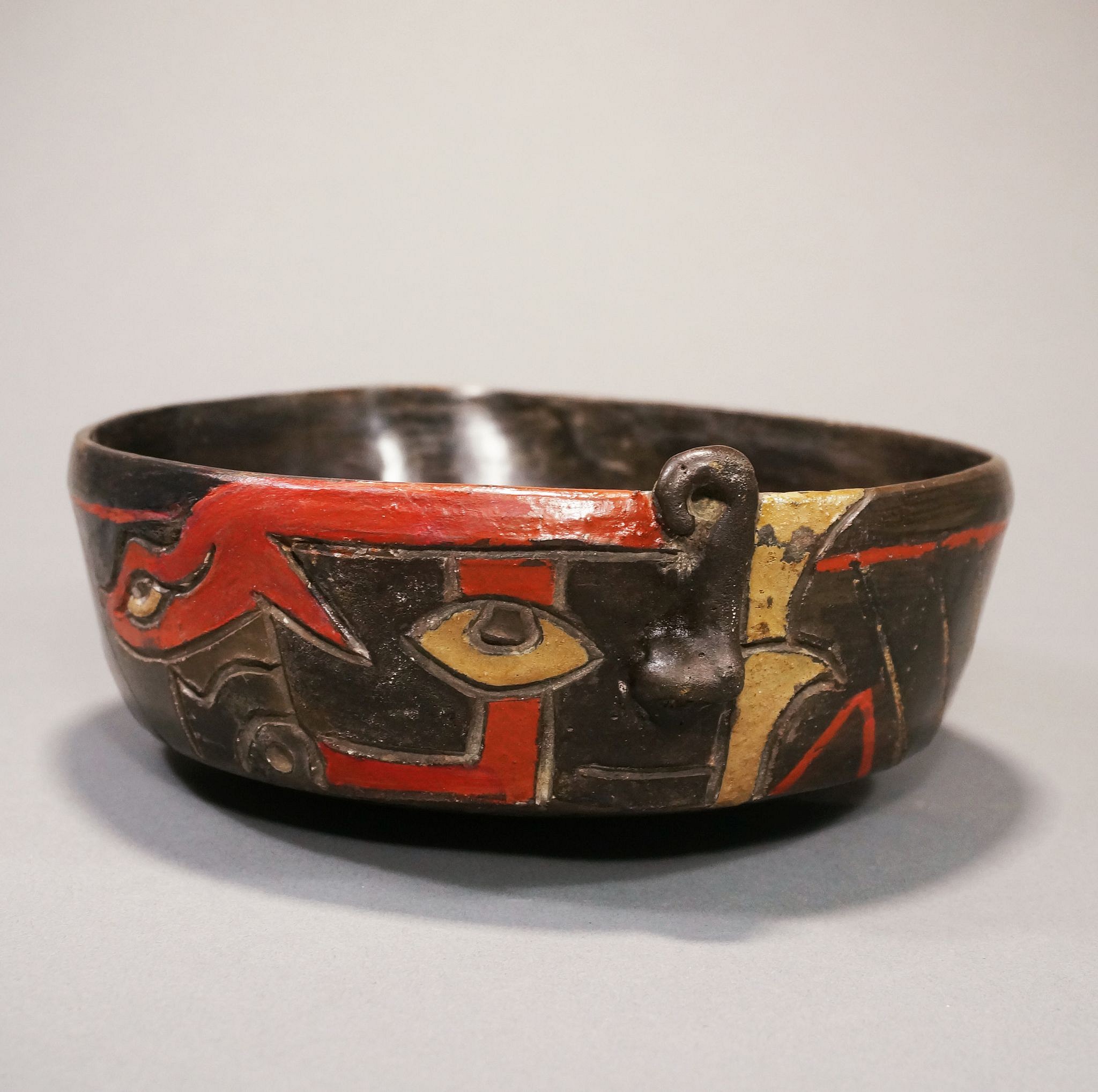
Peru | Colonial Qero with floral motifs in registers | | David Bernstein Pre-Columbian Art. Extensive inventory of Pre-Columbian art from South America, including ancient objects in ceramic, textiles, bronze, copper and gold.
53 / 108

Peru, Colonial Qero with floral motifs in registers

Decorated in five registers with flowers, the pair to this vessel is in the Museo Inka, Universadid Nacional del Cuzco and illustrated in Ochoa et. al. "Qeros: Arte Inka en vasos ceremoniales" (1998: 267). Some were made in pairs, particularly in the Colonial period. Qeros were festive drinking cups that Inca rulers, governors and other state officials used in ceremonies, and they were often gifted from one lord to another. Hans Monheim collection - Aachen Germany since 1950's.

Period: Peru, Inca, Colonial Period, circa AD1600-1800

Media: Wood

Dimensions: Height 6 1/2: x Width: 5 " across the top

Price Upon Request

M4044
  • View all works
  • PLAY
  • I N Q U I R E
  • Share
  • Print
  • More Works
I N Q U I R E Share Print
Peru, Early Chavin/Paracas Bowl with Transforming Cubist Face
This bowl demonstrates a human face with a distinct eye looking outward, transforming into the face of a feline entity.  The red serpent above the eye suggests the presence of a supernatural demon or perhaps a knowledgeable serpent spirit guide offering wisdom.  The incised designs are painted with polychrome resin pigments and has an extended lip on the rear upper edge, which was used to pour ritual libations - perhaps Ayahuasca or a similar psychedelic brew containing DMT from entheogenic plants found in the region.  This bowl is also an excellent example of the geometric abstract style with bold blocks of color favored by the Paracas.  It shares stylistic traits with the modern Surrealist and Cubist movements, featuring a morphing of narrative portraiture and purely abstract form.  Ancient art objects with abstract and surrealist qualities were highly sought after by sophisticated collectors with excellent taste during the mid-20th Century.  These collectors would combine ancient and modern artworks together, forming a unified gestalt aesthetic.  Abstraction is quite rare among pre-modern societies, and one hypothesis as to why the Andeans had such a sophisticated understanding of abstract form and color is the entheogen theory.  In his 2005 paper Psychoactive botanicals in ritual, religion and shamanism, Glenn H. Shepard discusses how Chavin de Huantar, the main Chavin temple, was located near a geologic unstable valley region in the Andes with a wealth of natural plant entheogens where two rivers merge.  The Chavin people believed that the spirit could transcend the body and fuse with the spirit of the jaguar, a belief that was likely facilitated by entheogen use.  This animistic belief system affected all subsequent Andean cultures, including the Paracas, whose would continue this belief.  This bowl depicts a human face with a distinct eye, transforming into a jaguar spirit with a bright red serpent framing the eye.  The red serpent suggests the presence of a sentient serpent demon or perhaps a knowledgeable spirit guide offering wisdom.  
A very similar vessel is in the Oscar Landmann collection #119, Sao Paulo, Brazil. Ex-Collection Anton Roeckl, Germany.
Note: The bowl was painted within the incised designs with post-fired polychrome resin pigments and finished after firing with a second firing to melt the resin creating a glossy finish.  This tradition began with the Chavin cult, a psychedelic cult that engaged in ritualistic jaguar worship. Using psychedelics, one could transcend the body and become the spirit of the feline.  The Chavin influenced all subsequent Pre-Columbian cultures, including the Paracas, who would continue this belief.  This bowl demonstrates a human face with a distinct eye looking outward, transforming into the face of a feline entity.  The red serpent above the eye suggests the presents of a supernatural demon or perhaps a knowledgeable serpent spirit guide offering wisdom to the transforming shaman.  This design demonstrates an animist belief in an interconnected network of souls and spirits. Period: Peru, Paracas, Ocucaje, c. 500 BC -  AD 100 
Period: Peru, Paracas, Ocucaje, c. 500BC - 100AD BC
Media: Ceramic
Dimensions: Height: 2 1/2" x Diameter: 7"
$22,500
M7134
Peru | Early Chavin/Paracas Bowl with Transforming Cubist Face | | David Bernstein Pre-Columbian Art. Extensive inventory of Pre-Columbian art from South America, including ancient objects in ceramic, textiles, bronze, copper and gold.
54 / 108

Peru, Early Chavin/Paracas Bowl with Transforming Cubist Face

This bowl demonstrates a human face with a distinct eye looking outward, transforming into the face of a feline entity. The red serpent above the eye suggests the presence of a supernatural demon or perhaps a knowledgeable serpent spirit guide offering wisdom. The incised designs are painted with polychrome resin pigments and has an extended lip on the rear upper edge, which was used to pour ritual libations - perhaps Ayahuasca or a similar psychedelic brew containing DMT from entheogenic plants found in the region. This bowl is also an excellent example of the geometric abstract style with bold blocks of color favored by the Paracas. It shares stylistic traits with the modern Surrealist and Cubist movements, featuring a morphing of narrative portraiture and purely abstract form. Ancient art objects with abstract and surrealist qualities were highly sought after by sophisticated collectors with excellent taste during the mid-20th Century. These collectors would combine ancient and modern artworks together, forming a unified gestalt aesthetic. Abstraction is quite rare among pre-modern societies, and one hypothesis as to why the Andeans had such a sophisticated understanding of abstract form and color is the entheogen theory. In his 2005 paper Psychoactive botanicals in ritual, religion and shamanism, Glenn H. Shepard discusses how Chavin de Huantar, the main Chavin temple, was located near a geologic unstable valley region in the Andes with a wealth of natural plant entheogens where two rivers merge. The Chavin people believed that the spirit could transcend the body and fuse with the spirit of the jaguar, a belief that was likely facilitated by entheogen use. This animistic belief system affected all subsequent Andean cultures, including the Paracas, whose would continue this belief. This bowl depicts a human face with a distinct eye, transforming into a jaguar spirit with a bright red serpent framing the eye. The red serpent suggests the presence of a sentient serpent demon or perhaps a knowledgeable spirit guide offering wisdom. A very similar vessel is in the Oscar Landmann collection #119, Sao Paulo, Brazil. Ex-Collection Anton Roeckl, Germany. Note: The bowl was painted within the incised designs with post-fired polychrome resin pigments and finished after firing with a second firing to melt the resin creating a glossy finish. This tradition began with the Chavin cult, a psychedelic cult that engaged in ritualistic jaguar worship. Using psychedelics, one could transcend the body and become the spirit of the feline. The Chavin influenced all subsequent Pre-Columbian cultures, including the Paracas, who would continue this belief. This bowl demonstrates a human face with a distinct eye looking outward, transforming into the face of a feline entity. The red serpent above the eye suggests the presents of a supernatural demon or perhaps a knowledgeable serpent spirit guide offering wisdom to the transforming shaman. This design demonstrates an animist belief in an interconnected network of souls and spirits.

Period: Peru, Paracas, Ocucaje, c. 500 BC - AD 100

Period: Peru, Paracas, Ocucaje, c. 500BC - 100AD BC

Media: Ceramic

Dimensions: Height: 2 1/2" x Diameter: 7"

$22,500

M7134

  • View all works
  • PLAY
  • I N Q U I R E
  • Share
  • Print
  • More Works
I N Q U I R E Share Print
Peru, Early Middle Horizon Mother of Pearl Round Ear Spool Front with 13 Petals
This is a very large piece for a mother of pearl carving and must have come from a very large shell.  The 13 petal incised design does not represent a specific flower, but instead is an abstract form depicting a floral shape.  The center hole with incised ring is typical of Late Chavin/Early Moche iconography.
Period: Peru, Chavin, Late phase, North Coast, c. 600 - 400 BC
Media: Shell
Dimensions: Diameter: 2"
Price Upon Request
m7118
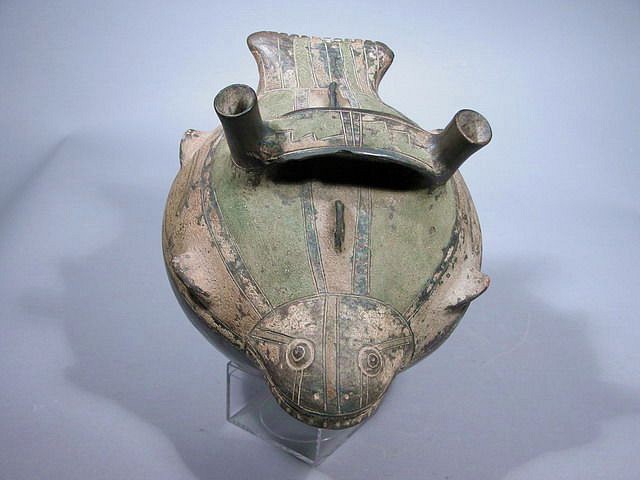
Peru | Early Middle Horizon Mother of Pearl Round Ear Spool Front with 13 Petals | | David Bernstein Pre-Columbian Art. Extensive inventory of Pre-Columbian art from South America, including ancient objects in ceramic, textiles, bronze, copper and gold.
55 / 108

Peru, Early Middle Horizon Mother of Pearl Round Ear Spool Front with 13 Petals

This is a very large piece for a mother of pearl carving and must have come from a very large shell. The 13 petal incised design does not represent a specific flower, but instead is an abstract form depicting a floral shape. The center hole with incised ring is typical of Late Chavin/Early Moche iconography.

Period: Peru, Chavin, Late phase, North Coast, c. 600 - 400 BC

Media: Shell

Dimensions: Diameter: 2"

Price Upon Request

m7118
  • View all works
  • PLAY
  • I N Q U I R E
  • Share
  • Print
  • More Works
I N Q U I R E Share Print
Peru, Effigy Vessel of a Patagonian Toothfish with Resin Pigment
This bridge-spout vessel depicts a toothfish decorated with longitudinal bands of buff and green pigment.  The protruding head and fins resemble the Patagonian toothfish, popularly known as the Chilean sea bass.  These fish were caught with a hook and line in ancient Pre-Columbia and are still caught this way in modern times.  The Patagoninan toothfish, (Dissostichus eleginoides) has a long life span and is thought to live up to 50 years.  The average toothfish weighs between 15 and 20 pounds, however they can grow as large as 220 pounds. The flaring spouts indicate that the ceramic was crafted in the Paracas Necropolis style, as opposed to the more common Cavernas style, which features blind bridge spouts.  The harmonic balance between naturalism and abstraction is a unique stylistic trait in Andean art that attracted cubist and minimalist artists such as Pablo Picasso and Henry Moore to ancient Andean art.  These famous artists were intrigued by Andean art and wanted to replicate this method of combining abstract forms and narrative imagery in their own paintings and sculpture.  Alan Sawyer discusses the Necropolis style in his book Ancient Peruvian Ceramics: The Nathan Cummings collection on pages 96-97, fig. 135-138.   The only other known Paracas toothfish vessel is in the Museum of the University Agraria, Lima, Peru.  Acquired from the estate of British collector. London, prior to 1996. Period: Peru, Paracas, South Coast, c. 500 - 200 BC
Period: Peru, Paracas, South Coast, c. 500 - 200 BC
Media: Ceramic
Dimensions: Height: 6 1/2" (14.2 cm.)  X  Length: 8" (18 cm.)
$35,000
96044
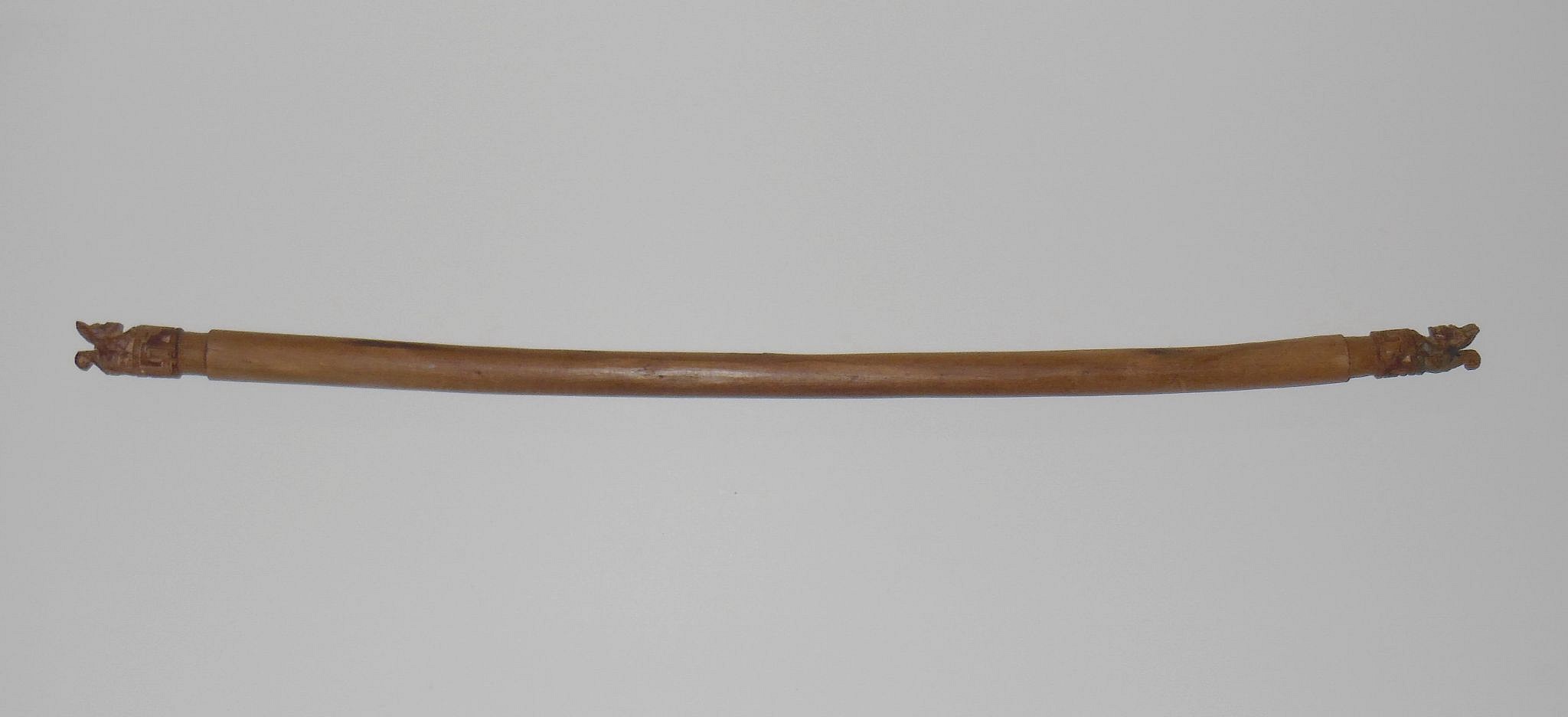
Peru | Effigy Vessel of a Patagonian Toothfish with Resin Pigment | | David Bernstein Pre-Columbian Art. Extensive inventory of Pre-Columbian art from South America, including ancient objects in ceramic, textiles, bronze, copper and gold.
56 / 108

Peru, Effigy Vessel of a Patagonian Toothfish with Resin Pigment

This bridge-spout vessel depicts a toothfish decorated with longitudinal bands of buff and green pigment. The protruding head and fins resemble the Patagonian toothfish, popularly known as the Chilean sea bass. These fish were caught with a hook and line in ancient Pre-Columbia and are still caught this way in modern times. The Patagoninan toothfish, (Dissostichus eleginoides) has a long life span and is thought to live up to 50 years. The average toothfish weighs between 15 and 20 pounds, however they can grow as large as 220 pounds. The flaring spouts indicate that the ceramic was crafted in the Paracas Necropolis style, as opposed to the more common Cavernas style, which features blind bridge spouts. The harmonic balance between naturalism and abstraction is a unique stylistic trait in Andean art that attracted cubist and minimalist artists such as Pablo Picasso and Henry Moore to ancient Andean art. These famous artists were intrigued by Andean art and wanted to replicate this method of combining abstract forms and narrative imagery in their own paintings and sculpture. Alan Sawyer discusses the Necropolis style in his book Ancient Peruvian Ceramics: The Nathan Cummings collection on pages 96-97, fig. 135-138. The only other known Paracas toothfish vessel is in the Museum of the University Agraria, Lima, Peru. Acquired from the estate of British collector. London, prior to 1996.

Period: Peru, Paracas, South Coast, c. 500 - 200 BC

Period: Peru, Paracas, South Coast, c. 500 - 200 BC

Media: Ceramic

Dimensions: Height: 6 1/2" (14.2 cm.) X Length: 8" (18 cm.)

$35,000

96044
  • View all works
  • PLAY
  • I N Q U I R E
  • Share
  • Print
  • More Works
I N Q U I R E Share Print
Peru, Huacho Carved Loom Bar with “Mooneater” Deities
This loom bar was once part of a backstrap loom - the most common loom type in the ancient Andes, dating back to the late Chavin Period. Andean backstrap looms are usually 22-28” in width.  It would have been one of two bars needed to hold the warps together to the upper bar.  This bar is elaborately decorated with an intricately carved “Mooneater” deity at each end.
Period: Peru, Huacho Valley, Late Intermediate Period, c. AD 700 - 1100
Media: Wood
Dimensions: Width: 24" x Diameter: 1/2"
$1,700
p2032H
Peru | Huacho Carved Loom Bar with “Mooneater” Deities | | David Bernstein Pre-Columbian Art. Extensive inventory of Pre-Columbian art from South America, including ancient objects in ceramic, textiles, bronze, copper and gold.
57 / 108

Peru, Huacho Carved Loom Bar with “Mooneater” Deities

This loom bar was once part of a backstrap loom - the most common loom type in the ancient Andes, dating back to the late Chavin Period. Andean backstrap looms are usually 22-28” in width. It would have been one of two bars needed to hold the warps together to the upper bar. This bar is elaborately decorated with an intricately carved “Mooneater” deity at each end.

Period: Peru, Huacho Valley, Late Intermediate Period, c. AD 700 - 1100

Media: Wood

Dimensions: Width: 24" x Diameter: 1/2"

$1,700

p2032H

  • View all works
  • PLAY
  • I N Q U I R E
  • Share
  • Print
  • More Works
I N Q U I R E Share Print
Peru, Inca Silver Bowl
An unusually high walled dish with flared edges, hammered from a single ingot of silver. It was repeatedly annealed and hammered to create a well-proportioned vessel.
Period: Peru, Inca, North Coast, c. AD 1350 - 500
Media: Metal
Dimensions: Diameter of bowl: 5 1/4 in., Height of flask:
$1,200
89400
Peru | Inca Silver Bowl | | David Bernstein Pre-Columbian Art. Extensive inventory of Pre-Columbian art from South America, including ancient objects in ceramic, textiles, bronze, copper and gold.
58 / 108

Peru, Inca Silver Bowl

An unusually high walled dish with flared edges, hammered from a single ingot of silver. It was repeatedly annealed and hammered to create a well-proportioned vessel.

Period: Peru, Inca, North Coast, c. AD 1350 - 500

Media: Metal

Dimensions: Diameter of bowl: 5 1/4 in., Height of flask:

$1,200

89400

  • View all works
  • PLAY
  • I N Q U I R E
  • Share
  • Print
  • More Works
I N Q U I R E Share Print
Peru, Lambayeque Whistling Vessel with Bat Atop Pacay Fruit
This ceramic bridge-spout whistling effigy vessel was crafted in the shape of fruit bat resting atop a Pacay.  The Pacay fruit, found in the Amazon, is related to mangoes and guavas.  Fruit bats have an extremely good sense of smell and sharp teeth with which to open the tough skins of fruits.  The whistle built into the vessel, customary for Lambayeque vessels, is seen just behind the bat.  Bats are a rare motif and quite meaningful in ancient Andean mythology as they are associated with transport to other worlds.  The vessel was painted with orange slip and black octopus ink on a buff ceramic ground.  There are only two other known Lambayeque vessels with sculptures of bats, one is illustrated in "Ceramics of Ancient Peru" by Christopher Donnan, 1992, p.89, and the other is the property of The American Museum of Natural History.
Period: Peru, Sican, c. AD 800 - 1100
Media: Ceramic
Dimensions: Height 8" x Length 6 1/2"
Price Upon Request
mm145
Peru | Lambayeque Whistling Vessel with Bat Atop Pacay Fruit | | David Bernstein Pre-Columbian Art. Extensive inventory of Pre-Columbian art from South America, including ancient objects in ceramic, textiles, bronze, copper and gold.
59 / 108

Peru, Lambayeque Whistling Vessel with Bat Atop Pacay Fruit

This ceramic bridge-spout whistling effigy vessel was crafted in the shape of fruit bat resting atop a Pacay. The Pacay fruit, found in the Amazon, is related to mangoes and guavas. Fruit bats have an extremely good sense of smell and sharp teeth with which to open the tough skins of fruits. The whistle built into the vessel, customary for Lambayeque vessels, is seen just behind the bat. Bats are a rare motif and quite meaningful in ancient Andean mythology as they are associated with transport to other worlds. The vessel was painted with orange slip and black octopus ink on a buff ceramic ground. There are only two other known Lambayeque vessels with sculptures of bats, one is illustrated in "Ceramics of Ancient Peru" by Christopher Donnan, 1992, p.89, and the other is the property of The American Museum of Natural History.

Period: Peru, Sican, c. AD 800 - 1100

Media: Ceramic

Dimensions: Height 8" x Length 6 1/2"

Price Upon Request

mm145

  • View all works
  • PLAY
  • I N Q U I R E
  • Share
  • Print
  • More Works
I N Q U I R E Share Print
Peru, Late Chavin Hammered and Soldered Gold  pendant with a Feline Head
This is a rare Chavin gold work that has been soldered - the ears to the head and the head to the body.  There are two sets of suspension holes on each side of the mouth.  There are two more suspension holes for danglers by each paw.  There is repousse depicting the mouth and nose and on each paw. Estate of Bill Simmons, acquired at Sotheby's Sale # 7996, May 2004, lot 107.
Period: Africa, Cameroon
Media: Metal
Dimensions: Height:  7cm x Width: 8.3cm  Wt. 24.3 grams.XRF  Au 85%, Ag 13.3%, Cu 1.08%.
Price Upon Request
n8011
Peru | Late Chavin Hammered and Soldered Gold pendant with a Feline Head | | David Bernstein Pre-Columbian Art. Extensive inventory of Pre-Columbian art from South America, including ancient objects in ceramic, textiles, bronze, copper and gold.
60 / 108

Peru, Late Chavin Hammered and Soldered Gold pendant with a Feline Head

This is a rare Chavin gold work that has been soldered - the ears to the head and the head to the body. There are two sets of suspension holes on each side of the mouth. There are two more suspension holes for danglers by each paw. There is repousse depicting the mouth and nose and on each paw. Estate of Bill Simmons, acquired at Sotheby's Sale # 7996, May 2004, lot 107.

Period: Africa, Cameroon

Media: Metal

Dimensions: Height: 7cm x Width: 8.3cm Wt. 24.3 grams.
XRF Au 85%, Ag 13.3%, Cu 1.08%.

Price Upon Request

n8011
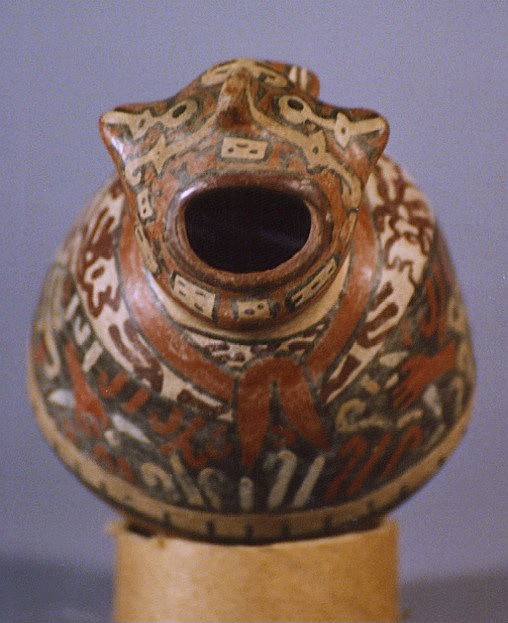
  • View all works
  • PLAY
  • I N Q U I R E
  • Share
  • Print
  • More Works
I N Q U I R E Share Print
Peru, Late Nazca Ceramic Vessel in the form of a Howling Man
A very delicately modeled and painted miniature vessel of a howling man.  The face can be read upside-down as well.  Seen from right-side up, the figure appears to be wearing a tunic and cape decorated with abstract heads.  From upside-down the tunic turns into a scarf, and the cape becomes the tunic.  The face also changes according to the direction the object is seen from.  The howling image is associated with decapitation and the trophy head ritual.
Period: Peru, Late Nasca drainage, South Coast, c. AD 600 - 800
Media: Ceramic
Dimensions: Height: 4 1/4"
Price Upon Request
92037
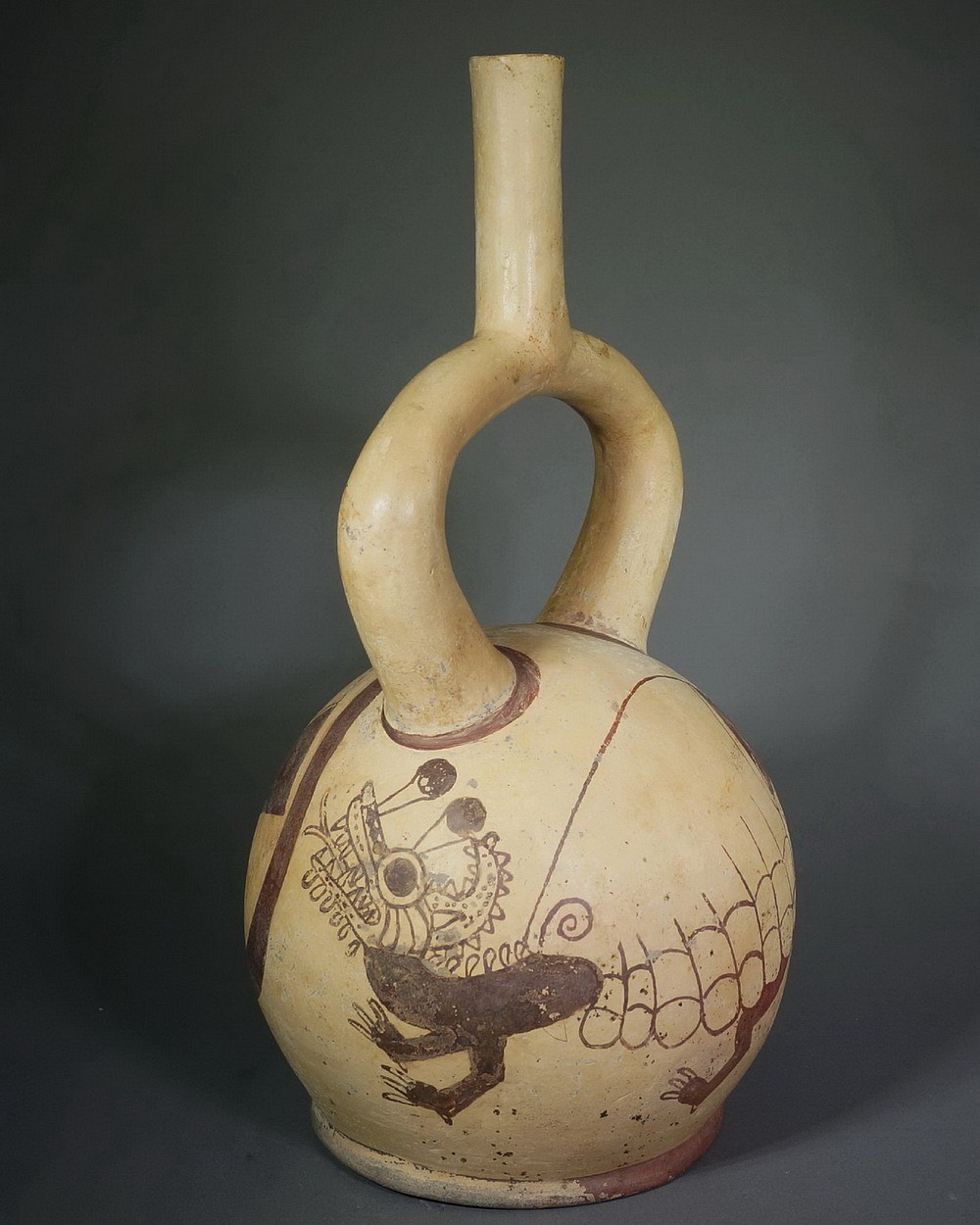
Peru | Late Nazca Ceramic Vessel in the form of a Howling Man | | David Bernstein Pre-Columbian Art. Extensive inventory of Pre-Columbian art from South America, including ancient objects in ceramic, textiles, bronze, copper and gold.
61 / 108

Peru, Late Nazca Ceramic Vessel in the form of a Howling Man

A very delicately modeled and painted miniature vessel of a howling man. The face can be read upside-down as well. Seen from right-side up, the figure appears to be wearing a tunic and cape decorated with abstract heads. From upside-down the tunic turns into a scarf, and the cape becomes the tunic. The face also changes according to the direction the object is seen from. The howling image is associated with decapitation and the trophy head ritual.

Period: Peru, Late Nasca drainage, South Coast, c. AD 600 - 800

Media: Ceramic

Dimensions: Height: 4 1/4"

Price Upon Request

92037
  • View all works
  • PLAY
  • I N Q U I R E
  • Share
  • Print
  • More Works
I N Q U I R E Share Print
Peru, Moche 4 Stirrup Spout Vessel painted with a Strombus Monster
The vessel is finely drawn with reddish brown slip on a cream ground and depicts a Strombus galeatus monster coming out of its shell on both sides.  The monster has a long curving tail and an exposed a front leg.  Christopher Donnan describes this monster in MOCHE ART OF PERU, pg. 64.  From the estate of Philip L. Herman prior to 1970.
Period: Peru, Moche IV/V, North Coast, c. AD 400 - 700
Media: Ceramic
Dimensions: Height: 12 1/4"
$6,500
n6048
Peru | Moche 4 Stirrup Spout Vessel painted with a Strombus Monster | | David Bernstein Pre-Columbian Art. Extensive inventory of Pre-Columbian art from South America, including ancient objects in ceramic, textiles, bronze, copper and gold.
62 / 108

Peru, Moche 4 Stirrup Spout Vessel painted with a Strombus Monster

The vessel is finely drawn with reddish brown slip on a cream ground and depicts a Strombus galeatus monster coming out of its shell on both sides. The monster has a long curving tail and an exposed a front leg. Christopher Donnan describes this monster in MOCHE ART OF PERU, pg. 64. From the estate of Philip L. Herman prior to 1970.

Period: Peru, Moche IV/V, North Coast, c. AD 400 - 700

Media: Ceramic

Dimensions: Height: 12 1/4"

$6,500

n6048

  • View all works
  • PLAY
  • I N Q U I R E
  • Share
  • Print
  • More Works
I N Q U I R E Share Print
Peru, Moche Ceramic Section to a Portrait Vessel
The portrait masks of the represents the same individual that is illustrated in MOCHE PORTRAITS OF ANCIENT PERU by Christopher Donnan on page 92.  The published version has the exact same facial features, but is older in age.  The Moche are known to have made portraits of the same person throughout different life stages. Ex. collection of Mark Moore, by descent from his father Lee Moore.  Prior to 1970.
Period: Peru, Moche IV, Huaca La Luna, North Coast, c. AD 300 - 450
Media: Ceramic
Dimensions: Height: 5 1/2" x Width: 7 1/4"
Price Upon Request
p2045
Peru | Moche Ceramic Section to a Portrait Vessel | | David Bernstein Pre-Columbian Art. Extensive inventory of Pre-Columbian art from South America, including ancient objects in ceramic, textiles, bronze, copper and gold.
63 / 108

Peru, Moche Ceramic Section to a Portrait Vessel

The portrait masks of the represents the same individual that is illustrated in MOCHE PORTRAITS OF ANCIENT PERU by Christopher Donnan on page 92. The published version has the exact same facial features, but is older in age. The Moche are known to have made portraits of the same person throughout different life stages. Ex. collection of Mark Moore, by descent from his father Lee Moore. Prior to 1970.

Period: Peru, Moche IV, Huaca La Luna, North Coast, c. AD 300 - 450

Media: Ceramic

Dimensions: Height: 5 1/2" x Width: 7 1/4"

Price Upon Request

p2045
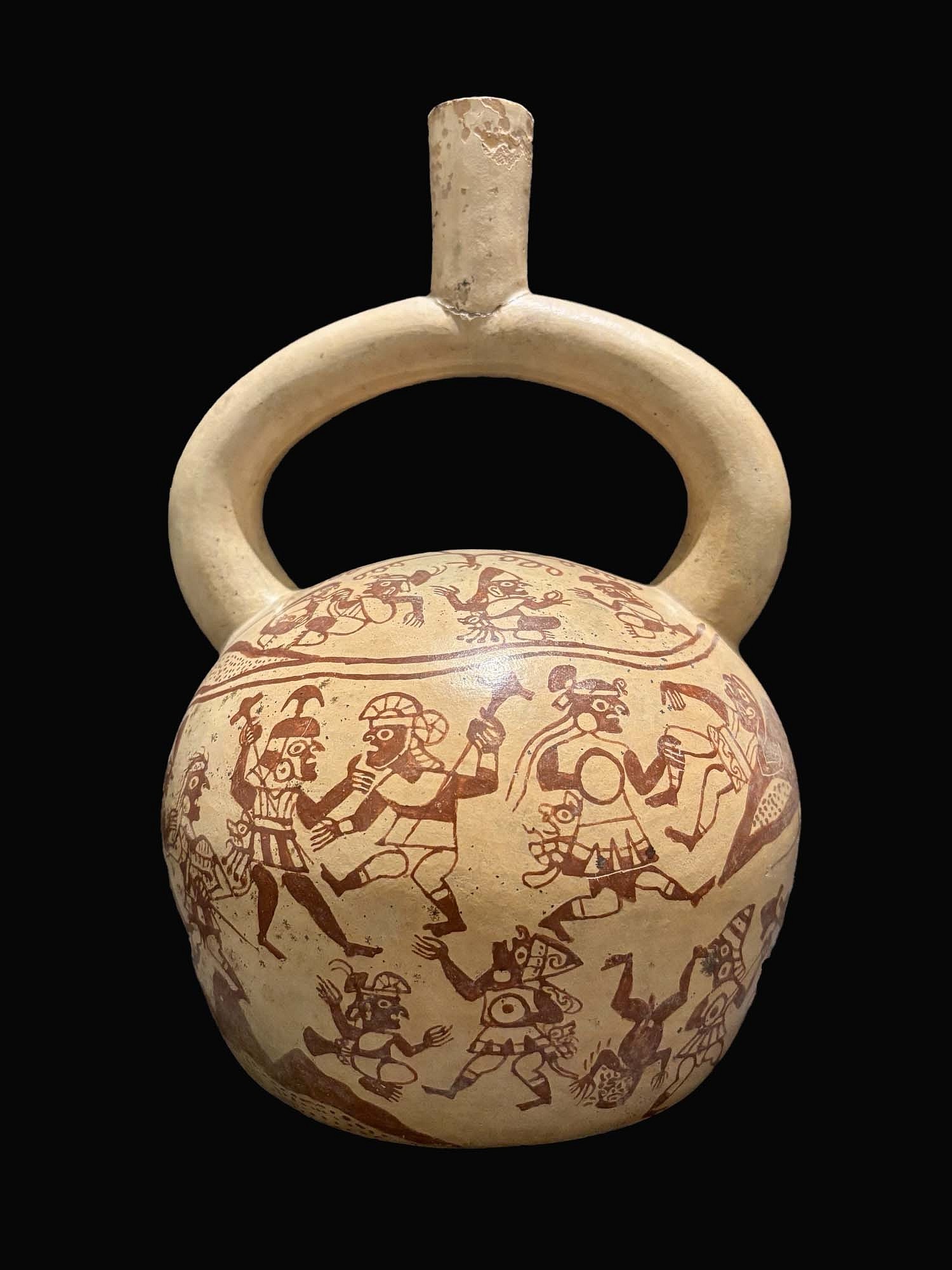
  • View all works
  • PLAY
  • I N Q U I R E
  • Share
  • Print
  • More Works
I N Q U I R E Share Print
Peru, Moche Copper Hand
This hand was hammered and raised over a wooden model. It is a clenched fist with fingernails to the palm. The right hand belonged to a set of separate pieces, including face mask, torso, feet and hands that were sewn onto a cloth banner and placed over the deceased, such as found in a tomb at Sipán (Alva and Donnan 1993: 65-66). The authors also illustrate a Moche vessel with two figures holding banners. A similar set of face mask, feet and hands is illustrated in Carcedo de Mufarech (1999: fig. 39).  
Period: Peru, Moche, Loma Negra, North Coast, c. AD 100 - 400
Media: Metal
Dimensions: Height: 12.5 cm; Width: 9.7 cm
$1,500
97107 B
Peru | Moche Copper Hand | | David Bernstein Pre-Columbian Art. Extensive inventory of Pre-Columbian art from South America, including ancient objects in ceramic, textiles, bronze, copper and gold.
64 / 108

Peru, Moche Copper Hand

This hand was hammered and raised over a wooden model. It is a clenched fist with fingernails to the palm. The right hand belonged to a set of separate pieces, including face mask, torso, feet and hands that were sewn onto a cloth banner and placed over the deceased, such as found in a tomb at Sipán (Alva and Donnan 1993: 65-66). The authors also illustrate a Moche vessel with two figures holding banners. A similar set of face mask, feet and hands is illustrated in Carcedo de Mufarech (1999: fig. 39).

Period: Peru, Moche, Loma Negra, North Coast, c. AD 100 - 400

Media: Metal

Dimensions: Height: 12.5 cm; Width: 9.7 cm

$1,500

97107 B

  • View all works
  • PLAY
  • I N Q U I R E
  • Share
  • Print
  • More Works
I N Q U I R E Share Print
Peru, Moche Fineline Painted Vessel with Warriors and Prisoner
This ceramic vessel features an exquisite example of Moche fineline painting, which reached its technical height towards the end of the ceramic sequence, during the Moche III and IV Phases). It depicts a complicated scene of male warriors dressed in traditional Moche warrior dress, conducting a symbolic ritual in which a captured prisoner is held upside-down and displayed as a war trophy.  The artist employed a new technique of incising around the edges of some of the painted imagery. Exhibited at the Guggenheim’s 1968 show Mastercrafstmen of Ancient Peru and illustrated in the corresponding catalog, on page 56.  Also illustrated in Pre-Columbian Art of South America by Alan Lapiner, on page 135. Also published in Christopher Donnan’s Moche Fineline Painting: Its Evolution and Its Artists, p. 56
Period: Peru, Moche III North Coast, c. AD 400 - 550
Media: Ceramic
Dimensions: Heigt: 9.5"
•SOLD
p6102
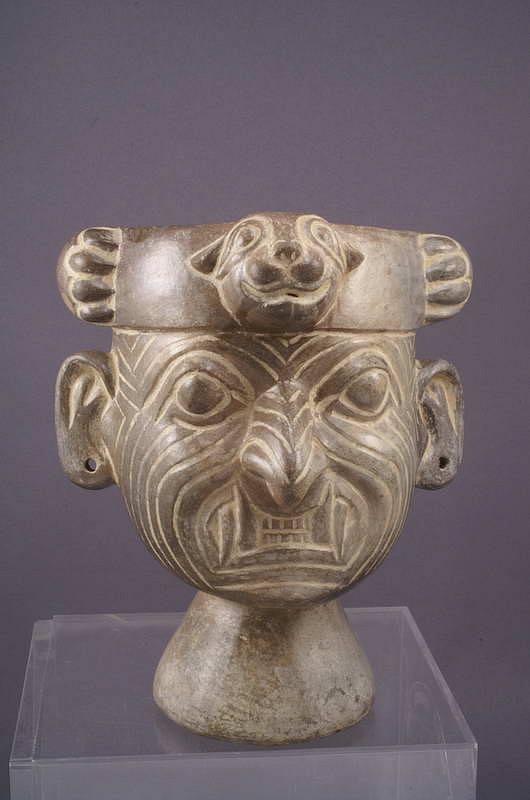
Peru | Moche Fineline Painted Vessel with Warriors and Prisoner | | David Bernstein Pre-Columbian Art. Extensive inventory of Pre-Columbian art from South America, including ancient objects in ceramic, textiles, bronze, copper and gold.
65 / 108

Peru, Moche Fineline Painted Vessel with Warriors and Prisoner

This ceramic vessel features an exquisite example of Moche fineline painting, which reached its technical height towards the end of the ceramic sequence, during the Moche III and IV Phases). It depicts a complicated scene of male warriors dressed in traditional Moche warrior dress, conducting a symbolic ritual in which a captured prisoner is held upside-down and displayed as a war trophy. The artist employed a new technique of incising around the edges of some of the painted imagery. Exhibited at the Guggenheim’s 1968 show Mastercrafstmen of Ancient Peru and illustrated in the corresponding catalog, on page 56. Also illustrated in Pre-Columbian Art of South America by Alan Lapiner, on page 135. Also published in Christopher Donnan’s Moche Fineline Painting: Its Evolution and Its Artists, p. 56

Period: Peru, Moche III North Coast, c. AD 400 - 550

Media: Ceramic

Dimensions: Heigt: 9.5"

•SOLD

p6102
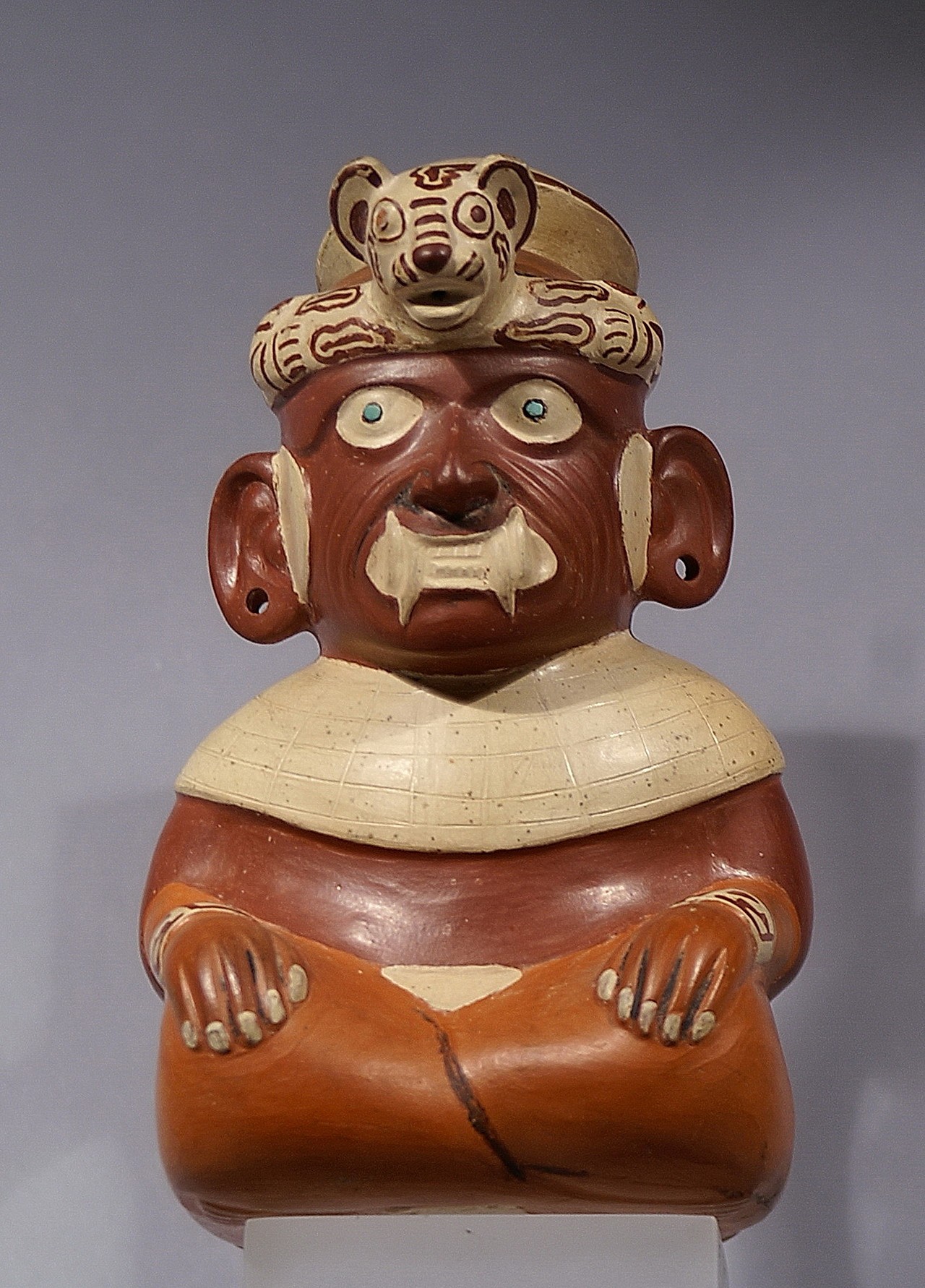
  • View all works
  • PLAY
  • I N Q U I R E
  • Share
  • Print
  • More Works
I N Q U I R E Share Print
Peru, Moche Grayware Rattle Cup with the Decapitator
A well modeled portrait of Ai Apaec wearing his characteristic puma ring headdress with its tail incised on the back of the vessel. The perforated base of the cup contains clay beads which make the vessel rattle with movement. Ai Apaec was an old wrinkled god associated with war and sacrifice, hence his other titles as the Decapitator and Wrinkle Face.
Period: Peru, Moche III, North Coast, c. AD 200 - 500
Media: Ceramic
Dimensions: Height: 5 1/4" x  Width: 4 1/2"
$5,200
M3147
Peru | Moche Grayware Rattle Cup with the Decapitator | | David Bernstein Pre-Columbian Art. Extensive inventory of Pre-Columbian art from South America, including ancient objects in ceramic, textiles, bronze, copper and gold.
66 / 108

Peru, Moche Grayware Rattle Cup with the Decapitator

A well modeled portrait of Ai Apaec wearing his characteristic puma ring headdress with its tail incised on the back of the vessel. The perforated base of the cup contains clay beads which make the vessel rattle with movement. Ai Apaec was an old wrinkled god associated with war and sacrifice, hence his other titles as the Decapitator and Wrinkle Face.

Period: Peru, Moche III, North Coast, c. AD 200 - 500

Media: Ceramic

Dimensions: Height: 5 1/4" x Width: 4 1/2"

$5,200

M3147

  • View all works
  • PLAY
  • I N Q U I R E
  • Share
  • Print
  • More Works
I N Q U I R E Share Print
Peru, Moche I - II Effigy Vessel of the Decapitator Ai Apaec
This is an early version of the Decapitator deity known as Ai Apaec. The deity always wears a feline headdress, but early versions also show him with a turban.  This headdress not only has a puma skin but also a Plume of feathers represented by the conical  form ontop of his head.  He also wears a lovely Pectoral with individual plaques sewn onto a leather backing.  The Decapitator is one of the earliest supernaturals in the Moche ceramic sequence, and he frequently carries a tumi knife and a decapitated head. The Decapitator continued into later cultures, notably the Wari and the Chimu. Formerly in a European collection since the 1970s.
Period: Peru, Moche I, North Coast, circa AD100-300
Media: Ceramic
Dimensions: Height: 7 1/2"
$29,000
M7073
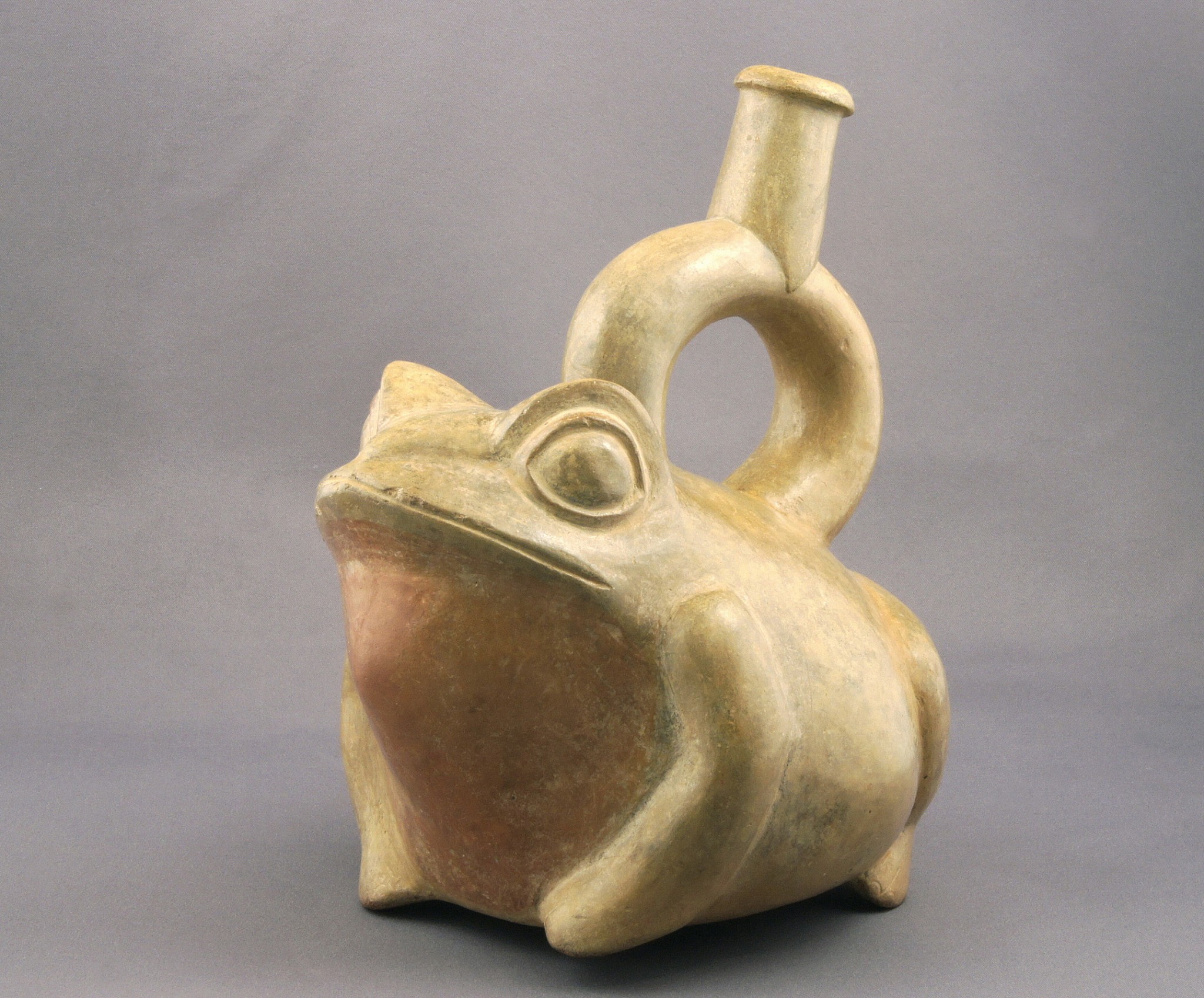
Peru | Moche I - II Effigy Vessel of the Decapitator Ai Apaec | | David Bernstein Pre-Columbian Art. Extensive inventory of Pre-Columbian art from South America, including ancient objects in ceramic, textiles, bronze, copper and gold.
67 / 108

Peru, Moche I - II Effigy Vessel of the Decapitator Ai Apaec

This is an early version of the Decapitator deity known as Ai Apaec. The deity always wears a feline headdress, but early versions also show him with a turban. This headdress not only has a puma skin but also a Plume of feathers represented by the conical form ontop of his head. He also wears a lovely Pectoral with individual plaques sewn onto a leather backing. The Decapitator is one of the earliest supernaturals in the Moche ceramic sequence, and he frequently carries a tumi knife and a decapitated head. The Decapitator continued into later cultures, notably the Wari and the Chimu. Formerly in a European collection since the 1970s.

Period: Peru, Moche I, North Coast, circa AD100-300

Media: Ceramic

Dimensions: Height: 7 1/2"

$29,000

M7073
  • View all works
  • PLAY
  • I N Q U I R E
  • Share
  • Print
  • More Works
I N Q U I R E Share Print
Peru, Moche I Ceramic stirrup-spout effigy of a seated toad in buff with red throat
This stirrup spout vessel depicting a life-like frog/toad attests to the Moche artist's fond awareness of the natural world.  Such careful attention and adeptness at naturalistic portrayals of animal images is common of Early Moche ceramics. Frogs have bulbous eyes, strong,  long webbed feet, and slimy  skin, while toads have stubby bodies, warty, dry skin, different chest cartliage and paratoid glands behind the eyes.  Their large eyes are defined with a ridge.  Also, toads do not have teeth,  while frogs have upper teeth. This rotund fellow with his alert wide-eyed gaze and attentive posture seems all too ready to ambush an unsuspecting fly.  It is slip painted in cream and the head tilts upward, exposing a rosy orange gullet beneath the determined, down-turned mouth. Images of frogs and toads (anurans) are commonly interpreted  in the art of many Pre-Columbian cultures. Because of their musical croaking performances after heavy rains, frogs and toads are associated with water, vegetation , fertility, and in some cases (usually toads), toxicity.  The cyclic quality of their development --the change from the fish-like tadpole to adult frog, allude to a natural affiliation with mythical concepts of transformation.  Similar examples are illustrated in "Pre-Columbian Art of South America", by Alan Lapiner, fig. 281, p129, and in "Moche Art of Peru", by Christopher B. Donnan, fig. 81, p.57. as well as in Ceramics of Ancient Peru by Donnan, 1992, UCLA, p. 128.
Period: Peru, Moche I, North Coast, circa AD100-300
Media: Ceramic
Dimensions: Height: 7" x Width: 5"
$5,400
98439
Peru | Moche I Ceramic stirrup-spout effigy of a seated toad in buff with red throat | | David Bernstein Pre-Columbian Art. Extensive inventory of Pre-Columbian art from South America, including ancient objects in ceramic, textiles, bronze, copper and gold.
68 / 108

Peru, Moche I Ceramic stirrup-spout effigy of a seated toad in buff with red throat

This stirrup spout vessel depicting a life-like frog/toad attests to the Moche artist's fond awareness of the natural world. Such careful attention and adeptness at naturalistic portrayals of animal images is common of Early Moche ceramics. Frogs have bulbous eyes, strong, long webbed feet, and slimy skin, while toads have stubby bodies, warty, dry skin, different chest cartliage and paratoid glands behind the eyes. Their large eyes are defined with a ridge. Also, toads do not have teeth, while frogs have upper teeth. This rotund fellow with his alert wide-eyed gaze and attentive posture seems all too ready to ambush an unsuspecting fly. It is slip painted in cream and the head tilts upward, exposing a rosy orange gullet beneath the determined, down-turned mouth. Images of frogs and toads (anurans) are commonly interpreted in the art of many Pre-Columbian cultures. Because of their musical croaking performances after heavy rains, frogs and toads are associated with water, vegetation , fertility, and in some cases (usually toads), toxicity. The cyclic quality of their development --the change from the fish-like tadpole to adult frog, allude to a natural affiliation with mythical concepts of transformation. Similar examples are illustrated in "Pre-Columbian Art of South America", by Alan Lapiner, fig. 281, p129, and in "Moche Art of Peru", by Christopher B. Donnan, fig. 81, p.57. as well as in Ceramics of Ancient Peru by Donnan, 1992, UCLA, p. 128.

Period: Peru, Moche I, North Coast, circa AD100-300

Media: Ceramic

Dimensions: Height: 7" x Width: 5"

$5,400

98439

  • View all works
  • PLAY
  • I N Q U I R E
  • Share
  • Print
  • More Works
I N Q U I R E Share Print
Peru, Moche II Grayware Vessel with Embracing Couple
An embracing couple is an extremely rare subject for Andean art from any culture.  Although ancient Andean art features many human characters such as hunters and shamans, as well as semi-human deities with a wide range themes and emotions, romantic couples are not a common theme.  In this sculptural depiction of a Moche couple, the male wears large ear ornaments, and holds a conch trumpet, and the female wears a feather plume in her hair, all signs of wealth and status.
Period: Peru, Moche II, North Coast, c. AD 200 - 350
Media: Ceramic
Dimensions: Height 8"
Price Upon Request
M9015H
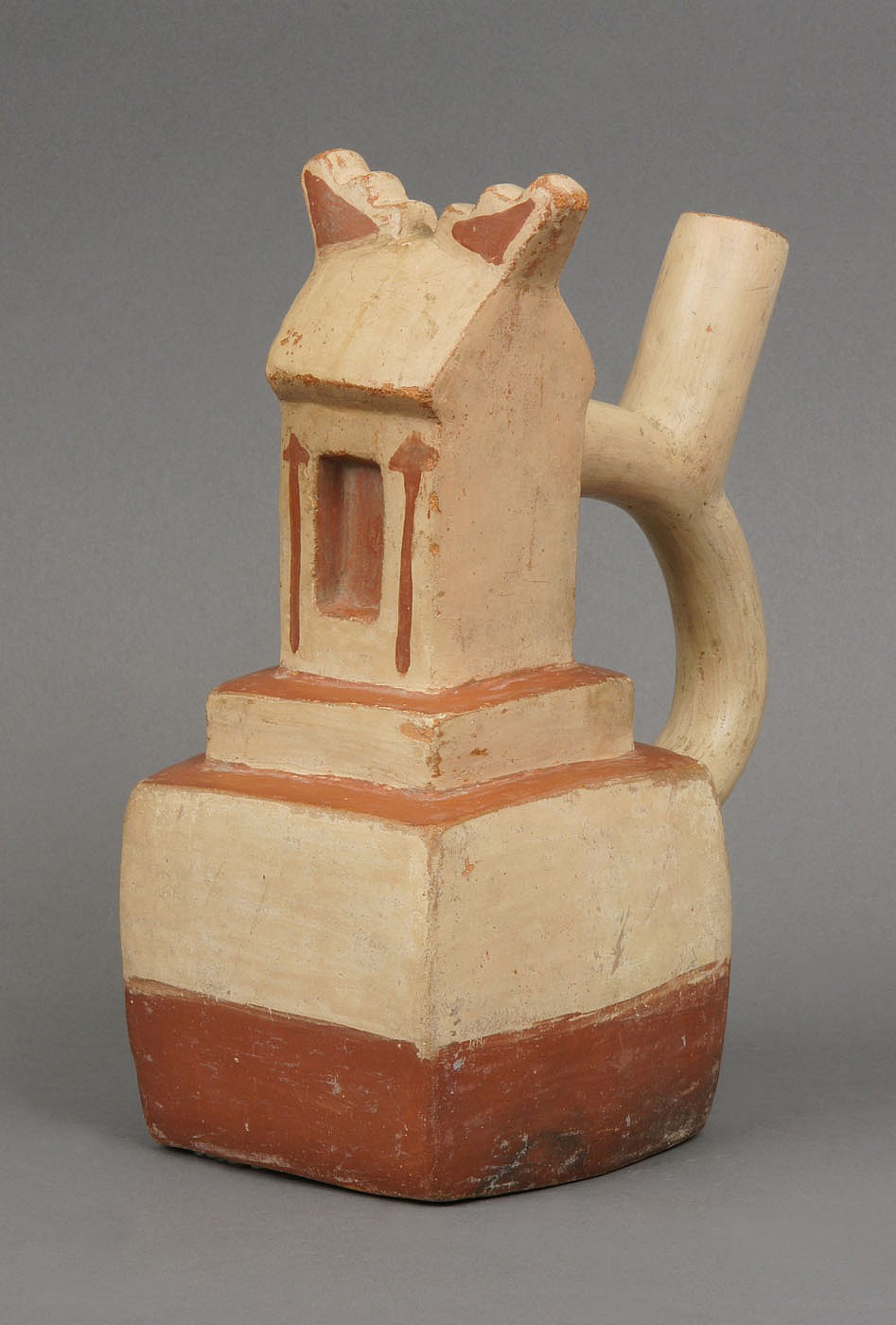
Peru | Moche II Grayware Vessel with Embracing Couple | | David Bernstein Pre-Columbian Art. Extensive inventory of Pre-Columbian art from South America, including ancient objects in ceramic, textiles, bronze, copper and gold.
69 / 108

Peru, Moche II Grayware Vessel with Embracing Couple

An embracing couple is an extremely rare subject for Andean art from any culture. Although ancient Andean art features many human characters such as hunters and shamans, as well as semi-human deities with a wide range themes and emotions, romantic couples are not a common theme. In this sculptural depiction of a Moche couple, the male wears large ear ornaments, and holds a conch trumpet, and the female wears a feather plume in her hair, all signs of wealth and status.

Period: Peru, Moche II, North Coast, c. AD 200 - 350

Media: Ceramic

Dimensions: Height 8"

Price Upon Request

M9015H
  • View all works
  • PLAY
  • I N Q U I R E
  • Share
  • Print
  • More Works
I N Q U I R E Share Print
Peru, Moche III Ceramic Vessel in the Form of a Gabled House
This house or religious center is detailed with a gabled roof and stucco decoration with painted  spears.   A priest is portrayed in the doorway in full regalia.    Ex Collection Of Sue Tishman, prior to 1970.
Period: Peru, Moche III, North Coast, circa AD300-500
Media: Ceramic
Dimensions: Height  9"
$7,000
M7019
Peru | Moche III Ceramic Vessel in the Form of a Gabled House | | David Bernstein Pre-Columbian Art. Extensive inventory of Pre-Columbian art from South America, including ancient objects in ceramic, textiles, bronze, copper and gold.
70 / 108

Peru, Moche III Ceramic Vessel in the Form of a Gabled House

This house or religious center is detailed with a gabled roof and stucco decoration with painted spears. A priest is portrayed in the doorway in full regalia. Ex Collection Of Sue Tishman, prior to 1970.

Period: Peru, Moche III, North Coast, circa AD300-500

Media: Ceramic

Dimensions: Height 9"

$7,000

M7019
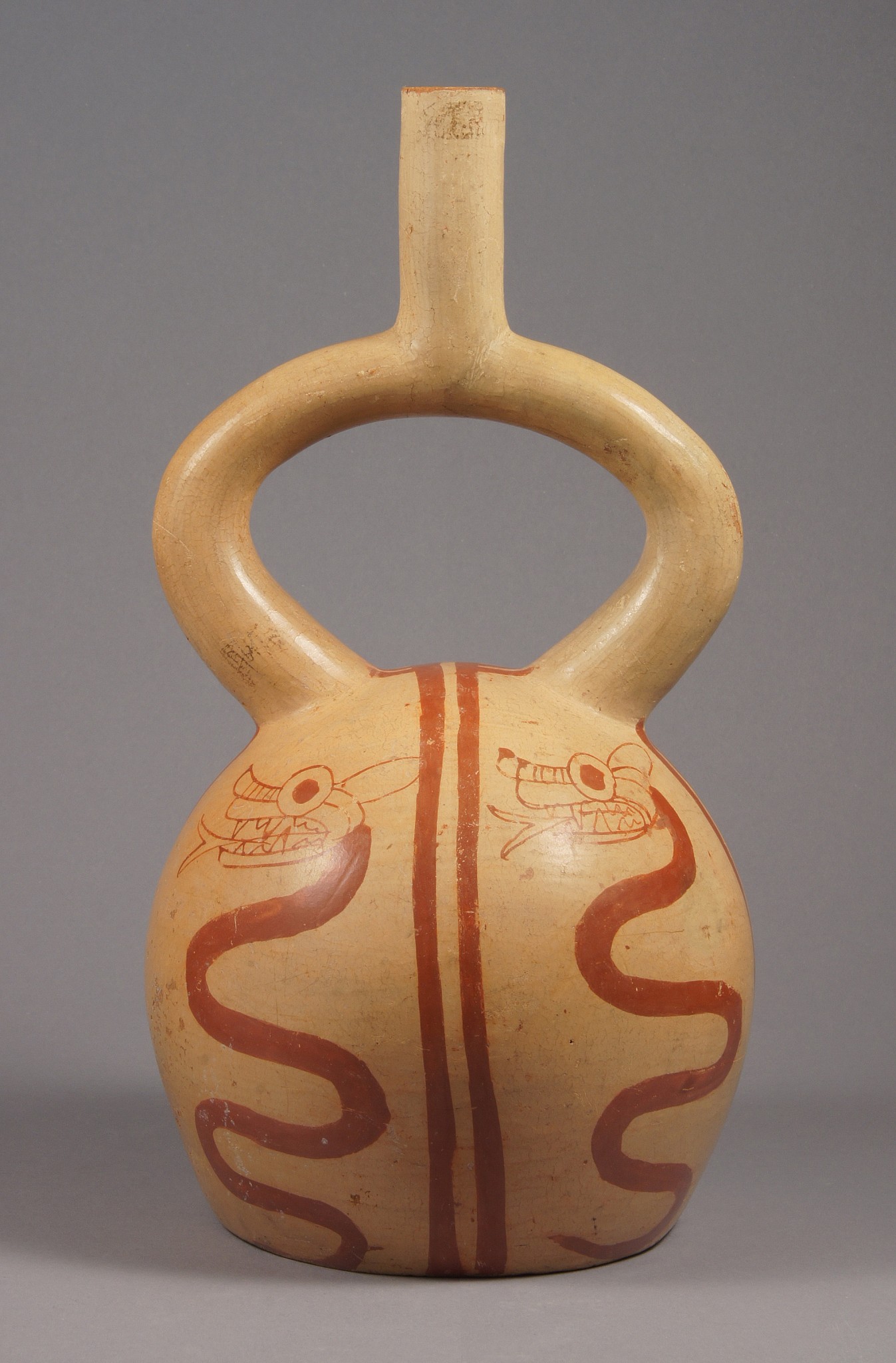
  • View all works
  • PLAY
  • I N Q U I R E
  • Share
  • Print
  • More Works
I N Q U I R E Share Print
Peru, Moche III Fineline Vessel Depicting a Coca Ceremony
A fine example depicting the coca ritual.  On one side we see 4 seated men holding the traditional gourd lime containers and administrating lime to extract the coca from the leaf.  On the other side we see a figure with hands clasped holding a coca leaf bag and surrounded by bats, dark balls, and the Bicephalus Arc (double-headed serpent) which symbolize psychic flight and the praying for rain.  There are three other known examples of the Coca-ritual under the Bicephalus Arc in Pre-Colombian art.  One is in the Linden Museum in Stuttgardt and two others are in the collection of the Museo Arqueologico Raphfael Larco Herrera, Lima.  All three are discussed in an article THE PRIESTS OF THE BICEPHALUS ARC by Santiago Uceda and published in THE ART AND ARCHAEOLOGY OF THE MOCHE, pg. 153-178, University of Texas Press 2008 . Formerly in the collection of Benno Mattel and exhibited at the British Consulate in Punta Del Este. Subsequently sold to a US collector in the US where it remained for ten years. Rollout drawing in Moche Archive #157.
Period: Peru, Moche III, North Coast, c. AD 200 - 500
Media: Ceramic
Dimensions: Height 10" x Diameter 5 3/4"
Price Upon Request
n2002
Peru | Moche III Fineline Vessel Depicting a Coca Ceremony | | David Bernstein Pre-Columbian Art. Extensive inventory of Pre-Columbian art from South America, including ancient objects in ceramic, textiles, bronze, copper and gold.
71 / 108

Peru, Moche III Fineline Vessel Depicting a Coca Ceremony

A fine example depicting the coca ritual. On one side we see 4 seated men holding the traditional gourd lime containers and administrating lime to extract the coca from the leaf. On the other side we see a figure with hands clasped holding a coca leaf bag and surrounded by bats, dark balls, and the Bicephalus Arc (double-headed serpent) which symbolize psychic flight and the praying for rain. There are three other known examples of the Coca-ritual under the Bicephalus Arc in Pre-Colombian art. One is in the Linden Museum in Stuttgardt and two others are in the collection of the Museo Arqueologico Raphfael Larco Herrera, Lima. All three are discussed in an article THE PRIESTS OF THE BICEPHALUS ARC by Santiago Uceda and published in THE ART AND ARCHAEOLOGY OF THE MOCHE, pg. 153-178, University of Texas Press 2008 . Formerly in the collection of Benno Mattel and exhibited at the British Consulate in Punta Del Este. Subsequently sold to a US collector in the US where it remained for ten years. Rollout drawing in Moche Archive #157.

Period: Peru, Moche III, North Coast, c. AD 200 - 500

Media: Ceramic

Dimensions: Height 10" x Diameter 5 3/4"

Price Upon Request

n2002

  • View all works
  • PLAY
  • I N Q U I R E
  • Share
  • Print
  • More Works
I N Q U I R E Share Print
Peru, Moche IV fine line ceramic stirrup spout vessel of Serpents
A large stirrup spout vessel painted with four undulating serpents facing upwards, one in each quadrant in red/brown on a beige ground.  The serpent represents rebirth, the shedding of its skin repeating as much as four times, perhaps for each season. Stirrup spout vessels were used  to hold  ceremonial corn beer and the spout allowed  the air to enter one channel while the liquid was able to pour  through the other channel.
Period: Moche, North Coast Peru, circa. 450-550 A.D.
Media: Ceramic
Dimensions: Height 11 1/2"
$4,500
90078
Peru | Moche IV fine line ceramic stirrup spout vessel of Serpents | | David Bernstein Pre-Columbian Art. Extensive inventory of Pre-Columbian art from South America, including ancient objects in ceramic, textiles, bronze, copper and gold.
72 / 108

Peru, Moche IV fine line ceramic stirrup spout vessel of Serpents

A large stirrup spout vessel painted with four undulating serpents facing upwards, one in each quadrant in red/brown on a beige ground. The serpent represents rebirth, the shedding of its skin repeating as much as four times, perhaps for each season. Stirrup spout vessels were used to hold ceremonial corn beer and the spout allowed the air to enter one channel while the liquid was able to pour through the other channel.

Period: Moche, North Coast Peru, circa. 450-550 A.D.

Media: Ceramic

Dimensions: Height 11 1/2"

$4,500

90078
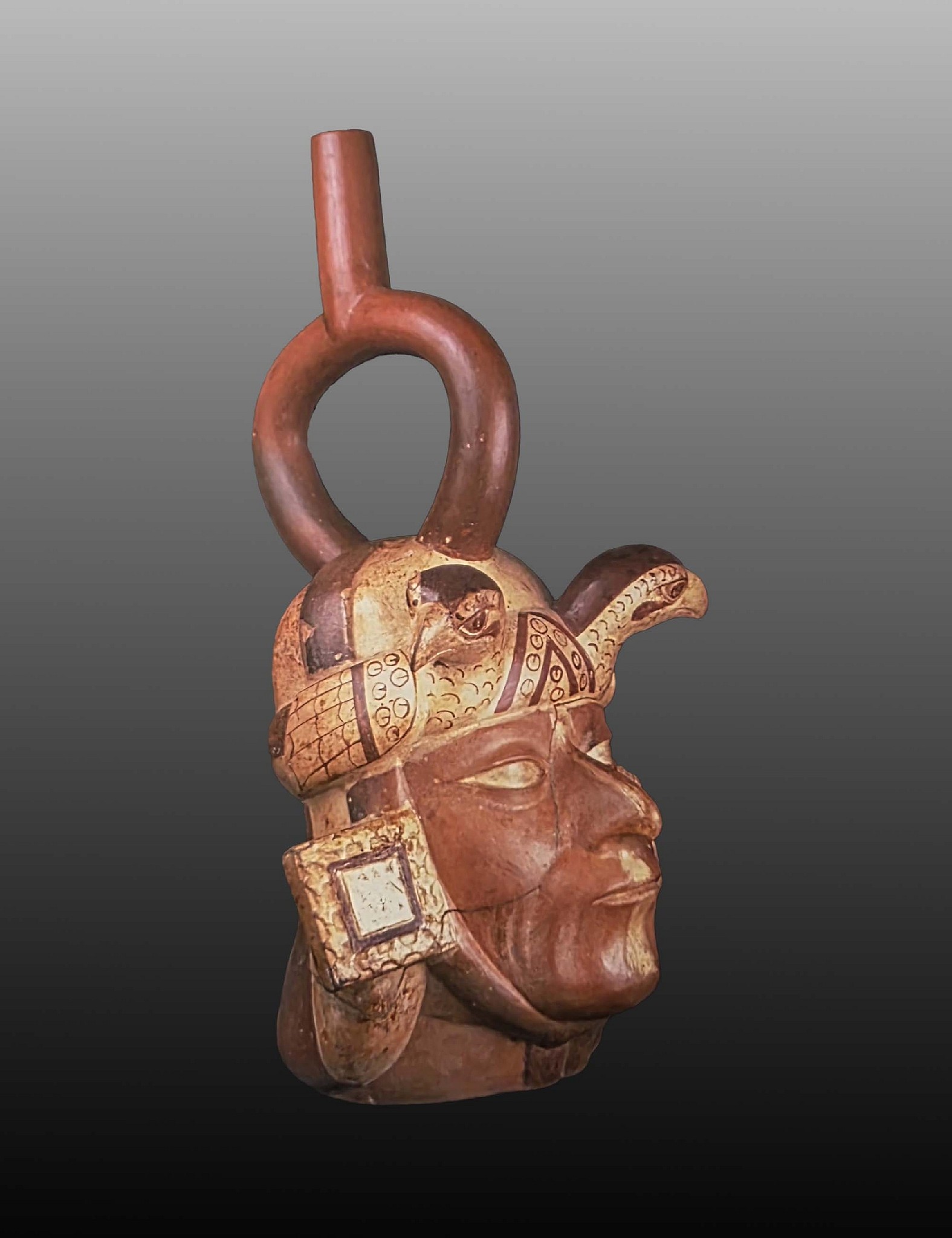
  • View all works
  • PLAY
  • I N Q U I R E
  • Share
  • Print
  • More Works
I N Q U I R E Share Print
Peru, Moche Portrait Vessel of a Lord
Reddish brown ceramic, open top, portrait vessel of a man wearing ear spools and a headdress with a puma head motif and two enormous front paws emerging from the sides. There are traces of spotted, beige slip decoration on the ear spools and spots on the headdress. This vessel is significantly larger than most portrait heads which average slightly more than half life-size, and it is in good condition. Portrait vessels play a significant role in Moche art as forerunners of a period of realism that followed them. It is believed that portraits were of powerful leaders, and that their presence in a grave signified an honor bestowed upon the deceased. A very similar portrait vessel is illustrated in "Ancient Peruvian Ceramics: The Nathan Cummings Collection," by Alan Sawyer (1996: pl: 37). Another, perhaps of the same person, is illustrated in "Moche Portraits from Ancient Peru" by Christopher Donnan (2004: fig.: 4.27).
Period: Peru, Moche IV, North Coast, c. AD 200 - 500
Media: Ceramic
Dimensions: Height: 9 3/4"
Price Upon Request
96077
Peru | Moche Portrait Vessel of a Lord | | David Bernstein Pre-Columbian Art. Extensive inventory of Pre-Columbian art from South America, including ancient objects in ceramic, textiles, bronze, copper and gold.
73 / 108

Peru, Moche Portrait Vessel of a Lord

Reddish brown ceramic, open top, portrait vessel of a man wearing ear spools and a headdress with a puma head motif and two enormous front paws emerging from the sides. There are traces of spotted, beige slip decoration on the ear spools and spots on the headdress. This vessel is significantly larger than most portrait heads which average slightly more than half life-size, and it is in good condition. Portrait vessels play a significant role in Moche art as forerunners of a period of realism that followed them. It is believed that portraits were of powerful leaders, and that their presence in a grave signified an honor bestowed upon the deceased. A very similar portrait vessel is illustrated in "Ancient Peruvian Ceramics: The Nathan Cummings Collection," by Alan Sawyer (1996: pl: 37). Another, perhaps of the same person, is illustrated in "Moche Portraits from Ancient Peru" by Christopher Donnan (2004: fig.: 4.27).

Period: Peru, Moche IV, North Coast, c. AD 200 - 500

Media: Ceramic

Dimensions: Height: 9 3/4"

Price Upon Request

96077

  • View all works
  • PLAY
  • I N Q U I R E
  • Share
  • Print
  • More Works
I N Q U I R E Share Print
Peru, Moche Portrait Vessel of “Long-Nose” with Square Ear Ornaments
This Moche ceramic vessel depicts the classic recurring Moche theme of the “Long-Nose” figure, a male warrior who would have participated in ritual combat.  “Long-Nose” is identifiable by his narrow face and lenticular eyes, and often features a vertical white strip painted from forehead to chin.  In many of his portraits, including the one depicted for this vessel, he wears square ear ornaments bordered by war clubs. In addition to portrait head vessels, Long-Nose was also depicted by Moche in some full figure ceramic portraits, several of which show him elaborately dressed, holding a spatula above around bowl.  From the Peruvian ceramic collection of Benno Mattel, Punta del Este, Uruguay, acquired prior to the 1960s.  Depicted in Moche Portraits from Ancient Peru, by Christopher Donnan, on pages 112, and 124.

Period: Peru, Moche, North Coast, c. AD 400-600
Media: Ceramic
Dimensions: Height: 12"
$28,000
Z106
Peru | Moche Portrait Vessel of “Long-Nose” with Square Ear Ornaments | | David Bernstein Pre-Columbian Art. Extensive inventory of Pre-Columbian art from South America, including ancient objects in ceramic, textiles, bronze, copper and gold.
74 / 108

Peru, Moche Portrait Vessel of “Long-Nose” with Square Ear Ornaments

This Moche ceramic vessel depicts the classic recurring Moche theme of the “Long-Nose” figure, a male warrior who would have participated in ritual combat. “Long-Nose” is identifiable by his narrow face and lenticular eyes, and often features a vertical white strip painted from forehead to chin. In many of his portraits, including the one depicted for this vessel, he wears square ear ornaments bordered by war clubs. In addition to portrait head vessels, Long-Nose was also depicted by Moche in some full figure ceramic portraits, several of which show him elaborately dressed, holding a spatula above around bowl. From the Peruvian ceramic collection of Benno Mattel, Punta del Este, Uruguay, acquired prior to the 1960s. Depicted in Moche Portraits from Ancient Peru, by Christopher Donnan, on pages 112, and 124.

Period: Peru, Moche, North Coast, c. AD 400-600

Media: Ceramic

Dimensions: Height: 12"

$28,000

Z106

  • View all works
  • PLAY
  • I N Q U I R E
  • Share
  • Print
  • More Works
I N Q U I R E Share Print
Peru, Moche Stirrup Spout Redware Effigy Vessel of a Zoomorphic Amphibian
This beautiful redware vessel features a zoomorphic animal combining the features of a frog and a lizard, with human hands.  The vessel combines animal and human characteristics, likely to signify shamanic transformation.  The tail is painted with buff slip which is also used highlight the eyes, gills, and underside of the mouth.   The animal is depicted with human hands on both its forelegs and hindlegs, representing the ancient Andeans’ animist belief that humans can embody animal characteristics.  He is holding a spherical object - perhaps indicating that he is guarding an amphibian egg.  He sits atop a rectangular base.  Ex. collection Levi Stone, CT, prior to the 1970s.
Period: Peru, Moche I, North Coast, c. AD 100 - 300
Media: Ceramic
Dimensions: Length: 10" x Height: 8"
Price Upon Request
n2018
Peru | Moche Stirrup Spout Redware Effigy Vessel of a Zoomorphic Amphibian | | David Bernstein Pre-Columbian Art. Extensive inventory of Pre-Columbian art from South America, including ancient objects in ceramic, textiles, bronze, copper and gold.
75 / 108

Peru, Moche Stirrup Spout Redware Effigy Vessel of a Zoomorphic Amphibian

This beautiful redware vessel features a zoomorphic animal combining the features of a frog and a lizard, with human hands. The vessel combines animal and human characteristics, likely to signify shamanic transformation. The tail is painted with buff slip which is also used highlight the eyes, gills, and underside of the mouth. The animal is depicted with human hands on both its forelegs and hindlegs, representing the ancient Andeans’ animist belief that humans can embody animal characteristics. He is holding a spherical object - perhaps indicating that he is guarding an amphibian egg. He sits atop a rectangular base. Ex. collection Levi Stone, CT, prior to the 1970s.

Period: Peru, Moche I, North Coast, c. AD 100 - 300

Media: Ceramic

Dimensions: Length: 10" x Height: 8"

Price Upon Request

n2018
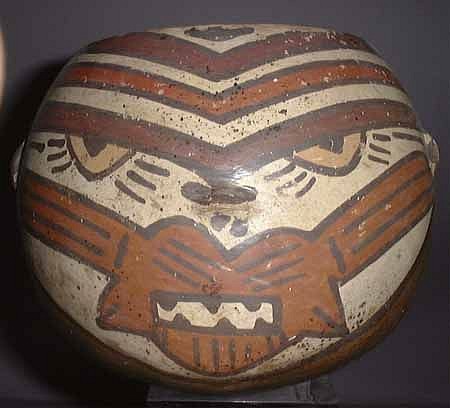
  • View all works
  • PLAY
  • I N Q U I R E
  • Share
  • Print
  • More Works
I N Q U I R E Share Print
Peru, Nasca Bridgespout Vessel Painted with 23 Foxes On White Ground
A late Nasca period vessel, T/L tested, verified as 1650 years old by CIRAM Labs.  Prof. Donald Proulx in his Sourcebook of Nasca Ceramic Iconography (pg. 141) describes the Andean Fox with the following characteristics, drawn in profile with elongated snout, pointed ears, whiskers and thick black tail. Deiter Eislab Illustrated 5 ceramics with similar painted foxes in ALTPERUANISCHE KULTUREN NAZCAII, plate 6-9.
Period: Peru, Nasca, South Coast, c. AD 400 - 800
Media: Ceramic
Dimensions: Height; 5 1/2" x  Diameter: 6"
Price Upon Request
n4052
Peru | Nasca Bridgespout Vessel Painted with 23 Foxes On White Ground | | David Bernstein Pre-Columbian Art. Extensive inventory of Pre-Columbian art from South America, including ancient objects in ceramic, textiles, bronze, copper and gold.
76 / 108

Peru, Nasca Bridgespout Vessel Painted with 23 Foxes On White Ground

A late Nasca period vessel, T/L tested, verified as 1650 years old by CIRAM Labs. Prof. Donald Proulx in his Sourcebook of Nasca Ceramic Iconography (pg. 141) describes the Andean Fox with the following characteristics, drawn in profile with elongated snout, pointed ears, whiskers and thick black tail. Deiter Eislab Illustrated 5 ceramics with similar painted foxes in ALTPERUANISCHE KULTUREN NAZCAII, plate 6-9.

Period: Peru, Nasca, South Coast, c. AD 400 - 800

Media: Ceramic

Dimensions: Height; 5 1/2" x Diameter: 6"

Price Upon Request

n4052

  • View all works
  • PLAY
  • I N Q U I R E
  • Share
  • Print
  • More Works
I N Q U I R E Share Print
Peru, Nazca Ceramic Bowl with puma head wearing a mouth mask
This large and colorful bowl is decorated with a feline type face wearing a fanged mouth mask with flaring whiskers. The nose, ears and chin are subtly raised. The forehead is decorated with a succession of chevron stripes and the back of the vessel is decorated with two series of semi-circular motifs floating on a band of warm dark brown. The shape of the vessel is globular and the color scheme is maroon, sienna, cream, tan and black. Trophy heads are represented with the most frequency on these vessels. With the exception of foxes, animal portrait masks are seldom represented on this type of vessel. Ceramic vessels with similar masked iconography are featured in "Nasca Geheimnisvolle Zeichen im Alten Peru," Museum Reitberg Zurich, 1999 (exhibition catalog).
Period: Peru, Nasca, South Coast, c. AD 400 - 800
Media: Ceramic
Dimensions: Height  6 1/2" x Diameter 6 1/2"
Price Upon Request
97130
Peru | Nazca Ceramic Bowl with puma head wearing a mouth mask | | David Bernstein Pre-Columbian Art. Extensive inventory of Pre-Columbian art from South America, including ancient objects in ceramic, textiles, bronze, copper and gold.
77 / 108

Peru, Nazca Ceramic Bowl with puma head wearing a mouth mask

This large and colorful bowl is decorated with a feline type face wearing a fanged mouth mask with flaring whiskers. The nose, ears and chin are subtly raised. The forehead is decorated with a succession of chevron stripes and the back of the vessel is decorated with two series of semi-circular motifs floating on a band of warm dark brown. The shape of the vessel is globular and the color scheme is maroon, sienna, cream, tan and black. Trophy heads are represented with the most frequency on these vessels. With the exception of foxes, animal portrait masks are seldom represented on this type of vessel. Ceramic vessels with similar masked iconography are featured in "Nasca Geheimnisvolle Zeichen im Alten Peru," Museum Reitberg Zurich, 1999 (exhibition catalog).

Period: Peru, Nasca, South Coast, c. AD 400 - 800

Media: Ceramic

Dimensions: Height 6 1/2" x Diameter 6 1/2"

Price Upon Request

97130

  • View all works
  • PLAY
  • I N Q U I R E
  • Share
  • Print
  • More Works
I N Q U I R E Share Print
Peru, Nazca lug handled vessel wearing a striped tunic
The figure is wearing a woven read headband and has a painted mustache with bird head decoration for his eyes. He is wearing a colorful stripped tunic with fringe, which is typical for Nazca weaving. This lug handle vessel was made for carrying Chicha or corn beer with a temp line passing through the lug handles so that it could be carried on a person's back.  
A similar vessel wearing a tunic is illustrated in CATA PGP DE A CERA OCA MAZCA, by Concepcion Blasco Busqued, 1991, Madrid, pg 94.
Period: Peru, Nasca, c. AD 400 - 800
Media: Ceramic
Dimensions: Height 11" x Width 10"
Price Upon Request
n3042
Peru | Nazca lug handled vessel wearing a striped tunic | | David Bernstein Pre-Columbian Art. Extensive inventory of Pre-Columbian art from South America, including ancient objects in ceramic, textiles, bronze, copper and gold.
78 / 108

Peru, Nazca lug handled vessel wearing a striped tunic

The figure is wearing a woven read headband and has a painted mustache with bird head decoration for his eyes. He is wearing a colorful stripped tunic with fringe, which is typical for Nazca weaving. This lug handle vessel was made for carrying Chicha or corn beer with a temp line passing through the lug handles so that it could be carried on a person's back.
A similar vessel wearing a tunic is illustrated in CATA PGP DE A CERA OCA MAZCA, by Concepcion Blasco Busqued, 1991, Madrid, pg 94.

Period: Peru, Nasca, c. AD 400 - 800

Media: Ceramic

Dimensions: Height 11" x Width 10"

Price Upon Request

n3042
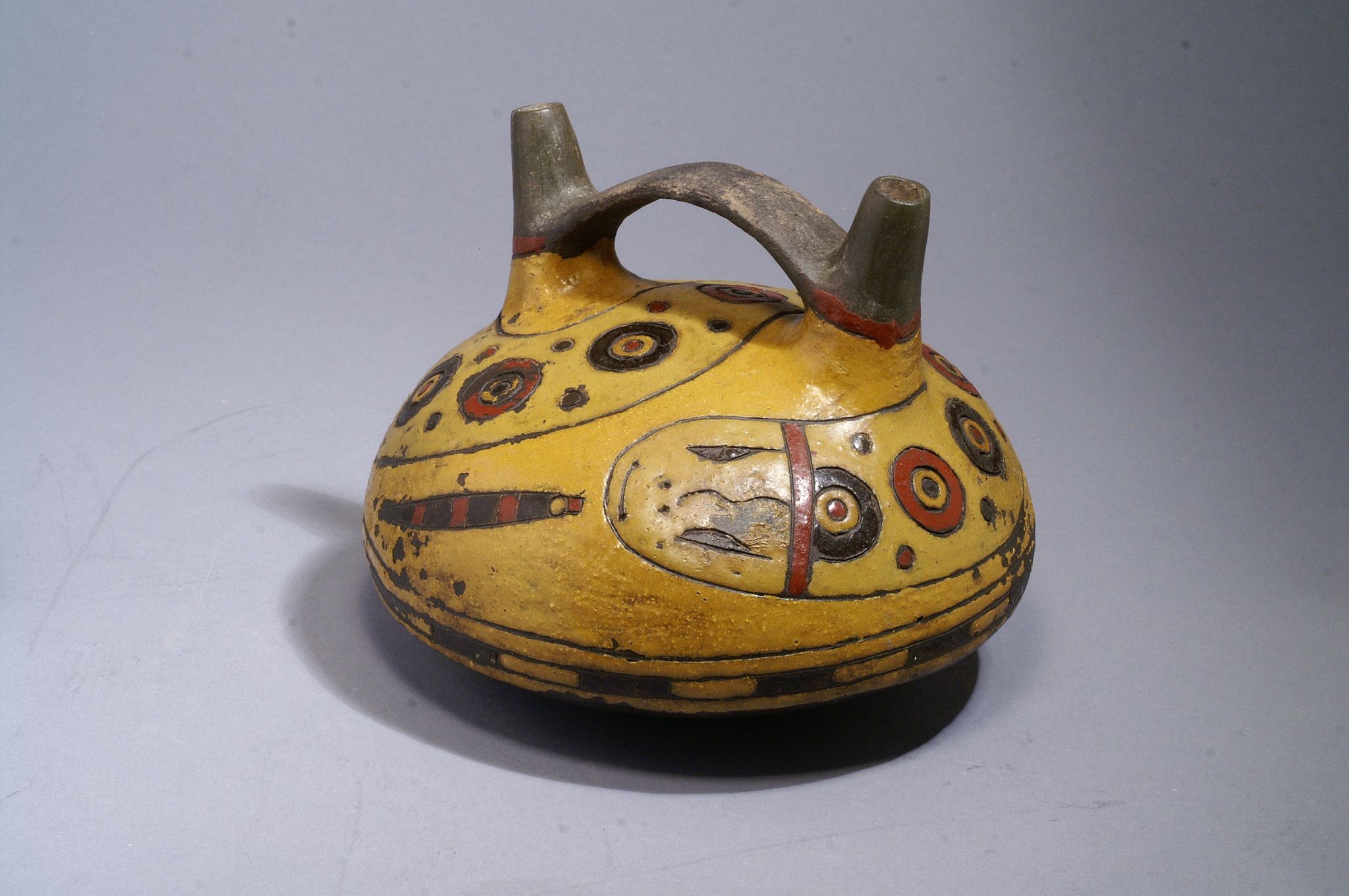
  • View all works
  • PLAY
  • I N Q U I R E
  • Share
  • Print
  • More Works
I N Q U I R E Share Print
Peru, Pair of Chancay White, Double-chambered Whistling Vessels with figures
It is a rarity to find ceramic vessels in pairs that provide such excellent examples of the elegantly restrained aesthetics of the classic Chancay style.  The presence of the musician figures atop one of the chambers on each vessel attests to the Chancay artist's stylish wit that cleverly enforces the sibilant properties of the vessels.  Each is comprised of two circular chambers that connect at the sides.  Each chamber sets on its individual pedestal, and a bridge handle links a tall conical spout on one of the chambers to a decorative musician figure identified by his double cone headdress and large earspools.  When liquid is poured from one chamber to another the air between them is displaced, resulting in a whistling sound made through a fipple under the figure. Ceramic vessels in the Chancay style are illustrated and discussed in "Contemporaneidad del Arte Chancay," Museo de Arte de Lima (1998).
Period: Peru, Chancay, Central Coast, c. AD 1100 - 1430
Media: Ceramic
Dimensions: Height: 10" & 10 1/2"'
Price Upon Request
97000
Peru | Pair of Chancay White, Double-chambered Whistling Vessels with figures | | David Bernstein Pre-Columbian Art. Extensive inventory of Pre-Columbian art from South America, including ancient objects in ceramic, textiles, bronze, copper and gold.
79 / 108

Peru, Pair of Chancay White, Double-chambered Whistling Vessels with figures

It is a rarity to find ceramic vessels in pairs that provide such excellent examples of the elegantly restrained aesthetics of the classic Chancay style. The presence of the musician figures atop one of the chambers on each vessel attests to the Chancay artist's stylish wit that cleverly enforces the sibilant properties of the vessels. Each is comprised of two circular chambers that connect at the sides. Each chamber sets on its individual pedestal, and a bridge handle links a tall conical spout on one of the chambers to a decorative musician figure identified by his double cone headdress and large earspools. When liquid is poured from one chamber to another the air between them is displaced, resulting in a whistling sound made through a fipple under the figure. Ceramic vessels in the Chancay style are illustrated and discussed in "Contemporaneidad del Arte Chancay," Museo de Arte de Lima (1998).

Period: Peru, Chancay, Central Coast, c. AD 1100 - 1430

Media: Ceramic

Dimensions: Height: 10" & 10 1/2"'

Price Upon Request

97000

  • View all works
  • PLAY
  • I N Q U I R E
  • Share
  • Print
  • More Works
I N Q U I R E Share Print
Peru, Paracas Bridge Spout Vessel Painted with Double-headed Undulating Eel
This vessel was painted with two neighboring hues of neutral yellow resinous paint, one for the ground and the other for the double-headed serpent. The rare color palette of this vessel departs from that of most Paracas vessels, which generally employ starkly contrasting colors.  The animal depicted in the painting is probably an Amphisbaena, a species of worm-like snakes whose tails resemble heads as an evolutionary adaptation to fool predators. Acquired from a Miami collector in 2006. Period: Peru, Paracas, Ocucaje Phase 9, Ica valley, South Coast, c. 300 - 200 BC
Period: Peru, Paracas, Ocucaje Phase 9, Ica valley, South Coast, c. 300 - 200 BC
Media: Ceramic
Dimensions: Diameter: 6 1/4" x Height: 5"
$8,750
M6088
Peru | Paracas Bridge Spout Vessel Painted with Double-headed Undulating Eel | | David Bernstein Pre-Columbian Art. Extensive inventory of Pre-Columbian art from South America, including ancient objects in ceramic, textiles, bronze, copper and gold.
80 / 108

Peru, Paracas Bridge Spout Vessel Painted with Double-headed Undulating Eel

This vessel was painted with two neighboring hues of neutral yellow resinous paint, one for the ground and the other for the double-headed serpent. The rare color palette of this vessel departs from that of most Paracas vessels, which generally employ starkly contrasting colors. The animal depicted in the painting is probably an Amphisbaena, a species of worm-like snakes whose tails resemble heads as an evolutionary adaptation to fool predators. Acquired from a Miami collector in 2006.

Period: Peru, Paracas, Ocucaje Phase 9, Ica valley, South Coast, c. 300 - 200 BC

Period: Peru, Paracas, Ocucaje Phase 9, Ica valley, South Coast, c. 300 - 200 BC

Media: Ceramic

Dimensions: Diameter: 6 1/4" x Height: 5"

$8,750

M6088
  • View all works
  • PLAY
  • I N Q U I R E
  • Share
  • Print
  • More Works
I N Q U I R E Share Print
Peru, Paracas Bridge Spout Vessel with Falcon's Head
Peru, Paracas, Upper Callango basin phase 8, South Coast, c. 700 - 200 BC
This beautiful ceramic blind bridge spout vessel is crafted in the shape of a falcon with a sculpted head and incised drawings to create the falcon’s body and wings. The chamber was enhanced with a series of squarish "U" shapes, accented with a single Chavinoid eye in profile.  The vessel is decorated with post-firing slip colors of red, green, brown, and tan.  A similar vessel is illustrated ANCIENT PERUVIAN CERAMICS: THE NATHAN CUMMINGS COLLECTION, pages 116 & 117.  A detailed discussion regarding these vessels can be found in THE PARACAS POTTERY OF ICA - A STUDY IN STYLE AND TIME on page 333. Period: Peru, Paracas, Upper Callango basin phase 8, South Coast, c. 700 - 200 BC 

Period: Peru, Paracas, Upper Callango basin phase 8, South Coast, c. 700 - 200 BC
Media: Ceramic
Dimensions: Height: 5 in.   Diameter: 6 in.
Price Upon Request
n2044C
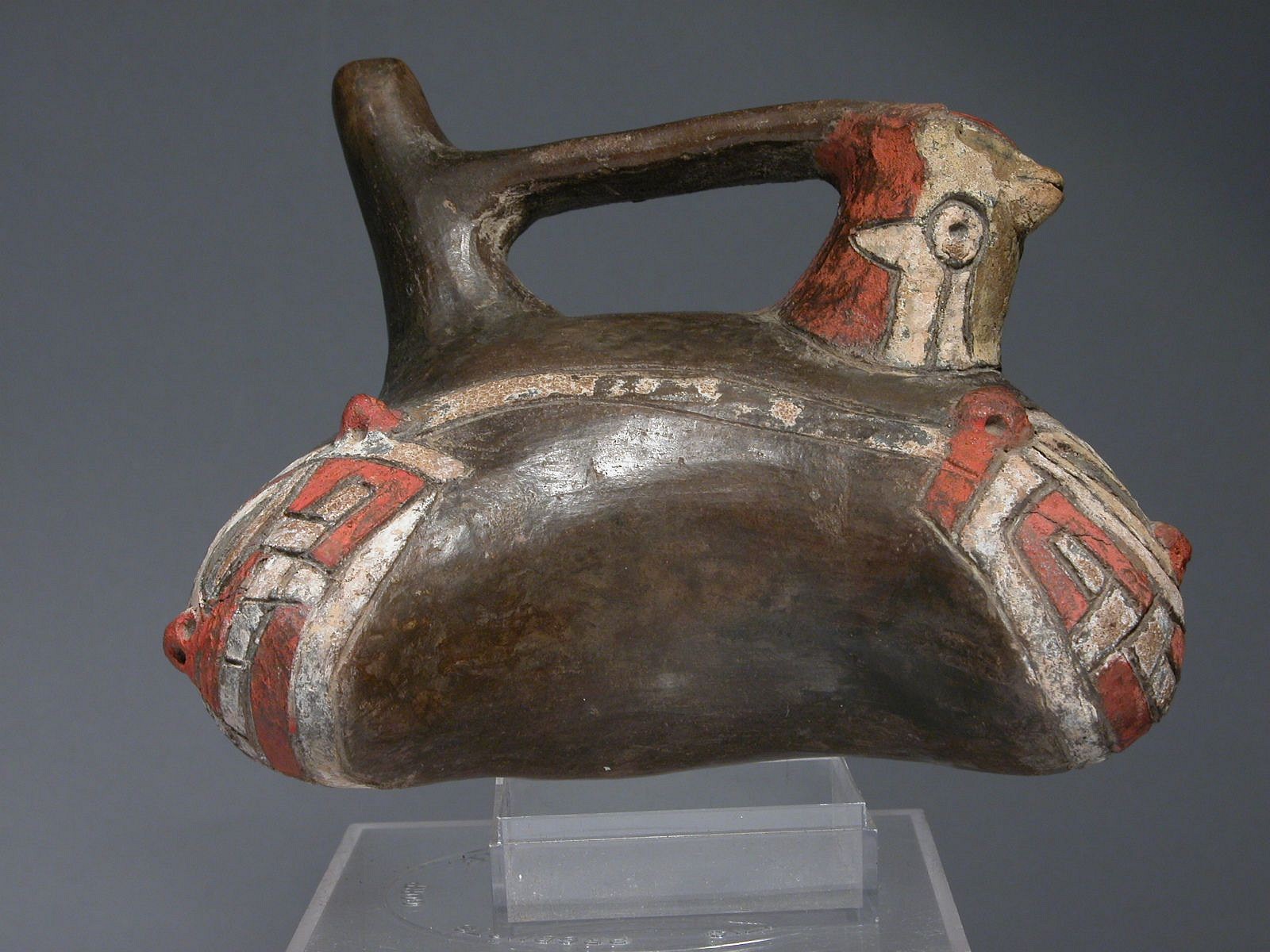
Peru | Paracas Bridge Spout Vessel with Falcon's Head | | David Bernstein Pre-Columbian Art. Extensive inventory of Pre-Columbian art from South America, including ancient objects in ceramic, textiles, bronze, copper and gold.
81 / 108

Peru, Paracas Bridge Spout Vessel with Falcon's Head

Peru, Paracas, Upper Callango basin phase 8, South Coast, c. 700 - 200 BC This beautiful ceramic blind bridge spout vessel is crafted in the shape of a falcon with a sculpted head and incised drawings to create the falcon’s body and wings. The chamber was enhanced with a series of squarish "U" shapes, accented with a single Chavinoid eye in profile. The vessel is decorated with post-firing slip colors of red, green, brown, and tan. A similar vessel is illustrated ANCIENT PERUVIAN CERAMICS: THE NATHAN CUMMINGS COLLECTION, pages 116 & 117. A detailed discussion regarding these vessels can be found in THE PARACAS POTTERY OF ICA - A STUDY IN STYLE AND TIME on page 333.

Period: Peru, Paracas, Upper Callango basin phase 8, South Coast, c. 700 - 200 BC

Period: Peru, Paracas, Upper Callango basin phase 8, South Coast, c. 700 - 200 BC

Media: Ceramic

Dimensions: Height: 5 in. Diameter: 6 in.

Price Upon Request

n2044C
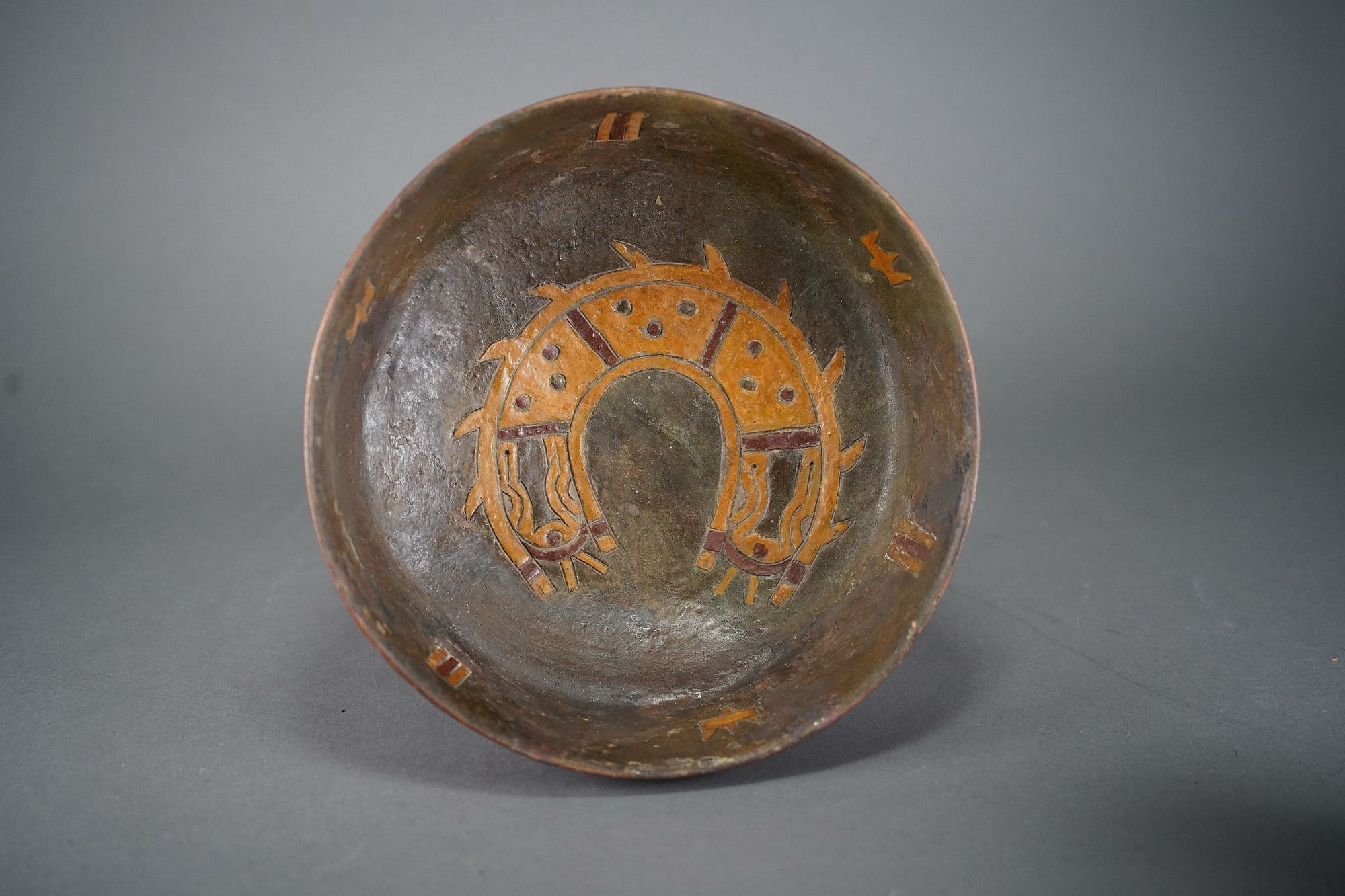
  • View all works
  • PLAY
  • I N Q U I R E
  • Share
  • Print
  • More Works
I N Q U I R E Share Print
Peru, Paracas Callango Bridge Spout Effigy Vessel
This early "Callango" style vessel was painted with post-fire red and white pigments. This vessel combines two classic Andean elements: the eared falcon and the double-headed serpent.   The bridge has a blind spout decorated with an eared falcon, while the body represents the double-headed Rainbow Serpent, a key figure in Andean cosmology. The double-head serpent motif originated during the Chavin period, and likely represents the Amphisbaena fuligoninos – a snake that appears to have two heads  to intimidate predators. Both the eared falcon ad the double-headed snake motifs are illustrated in Christopher Donnan’s, "Ancient Peruvian Ceramics" in plates 51 and 2.  Acquired from Christie’s in 1998, previously in an old estate prior to 1970. Period: Peru, Paracas, Early Phase, South Coast, c. 900 - 600 BC
Period: Peru, Paracas, Early Phase, South Coast, c. 900 - 600 BC
Media: Ceramic
Dimensions: Length: 5 1/2 x Height: 4"
$4,750
98429b
Peru | Paracas Callango Bridge Spout Effigy Vessel | | David Bernstein Pre-Columbian Art. Extensive inventory of Pre-Columbian art from South America, including ancient objects in ceramic, textiles, bronze, copper and gold.
82 / 108

Peru, Paracas Callango Bridge Spout Effigy Vessel

This early "Callango" style vessel was painted with post-fire red and white pigments. This vessel combines two classic Andean elements: the eared falcon and the double-headed serpent. The bridge has a blind spout decorated with an eared falcon, while the body represents the double-headed Rainbow Serpent, a key figure in Andean cosmology. The double-head serpent motif originated during the Chavin period, and likely represents the Amphisbaena fuligoninos – a snake that appears to have two heads to intimidate predators. Both the eared falcon ad the double-headed snake motifs are illustrated in Christopher Donnan’s, "Ancient Peruvian Ceramics" in plates 51 and 2. Acquired from Christie’s in 1998, previously in an old estate prior to 1970.

Period: Peru, Paracas, Early Phase, South Coast, c. 900 - 600 BC

Period: Peru, Paracas, Early Phase, South Coast, c. 900 - 600 BC

Media: Ceramic

Dimensions: Length: 5 1/2 x Height: 4"

$4,750

98429b

  • View all works
  • PLAY
  • I N Q U I R E
  • Share
  • Print
  • More Works
I N Q U I R E Share Print
Peru, Paracas Dish with Double-headed Serpent
This painted dish is illustrated with a curved double-headed serpent, painted on the inside of the bowl as is characteristic of the later Callango phases.  The double- headed serpent is a primal, animistic motif that originated early in Andean art history, during the Chavin period and is believed to depict an actual reptilian species known as Amphisbaena fuligoninos.  This strange nocturnal species, which can currently be found in Ecuador down to Chile, possesses genetic traits of both snakes and worms.   Although the amphisbaena snakes do not actually possess two heads, they evolved a tail that closely resembles their head as a defense mechanism against potential predators.  When threatened, the amphisbaena species displays confusing behavior, acting as if its tail is a second head.  The element of surprise diverts the attention of predators, creating confusion.  While the predators are deliberating about which head to attack, the Amphisbaena snake buys itself time to escape.  If attacked, there is a 50/50 chance the snake’s real head will be struck, allowing for an increased chance of survival.  Ancient shamans likely revered the snakes for their deceptive qualities and used their non-lethal, paralytic venom for medicinal properties.  
New York private collection prior to 1980.
Cracks professionally restored with some inpainting; all parts original. Period: Peru, Paracas, Callango, Phase 8, c. 300 - 200 BC

Period: Peru, Paracas, Callango, Phase 8, c. 300 - 200 BC
Media: Ceramic
Dimensions: Diameter: 7" x Height: 2 7/8"
$5,500
M9029
Peru | Paracas Dish with Double-headed Serpent | | David Bernstein Pre-Columbian Art. Extensive inventory of Pre-Columbian art from South America, including ancient objects in ceramic, textiles, bronze, copper and gold.
83 / 108

Peru, Paracas Dish with Double-headed Serpent

This painted dish is illustrated with a curved double-headed serpent, painted on the inside of the bowl as is characteristic of the later Callango phases. The double- headed serpent is a primal, animistic motif that originated early in Andean art history, during the Chavin period and is believed to depict an actual reptilian species known as Amphisbaena fuligoninos. This strange nocturnal species, which can currently be found in Ecuador down to Chile, possesses genetic traits of both snakes and worms. Although the amphisbaena snakes do not actually possess two heads, they evolved a tail that closely resembles their head as a defense mechanism against potential predators. When threatened, the amphisbaena species displays confusing behavior, acting as if its tail is a second head. The element of surprise diverts the attention of predators, creating confusion. While the predators are deliberating about which head to attack, the Amphisbaena snake buys itself time to escape. If attacked, there is a 50/50 chance the snake’s real head will be struck, allowing for an increased chance of survival. Ancient shamans likely revered the snakes for their deceptive qualities and used their non-lethal, paralytic venom for medicinal properties. New York private collection prior to 1980. Cracks professionally restored with some inpainting; all parts original.

Period: Peru, Paracas, Callango, Phase 8, c. 300 - 200 BC

Period: Peru, Paracas, Callango, Phase 8, c. 300 - 200 BC

Media: Ceramic

Dimensions: Diameter: 7" x Height: 2 7/8"

$5,500

M9029

  • View all works
  • PLAY
  • I N Q U I R E
  • Share
  • Print
  • More Works
I N Q U I R E Share Print
Peru, Paracas Falcon Effigy Vessel
This Paracas vessel has a blind-spout in the form of a falcon with pointed ears.  The compressed, ovoid-shaped body was decorated with resin, painted, and incised, directly below the bridge spout handle.  The chamber was enhanced with a series of squarish "U" shapes, accented with a central red stripe flanked by blocks of dark olive green and yellow ochre. These geometric configurations could be interpreted as highly abstracted bird forms and their presence is consistent within the development of the Phase 8 ceramic style.  The use of resin painted designs outlined by incisions, referred to as "zoned" design, can also be assigned to Phase 8.  Excellent literature and illustrations of the various phases of Paracas style ceramics are provided in Menzel, Rowe and Dawson's "The Paracas Pottery of Ica: A Study in Style and Time," 1969. Acquired by David Bernstein in 1994. Period: Peru, Callango style, Paracas, South Coast, c. 700 - 500 BC
Period: Peru, Callango style, Paracas, South Coast, c. 700 - 500 BC
Media: Ceramic
Dimensions: Height 4 5/8"
$2,800
94131
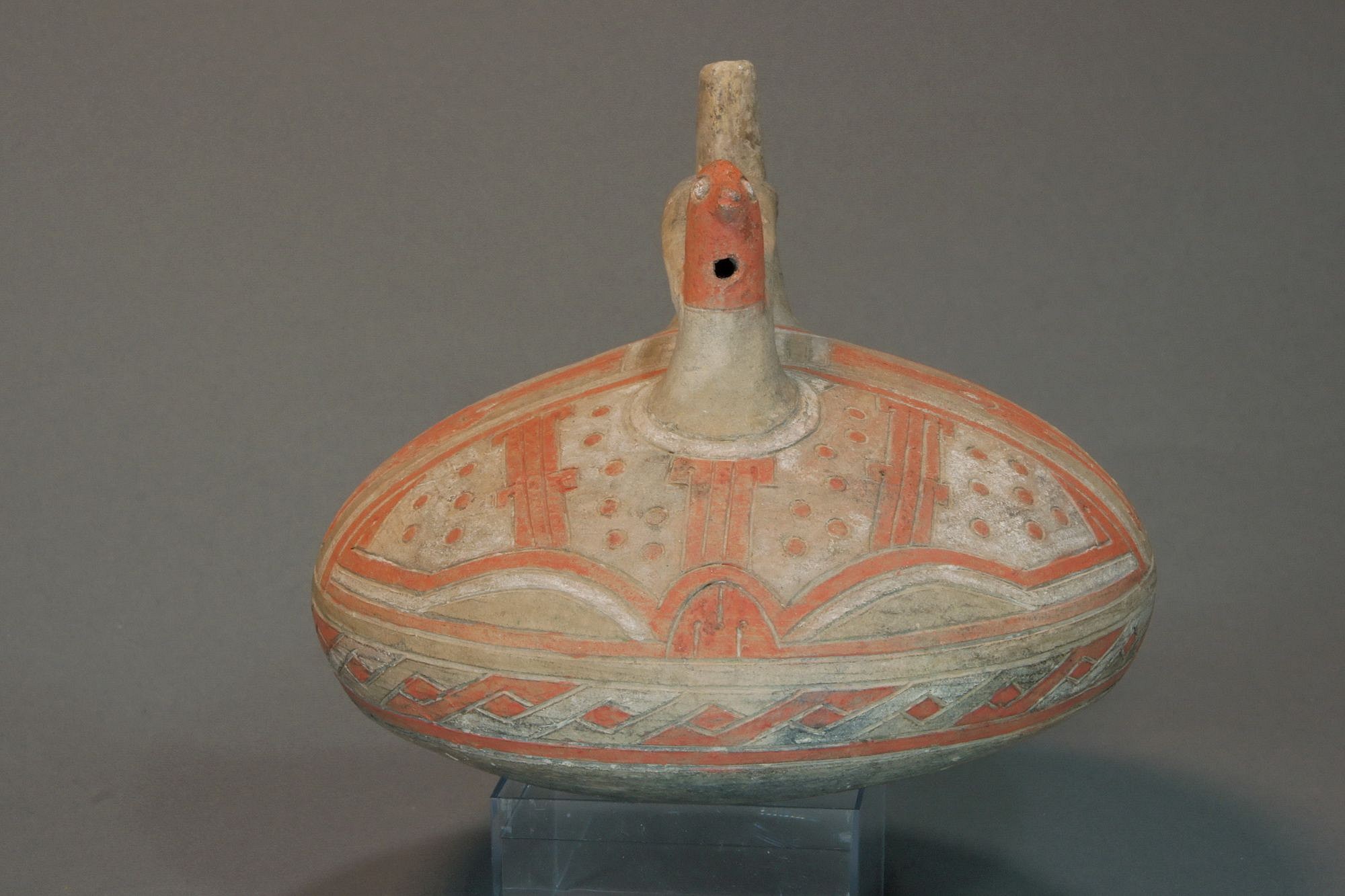
Peru | Paracas Falcon Effigy Vessel | | David Bernstein Pre-Columbian Art. Extensive inventory of Pre-Columbian art from South America, including ancient objects in ceramic, textiles, bronze, copper and gold.
84 / 108

Peru, Paracas Falcon Effigy Vessel

This Paracas vessel has a blind-spout in the form of a falcon with pointed ears. The compressed, ovoid-shaped body was decorated with resin, painted, and incised, directly below the bridge spout handle. The chamber was enhanced with a series of squarish "U" shapes, accented with a central red stripe flanked by blocks of dark olive green and yellow ochre. These geometric configurations could be interpreted as highly abstracted bird forms and their presence is consistent within the development of the Phase 8 ceramic style. The use of resin painted designs outlined by incisions, referred to as "zoned" design, can also be assigned to Phase 8. Excellent literature and illustrations of the various phases of Paracas style ceramics are provided in Menzel, Rowe and Dawson's "The Paracas Pottery of Ica: A Study in Style and Time," 1969. Acquired by David Bernstein in 1994.

Period: Peru, Callango style, Paracas, South Coast, c. 700 - 500 BC

Period: Peru, Callango style, Paracas, South Coast, c. 700 - 500 BC

Media: Ceramic

Dimensions: Height 4 5/8"

$2,800

94131
  • View all works
  • PLAY
  • I N Q U I R E
  • Share
  • Print
  • More Works
I N Q U I R E Share Print
Peru, Paracas Late Phase 7 Ceramic Bridge-Spout Vessel with Hawk Head and Incised Feline Face
Paracas Iconography has been described in detail in THE PARACAS POTTERY OF ICA: A Study in Style and Time, by D. Menzel, J. Rowe and L. Dawson, U.C Press Berkley, 1964, pages 75 - 100.  The hawk 's head is at the top of the blind spout, with its wings incised on the body of the vessel.  The feline face on the front of the vessel has a distinct nose with 3 vertical lines representing its nostrils, each ending in small holes. These features, along with the slender arching eyes and brow terminating with a closed triangle and an incised circle around the base of the spout indicate that this is a Paracas Phase 7 vessel.  See pages 232 and 325 of The Paracas Pottery of the Ica for similar illustrated vessels.  The incised lines are filled in with cinnabar pigment. From the estate of Dr. Ernst Barash, prior to 1969. Acquired by David Bernstein in 2014. Period: Peru, Paracas, Upper Callango Basin, Phase 8, South Coast, c. 700 - 200 BC
Period: Peru, Paracas, Upper Callango basin phase 6, South Coast, c. 700 - 200 BC
Dimensions: Height: 4" x Diameter: 5"
$8,500
n4046
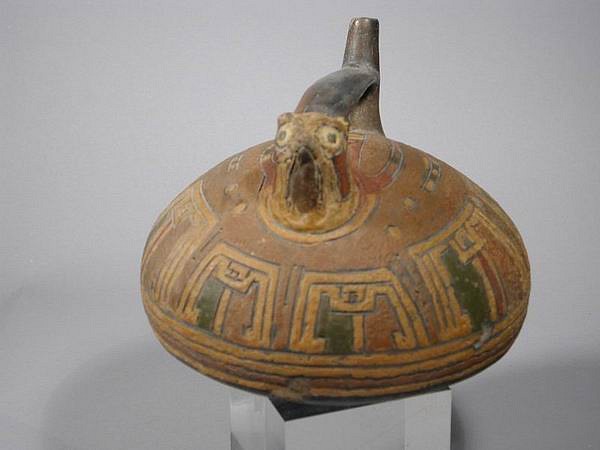
Peru | Paracas Late Phase 7 Ceramic Bridge-Spout Vessel with Hawk Head and Incised Feline Face | | David Bernstein Pre-Columbian Art. Extensive inventory of Pre-Columbian art from South America, including ancient objects in ceramic, textiles, bronze, copper and gold.
85 / 108

Peru, Paracas Late Phase 7 Ceramic Bridge-Spout Vessel with Hawk Head and Incised Feline Face

Paracas Iconography has been described in detail in THE PARACAS POTTERY OF ICA: A Study in Style and Time, by D. Menzel, J. Rowe and L. Dawson, U.C Press Berkley, 1964, pages 75 - 100. The hawk 's head is at the top of the blind spout, with its wings incised on the body of the vessel. The feline face on the front of the vessel has a distinct nose with 3 vertical lines representing its nostrils, each ending in small holes. These features, along with the slender arching eyes and brow terminating with a closed triangle and an incised circle around the base of the spout indicate that this is a Paracas Phase 7 vessel. See pages 232 and 325 of The Paracas Pottery of the Ica for similar illustrated vessels. The incised lines are filled in with cinnabar pigment. From the estate of Dr. Ernst Barash, prior to 1969. Acquired by David Bernstein in 2014.

Period: Peru, Paracas, Upper Callango Basin, Phase 8, South Coast, c. 700 - 200 BC

Period: Peru, Paracas, Upper Callango basin phase 6, South Coast, c. 700 - 200 BC

Dimensions: Height: 4" x Diameter: 5"

$8,500

n4046
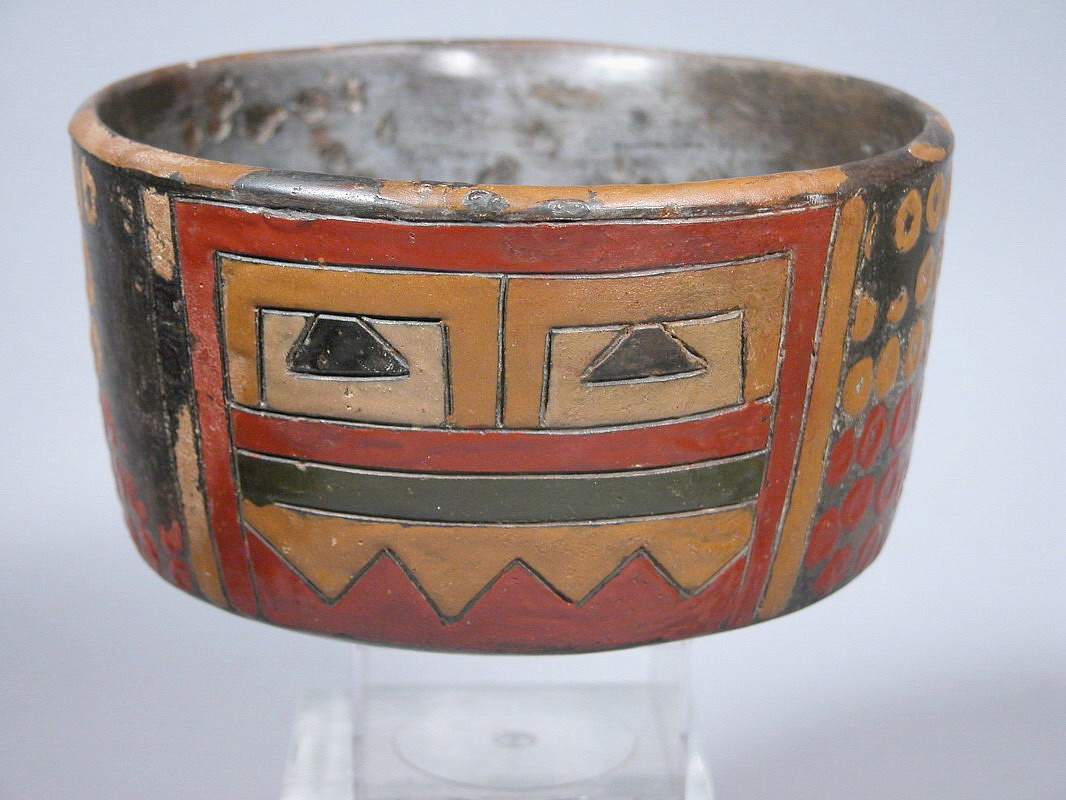
  • View all works
  • PLAY
  • I N Q U I R E
  • Share
  • Print
  • More Works
I N Q U I R E Share Print
Peru, Paracas Ocucaje Bridge Spout Vessel
This Paracas vessel has one blind spout modeled in the form of a falcon’s head with feline ears.  The compressed, ovoid body was decorated with a resin-painted and incised bird directly below the bridge spout handle.  The chamber was enhanced with a series of squarish "U" shapes, accented with a single Chavinoid eye in profile. The circumference is decorated with blocks of dark olive green and yellow ochre.  These geometric configurations resemble abstract bird forms, the style of which is consistent the Paracas Phase 8 ceramic style.  The use of resin painted designs outlined by incisions, referred to as "zoned" design, can also be assigned to Phase 8.  Literature and illustrations of the various phases of Paracas style ceramics are provided in Menzel, Rowe and Dawson, "The Paracas Pottery of Ica: A Study in Style and Time" (1969). Acquired from Auction in 2016 from an old estate. Period: Peru, Paracas, Ocucaje Phase 8, South Coast, c. 700 - 200 BC

Period: Peru, Paracas, Ocucaje Phase 8, South Coast, c. 700 - 200 BC
Media: Ceramic
Dimensions: Height: 5 1/2 " x Diameter: 5 1/2"
$4,000
98137B
Peru | Paracas Ocucaje Bridge Spout Vessel | | David Bernstein Pre-Columbian Art. Extensive inventory of Pre-Columbian art from South America, including ancient objects in ceramic, textiles, bronze, copper and gold.
86 / 108

Peru, Paracas Ocucaje Bridge Spout Vessel

This Paracas vessel has one blind spout modeled in the form of a falcon’s head with feline ears. The compressed, ovoid body was decorated with a resin-painted and incised bird directly below the bridge spout handle. The chamber was enhanced with a series of squarish "U" shapes, accented with a single Chavinoid eye in profile. The circumference is decorated with blocks of dark olive green and yellow ochre. These geometric configurations resemble abstract bird forms, the style of which is consistent the Paracas Phase 8 ceramic style. The use of resin painted designs outlined by incisions, referred to as "zoned" design, can also be assigned to Phase 8. Literature and illustrations of the various phases of Paracas style ceramics are provided in Menzel, Rowe and Dawson, "The Paracas Pottery of Ica: A Study in Style and Time" (1969). Acquired from Auction in 2016 from an old estate.

Period: Peru, Paracas, Ocucaje Phase 8, South Coast, c. 700 - 200 BC

Period: Peru, Paracas, Ocucaje Phase 8, South Coast, c. 700 - 200 BC

Media: Ceramic

Dimensions: Height: 5 1/2 " x Diameter: 5 1/2"

$4,000

98137B

  • View all works
  • PLAY
  • I N Q U I R E
  • Share
  • Print
  • More Works
I N Q U I R E Share Print
Peru, Paracas Polychrome Bowl with Incised Mask Design
This Paracas bowl was decorated with an abstracted geometric mask painted in rich post-fire pigments of red, ochre, olive green, and buff.  The bowl also features geometric checkerboard patterns to the left and right of the face. There is a slight lip on the upper rim for pouring or drinking ritual libations.  Abstract geometric vessels such as this were highly sought after by European and American painters during the heyday of the Modernist movement in the early and Mid-20th Century. A similar example is on display at the Metropolitan Museum of Art in New York and is illustrated in Alan Sawyer's, "Ancient Peruvian Ceramics," 1966, on page 74. This vessel has excellent provenance. It was acquired prior to 1970 and was loaned by the Landmann family of Westchester, NY, to the American Museum of Natural History in New York, where it was on view from 1984 to 1994. Period: Peru, Paracas, Late Phase, South Coast, c. 300 - 200 BC
Period: Peru, Paracas, Late Phase, South Coast, c. 300 - 200 BC
Media: Ceramic
Dimensions: Height 3.14" Diameter 5.3/4"
$16,500
94081
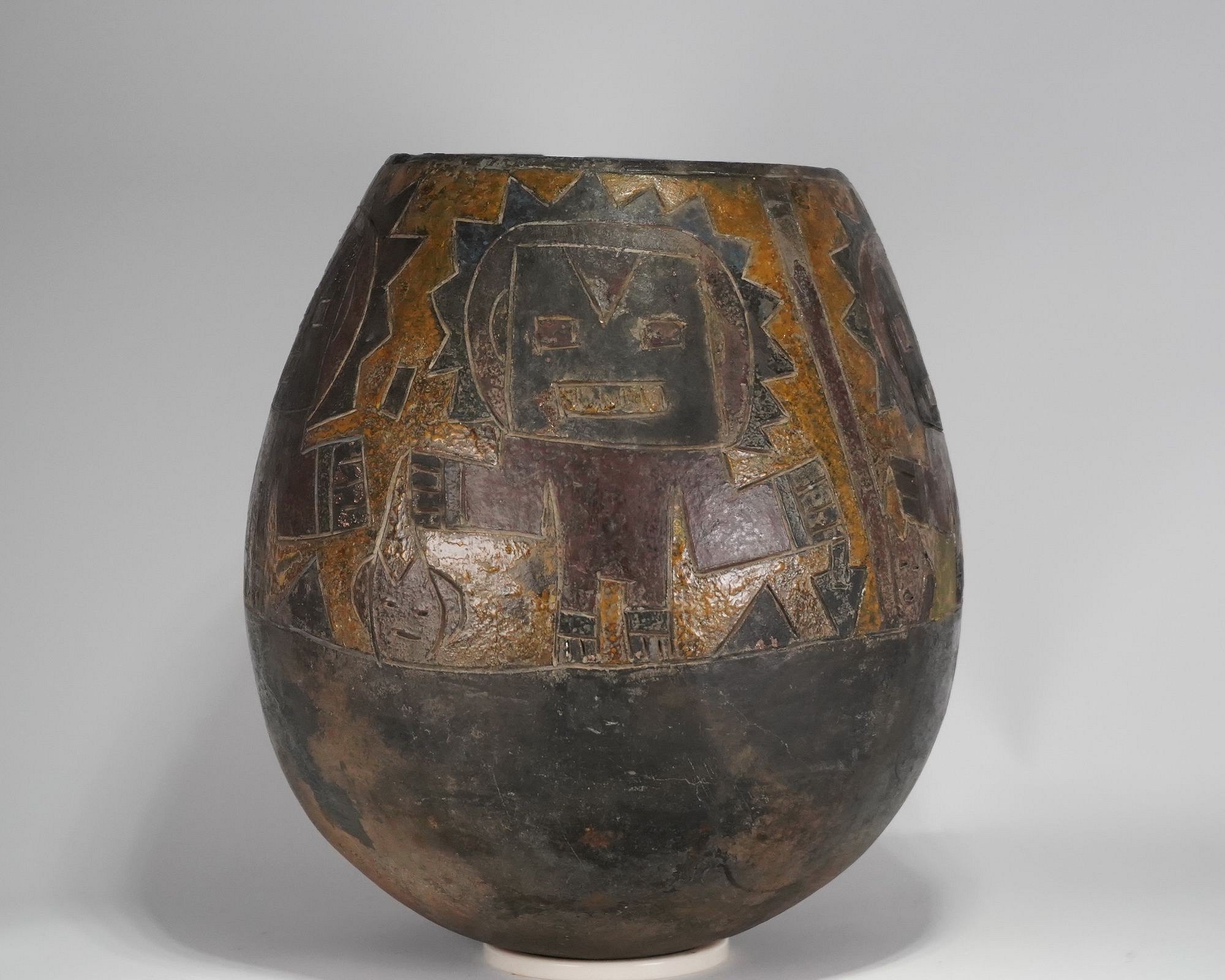
Peru | Paracas Polychrome Bowl with Incised Mask Design | | David Bernstein Pre-Columbian Art. Extensive inventory of Pre-Columbian art from South America, including ancient objects in ceramic, textiles, bronze, copper and gold.
87 / 108

Peru, Paracas Polychrome Bowl with Incised Mask Design

This Paracas bowl was decorated with an abstracted geometric mask painted in rich post-fire pigments of red, ochre, olive green, and buff. The bowl also features geometric checkerboard patterns to the left and right of the face. There is a slight lip on the upper rim for pouring or drinking ritual libations. Abstract geometric vessels such as this were highly sought after by European and American painters during the heyday of the Modernist movement in the early and Mid-20th Century. A similar example is on display at the Metropolitan Museum of Art in New York and is illustrated in Alan Sawyer's, "Ancient Peruvian Ceramics," 1966, on page 74. This vessel has excellent provenance. It was acquired prior to 1970 and was loaned by the Landmann family of Westchester, NY, to the American Museum of Natural History in New York, where it was on view from 1984 to 1994.

Period: Peru, Paracas, Late Phase, South Coast, c. 300 - 200 BC

Period: Peru, Paracas, Late Phase, South Coast, c. 300 - 200 BC

Media: Ceramic

Dimensions: Height 3.14" Diameter 5.3/4"

$16,500

94081
  • View all works
  • PLAY
  • I N Q U I R E
  • Share
  • Print
  • More Works
I N Q U I R E Share Print
Peru, Paracas Style Ceramic Ovoid Urn
This beautiful ceramic funerary urn features four warriors, crafted with both lines and color applied to the surface with resin painting.  Each shamanic warrior holds a trophy head, and one warrior also holds an obsidian pointed knife.  The post fire resin painting features copper hued reds and browns, marron, yellow ochre, and dark blue.  These large ovoid urns are rare, unique to a small 150 km area between the Pisco River and the Ica River, circa 200 to 100 BC.  The shape and the drawing of the figures' facial features indicates that the urn is likely from the Late Paracas Period, Paracas Phases 9 and 10. A similar vessel from the same region in the collection of the National Museum of the American Indian is illustrated in Indian Art in South America, by Frederick Dockstader on page 100 and in PAINTED CLOTH MUMMY MASKS OF ICA, PERU,fig. 21.  
Cracks restored especially to the lower section.  There are large areas of loss of the original pigment.Acquired by David Bernstein in 2012. Period: Peru, Paracas, Ocucaje Phase 9, Ica valley, South Coast, c. 300 - 200 BC
Period: Peru, Paracas, Ocucaje Phase 8, Ica valley, South Coast, c. 300 - 200 BC
Media: Ceramic
Dimensions: Height: 11" x Diameter: 9 1/2"
$18,500
n2112
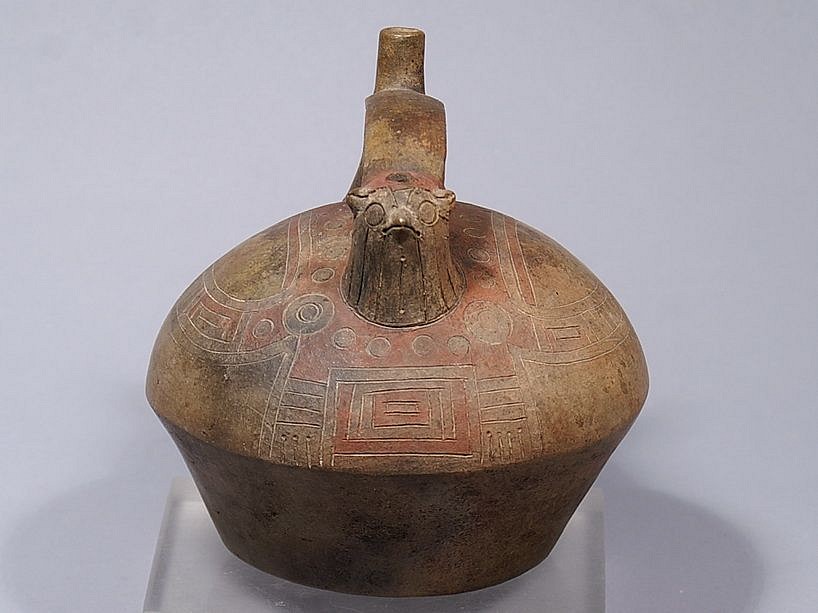
Peru | Paracas Style Ceramic Ovoid Urn | | David Bernstein Pre-Columbian Art. Extensive inventory of Pre-Columbian art from South America, including ancient objects in ceramic, textiles, bronze, copper and gold.
88 / 108

Peru, Paracas Style Ceramic Ovoid Urn

This beautiful ceramic funerary urn features four warriors, crafted with both lines and color applied to the surface with resin painting. Each shamanic warrior holds a trophy head, and one warrior also holds an obsidian pointed knife. The post fire resin painting features copper hued reds and browns, marron, yellow ochre, and dark blue. These large ovoid urns are rare, unique to a small 150 km area between the Pisco River and the Ica River, circa 200 to 100 BC. The shape and the drawing of the figures' facial features indicates that the urn is likely from the Late Paracas Period, Paracas Phases 9 and 10. A similar vessel from the same region in the collection of the National Museum of the American Indian is illustrated in Indian Art in South America, by Frederick Dockstader on page 100 and in PAINTED CLOTH MUMMY MASKS OF ICA, PERU,fig. 21.
Cracks restored especially to the lower section. There are large areas of loss of the original pigment.
Acquired by David Bernstein in 2012.

Period: Peru, Paracas, Ocucaje Phase 9, Ica valley, South Coast, c. 300 - 200 BC

Period: Peru, Paracas, Ocucaje Phase 8, Ica valley, South Coast, c. 300 - 200 BC

Media: Ceramic

Dimensions: Height: 11" x Diameter: 9 1/2"

$18,500

n2112
  • View all works
  • PLAY
  • I N Q U I R E
  • Share
  • Print
  • More Works
I N Q U I R E Share Print
Peru, Paracas, Juan Pablo Style Falcon Bridge-spout Vessel
The blind spout at one end of the bridge handle of this vessel is modeled with a falcon's head, a typical feature of the Early Paracas style found at the Juan Pablo site.  The surface on the upper body of the vessel has been delicately incised and painted to show the outstretched wings and tail feathers of the falcon. The falcon's body is decorated with circular pelt markings in a precise arrangement, with clearly delineated talons. The lower portion of the body has been left undecorated, as it would have been buried in the desert sand.  The overall color scheme consists of red, orange, ochre, black, and cream pigments.  This is a beautifully preserved example of Phase 3 of the Early Paracas period, in contrast to most Juan Pablo vessels which have been heavily restored.  Similar examples of this style are illustrated and discussed in Alan R. Sawyer's "Ancient Peruvian Ceramics: The Nathan Cummings Collection," published by The Metropolitan Museum of Art, New York in 1966.  Ex Collection of Jerome Pustilnik, acquired from Alan Lapiner prior to 1970. Period: Peru, Paracas, Ocucaje, South Coast, c. 300 - 200 BC
Period: Peru, Paracas, Ocucaje, South Coast, c. 300 - 200 BC
Media: Ceramic
Dimensions: H. 5 3/4 x L. 5 1/2 in.
$8,500
91002
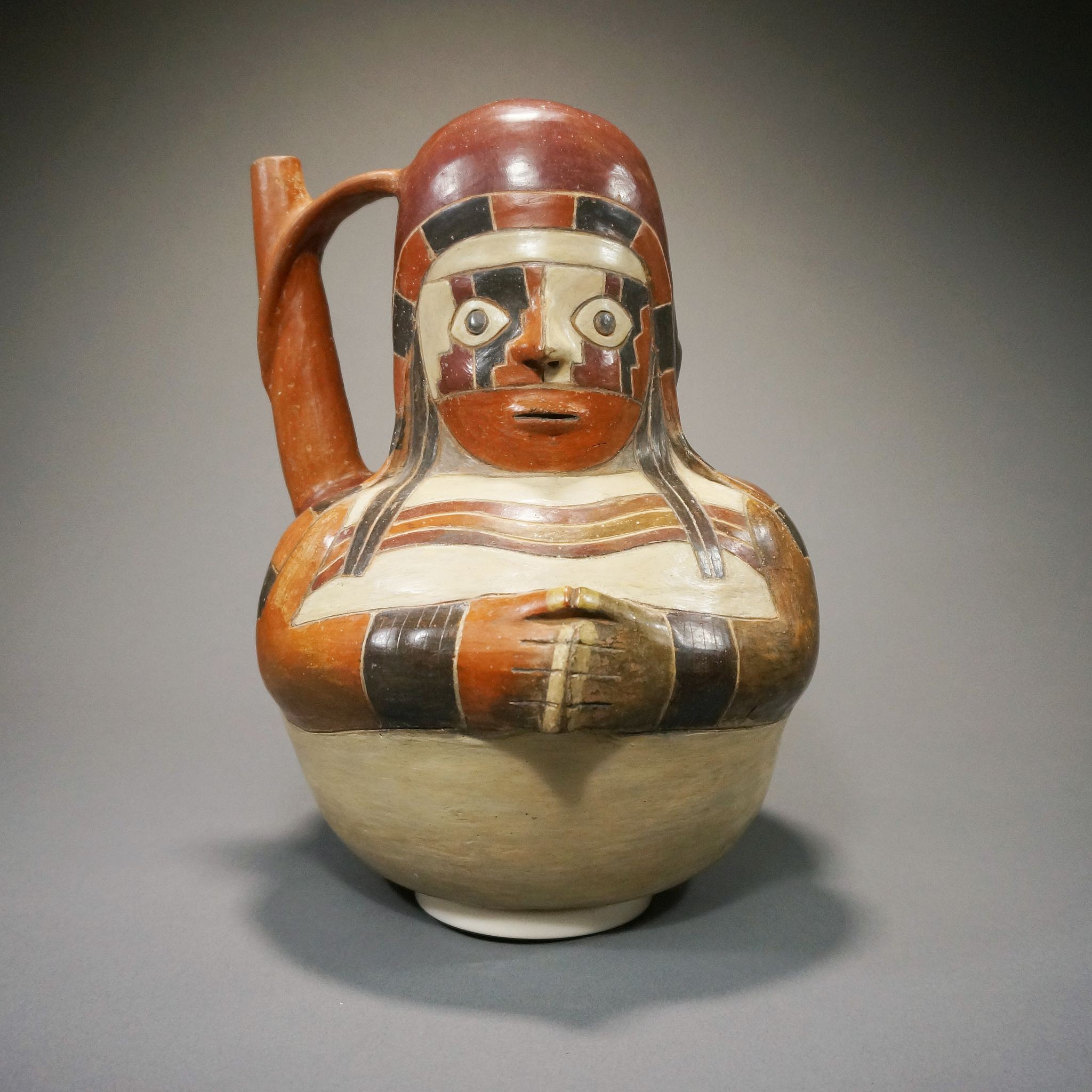
Peru | Paracas, Juan Pablo Style Falcon Bridge-spout Vessel | | David Bernstein Pre-Columbian Art. Extensive inventory of Pre-Columbian art from South America, including ancient objects in ceramic, textiles, bronze, copper and gold.
89 / 108

Peru, Paracas, Juan Pablo Style Falcon Bridge-spout Vessel

The blind spout at one end of the bridge handle of this vessel is modeled with a falcon's head, a typical feature of the Early Paracas style found at the Juan Pablo site. The surface on the upper body of the vessel has been delicately incised and painted to show the outstretched wings and tail feathers of the falcon. The falcon's body is decorated with circular pelt markings in a precise arrangement, with clearly delineated talons. The lower portion of the body has been left undecorated, as it would have been buried in the desert sand. The overall color scheme consists of red, orange, ochre, black, and cream pigments. This is a beautifully preserved example of Phase 3 of the Early Paracas period, in contrast to most Juan Pablo vessels which have been heavily restored. Similar examples of this style are illustrated and discussed in Alan R. Sawyer's "Ancient Peruvian Ceramics: The Nathan Cummings Collection," published by The Metropolitan Museum of Art, New York in 1966. Ex Collection of Jerome Pustilnik, acquired from Alan Lapiner prior to 1970.

Period: Peru, Paracas, Ocucaje, South Coast, c. 300 - 200 BC

Period: Peru, Paracas, Ocucaje, South Coast, c. 300 - 200 BC

Media: Ceramic

Dimensions: H. 5 3/4 x L. 5 1/2 in.

$8,500

91002
  • View all works
  • PLAY
  • I N Q U I R E
  • Share
  • Print
  • More Works
I N Q U I R E Share Print
Peru, Proto Nasca Janus Head Effigy of a Smoker
This rare Nasca Janus-headed shaman has two faces, one on either side; both faces depict the same individual who morphs in behavior as the vessel is rotated, telling a narrative story.  At the starting side of the narrative, the shaman is smoking a psychoactive plant, possibly tobacco combined with another entheogen. When the vessel is rotated, the same shaman has his face painted and is starring as if he is in a trance. In addition, he is seen wearing an elaborate ritual garb that includes a headdress, a face mask with a step-fret design, and a band of three waved lines across his chest.  These garments were not every day utilitarian clothing, and instead indicate a ritual shamanic costume reserved for important ceremonies.  The archaeological record indicates that many ancient Andean cultures may have smoked or drank preparations that contained mixtures of tobacco combined with other psychoactive substances.  There are very few representations of people smoking in Andean art, but the Spanish chroniclers describe the prevalence of smoking tobacco among the Inca. The early date of this ceramic suggests the use of tobacco in Pre-Columbia as early as AD 100. Acquired in 2004 in Paris. Formerly in the collection of Jean Lions. Period: Nasca, Proto Phase, South Coast, c. 100 BC - AD 200
Period: Peru, Nasca, Proto Phase, South Coast, c. 100 BC - AD 200
Media: Ceramic
Dimensions: Height: 10 1/4"
$28,000
M4047
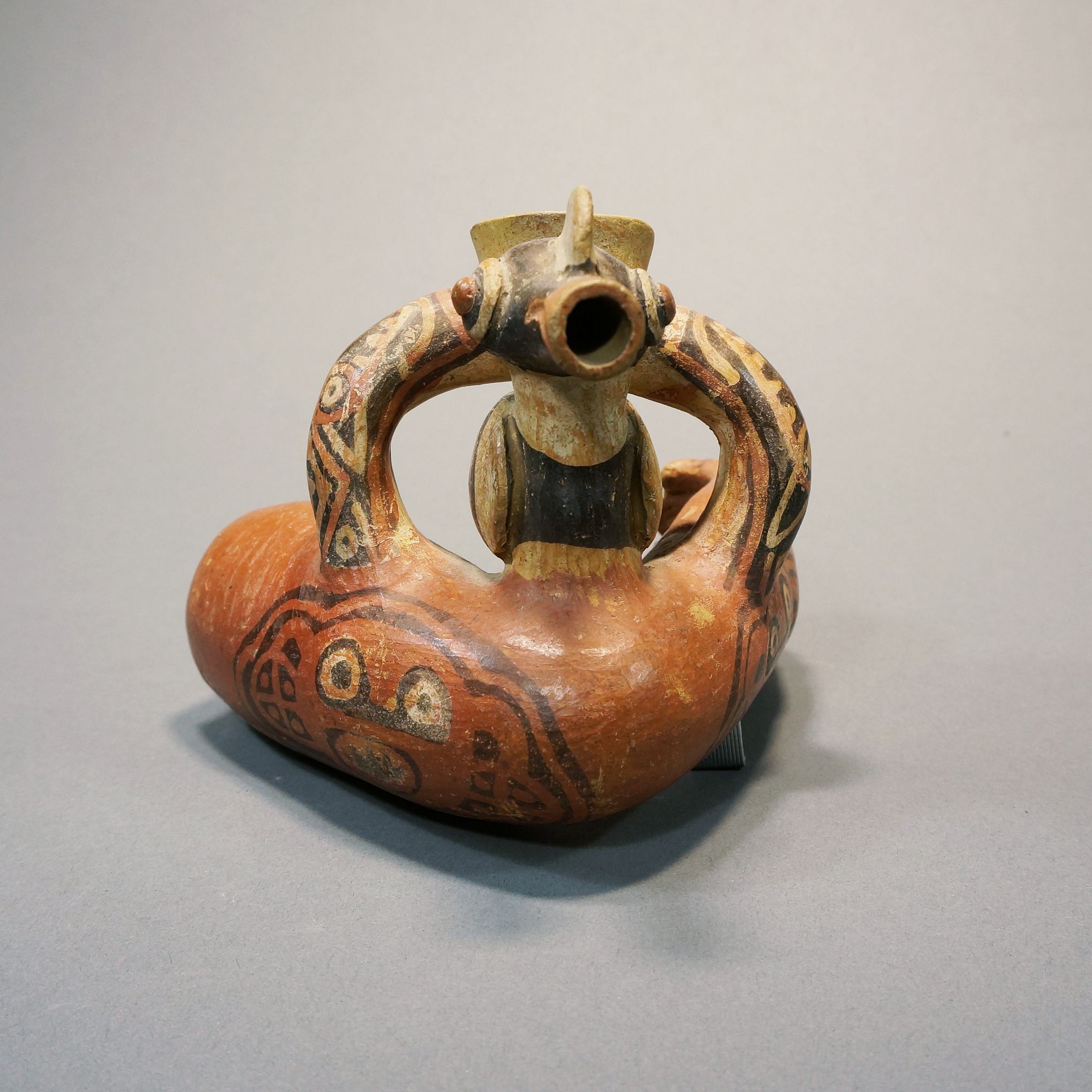
Peru | Proto Nasca Janus Head Effigy of a Smoker | | David Bernstein Pre-Columbian Art. Extensive inventory of Pre-Columbian art from South America, including ancient objects in ceramic, textiles, bronze, copper and gold.
90 / 108

Peru, Proto Nasca Janus Head Effigy of a Smoker

This rare Nasca Janus-headed shaman has two faces, one on either side; both faces depict the same individual who morphs in behavior as the vessel is rotated, telling a narrative story. At the starting side of the narrative, the shaman is smoking a psychoactive plant, possibly tobacco combined with another entheogen. When the vessel is rotated, the same shaman has his face painted and is starring as if he is in a trance. In addition, he is seen wearing an elaborate ritual garb that includes a headdress, a face mask with a step-fret design, and a band of three waved lines across his chest. These garments were not every day utilitarian clothing, and instead indicate a ritual shamanic costume reserved for important ceremonies. The archaeological record indicates that many ancient Andean cultures may have smoked or drank preparations that contained mixtures of tobacco combined with other psychoactive substances. There are very few representations of people smoking in Andean art, but the Spanish chroniclers describe the prevalence of smoking tobacco among the Inca. The early date of this ceramic suggests the use of tobacco in Pre-Columbia as early as AD 100. Acquired in 2004 in Paris. Formerly in the collection of Jean Lions.

Period: Nasca, Proto Phase, South Coast, c. 100 BC - AD 200

Period: Peru, Nasca, Proto Phase, South Coast, c. 100 BC - AD 200

Media: Ceramic

Dimensions: Height: 10 1/4"

$28,000

M4047
  • View all works
  • PLAY
  • I N Q U I R E
  • Share
  • Print
  • More Works
I N Q U I R E Share Print
Peru, Recuay Bridge Spout Effigy Vessel
This unusual figurative effigy depicts a clenched human arm decorated with a tattoo of a face with ear spools and a large-eye condor siting under the bridge spout.  The painted face is referred to as the "circular head motif" and signifies a celestial deity (Grieder, Terrence, The Art and Archaeology of Pashash, 1978).  The condor is the largest and most powerful bird in the Andes. The clenched fist motif depicts a severed bone, the meaning of which is not clear, however, condors were known to eat the remains of sacrificed captives.  A similar example is in the Berlin Volkeunde museum and is illustrated in KULTUREN RECUAY IV by Deiter Eisleb, pg.194.

Period: Peru, Recuay, North Highlands, c. 300 BC - AD 700
Media: Ceramic
Dimensions: Height  4 1/8"
$3,500
96148
Peru | Recuay Bridge Spout Effigy Vessel | | David Bernstein Pre-Columbian Art. Extensive inventory of Pre-Columbian art from South America, including ancient objects in ceramic, textiles, bronze, copper and gold.
91 / 108

Peru, Recuay Bridge Spout Effigy Vessel

This unusual figurative effigy depicts a clenched human arm decorated with a tattoo of a face with ear spools and a large-eye condor siting under the bridge spout.  The painted face is referred to as the "circular head motif" and signifies a celestial deity (Grieder, Terrence, The Art and Archaeology of Pashash, 1978).  The condor is the largest and most powerful bird in the Andes. The clenched fist motif depicts a severed bone, the meaning of which is not clear, however, condors were known to eat the remains of sacrificed captives.  A similar example is in the Berlin Volkeunde museum and is illustrated in KULTUREN RECUAY IV by Deiter Eisleb, pg.194.

Period: Peru, Recuay, North Highlands, c. 300 BC - AD 700

Media: Ceramic

Dimensions: Height 4 1/8"

$3,500

96148

  • View all works
  • PLAY
  • I N Q U I R E
  • Share
  • Print
  • More Works
I N Q U I R E Share Print
Peru, Recuay Ceremonial Procession or Audience Vessel
A shaman is the central figure surrounded by five attendants all holding what appears to be lime containers for the coca chewing ritual.  The shaman is wearing an elaborate headdress while the attends are wearing cloth headdress.  Decorated in orange slip on white ground.  A very similar piece is illustrated in  ALTPERUANISCHE KULTUREN - RECUAY IV pg. 117-120
Period: Peru, Recuay, North Highlands, c. 300 BC - AD 700
Media: Ceramic
Dimensions: Height 8"  x Diameter 6.5"
Price Upon Request
M9014
Peru | Recuay Ceremonial Procession or Audience Vessel | | David Bernstein Pre-Columbian Art. Extensive inventory of Pre-Columbian art from South America, including ancient objects in ceramic, textiles, bronze, copper and gold.
92 / 108

Peru, Recuay Ceremonial Procession or Audience Vessel

A shaman is the central figure surrounded by five attendants all holding what appears to be lime containers for the coca chewing ritual. The shaman is wearing an elaborate headdress while the attends are wearing cloth headdress. Decorated in orange slip on white ground. A very similar piece is illustrated in ALTPERUANISCHE KULTUREN - RECUAY IV pg. 117-120

Period: Peru, Recuay, North Highlands, c. 300 BC - AD 700

Media: Ceramic

Dimensions: Height 8" x Diameter 6.5"

Price Upon Request

M9014

  • View all works
  • PLAY
  • I N Q U I R E
  • Share
  • Print
  • More Works
I N Q U I R E Share Print
Peru, Recuay Mythical animal effigy vessel
The animal has attributes of a feline with oversized incisors and a long tail in the rear. The animal is anthropomorphic with human hands and feet displayed in a sitting position. He has red slip and negative resist decoration on a white ground. This motif is unusual in that the same posture is mostly represented by males on ceramics, while this is an animal. I know of other such examples illustrated in the literature.
Period: Peru, Recuay, North Coast, circa 300 BC-AD300
Media: Ceramic
Dimensions: Height 8"
Price Upon Request
M9015
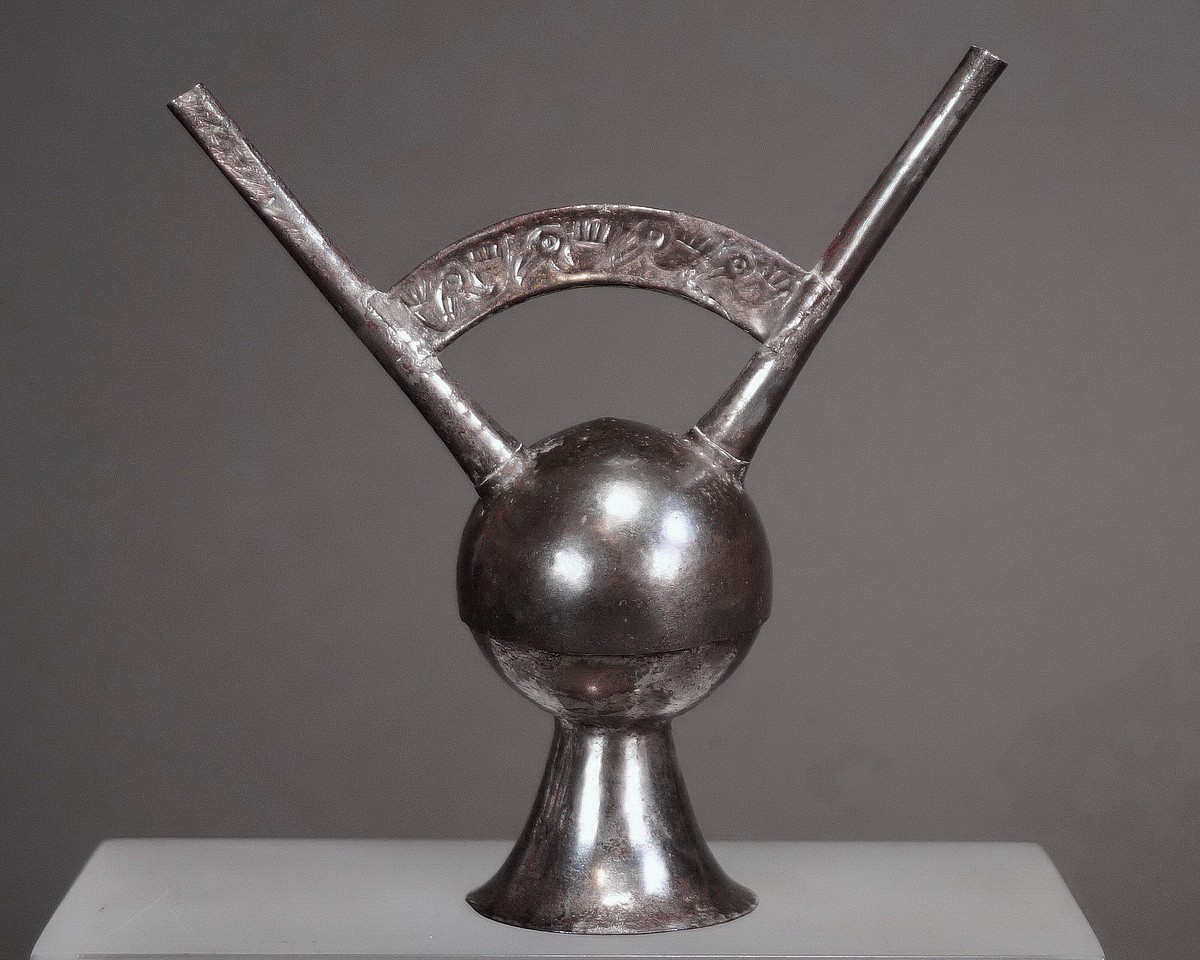
Peru | Recuay Mythical animal effigy vessel | | David Bernstein Pre-Columbian Art. Extensive inventory of Pre-Columbian art from South America, including ancient objects in ceramic, textiles, bronze, copper and gold.
93 / 108

Peru, Recuay Mythical animal effigy vessel

The animal has attributes of a feline with oversized incisors and a long tail in the rear. The animal is anthropomorphic with human hands and feet displayed in a sitting position. He has red slip and negative resist decoration on a white ground. This motif is unusual in that the same posture is mostly represented by males on ceramics, while this is an animal. I know of other such examples illustrated in the literature.

Period: Peru, Recuay, North Coast, circa 300 BC-AD300

Media: Ceramic

Dimensions: Height 8"

Price Upon Request

M9015
  • View all works
  • PLAY
  • I N Q U I R E
  • Share
  • Print
  • More Works
I N Q U I R E Share Print
Peru, Sican Gilt Silver Miniature Double Spouted Vessel
The vessel was made for a child's tomb.  It has an arched bridge with four marine birds embossed on each side and is made from 6 components that are soldered together.  The base metal is copper, and there is a thin outer layer of silver, which is worn in a few places.  Gilding, the method used to create this vessel, was a much more difficult process then sculpting with pure silver.
Period: Peru, Sican, Batan Grande (Upper Leche River Valley), North Coast, c. AD 850 - 1150
Media: Metal
Dimensions: Height: 5" x Width: 4 3/4"
Price Upon Request
n8036
Peru | Sican Gilt Silver Miniature Double Spouted Vessel | | David Bernstein Pre-Columbian Art. Extensive inventory of Pre-Columbian art from South America, including ancient objects in ceramic, textiles, bronze, copper and gold.
94 / 108

Peru, Sican Gilt Silver Miniature Double Spouted Vessel

The vessel was made for a child's tomb. It has an arched bridge with four marine birds embossed on each side and is made from 6 components that are soldered together. The base metal is copper, and there is a thin outer layer of silver, which is worn in a few places. Gilding, the method used to create this vessel, was a much more difficult process then sculpting with pure silver.

Period: Peru, Sican, Batan Grande (Upper Leche River Valley), North Coast, c. AD 850 - 1150

Media: Metal

Dimensions: Height: 5" x Width: 4 3/4"

Price Upon Request

n8036

  • View all works
  • PLAY
  • I N Q U I R E
  • Share
  • Print
  • More Works
I N Q U I R E Share Print
Peru, Sican Gold Flared Beaker with Embossed Toads
Bufo Marinus toads, depicted on this vessel beaker, are found on the dry coastal desert coast of Northern Peru.  These toads are identifiable by their highly textured skin, represented by six sets of incised circles. Acquired from a private Texas collector, prior to the 1970s.  Some traces of cinnabar.
Period: Peru, North Coast, Sican, Batan Grande,
Media: Metal
Dimensions: Height: 51/2" x Width: 4.2" Weight: 118 grams.
$32,000
N6001
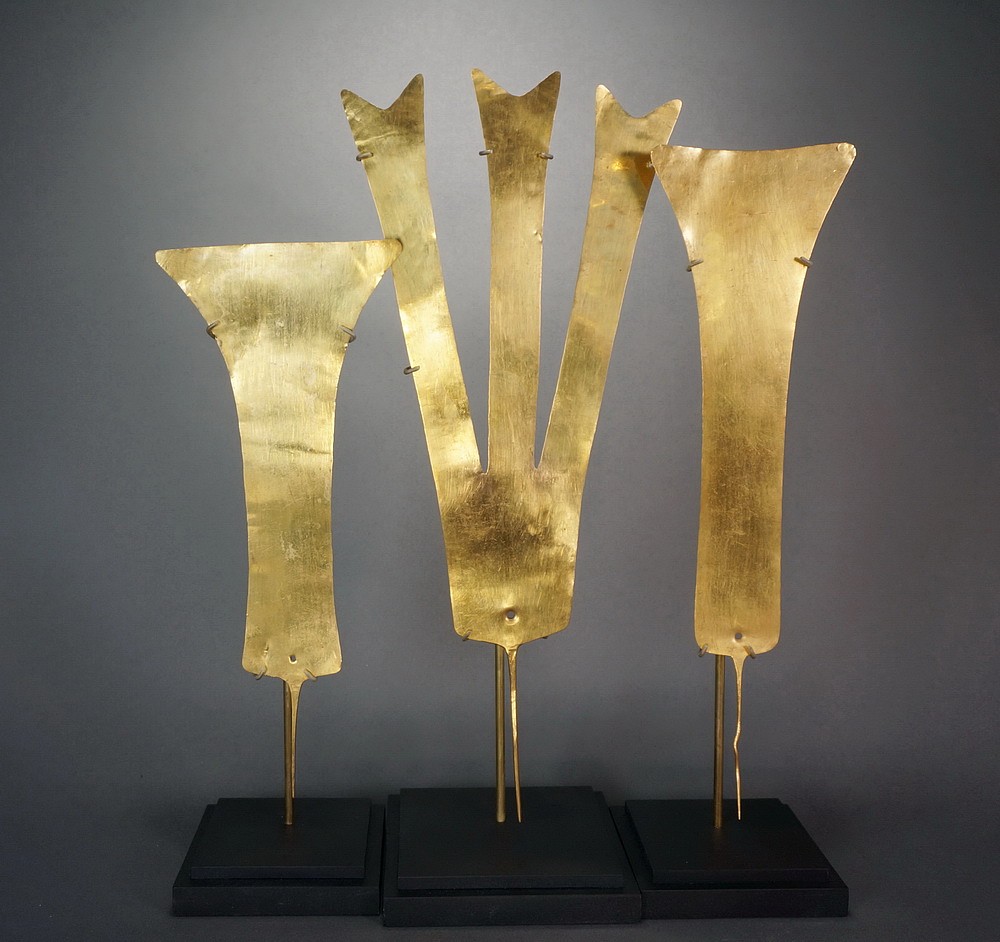
Peru | Sican Gold Flared Beaker with Embossed Toads | | David Bernstein Pre-Columbian Art. Extensive inventory of Pre-Columbian art from South America, including ancient objects in ceramic, textiles, bronze, copper and gold.
95 / 108

Peru, Sican Gold Flared Beaker with Embossed Toads

Bufo Marinus toads, depicted on this vessel beaker, are found on the dry coastal desert coast of Northern Peru. These toads are identifiable by their highly textured skin, represented by six sets of incised circles. Acquired from a private Texas collector, prior to the 1970s. Some traces of cinnabar.

Period: Peru, North Coast, Sican, Batan Grande,

Media: Metal

Dimensions: Height: 51/2" x Width: 4.2" Weight: 118 grams.

$32,000

N6001

  • View all works
  • PLAY
  • I N Q U I R E
  • Share
  • Print
  • More Works
I N Q U I R E Share Print
Peru, Three Chavin Gold Plumes for Headdress
Three hammered gold plumes were used as headdress or turban ornaments with tapering shafts.  They were each fabricated from an individual nugget by repeatedly hammering and annealing. They are illustrated in TRUJILLO Precolumbino, Odebrecht-Lavalle, Editores 1990, pg 293.  Other similar examples are illustrated in Oro del Antiguo Peru, pl. 51.  These plumes are considered very large for early Peruvian  goldwork.
Period: Peru, Chavin, Tembladera, Late Phase, North Coast, c. 900 - 200 BC
Media: Metal
Dimensions: Height: 9", 11", 12"  Weight for the three 90 gramsXRF: Au.81, Ag. 9.5%, Cu. 10.1%  average for the 3
Price Upon Request
94192
Peru | Three Chavin Gold Plumes for Headdress | | David Bernstein Pre-Columbian Art. Extensive inventory of Pre-Columbian art from South America, including ancient objects in ceramic, textiles, bronze, copper and gold.
96 / 108

Peru, Three Chavin Gold Plumes for Headdress

Three hammered gold plumes were used as headdress or turban ornaments with tapering shafts. They were each fabricated from an individual nugget by repeatedly hammering and annealing. They are illustrated in TRUJILLO Precolumbino, Odebrecht-Lavalle, Editores 1990, pg 293. Other similar examples are illustrated in Oro del Antiguo Peru, pl. 51. These plumes are considered very large for early Peruvian goldwork.

Period: Peru, Chavin, Tembladera, Late Phase, North Coast, c. 900 - 200 BC

Media: Metal

Dimensions: Height: 9", 11", 12" Weight for the three 90 grams
XRF: Au.81, Ag. 9.5%, Cu. 10.1% average for the 3

Price Upon Request

94192
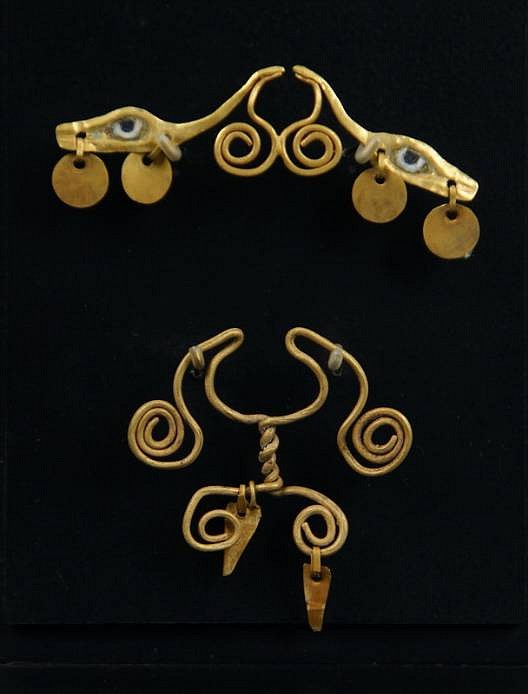
  • View all works
  • PLAY
  • I N Q U I R E
  • Share
  • Print
  • More Works
I N Q U I R E Share Print
Peru, Two Chavin gold nose ornaments with openwork coils and dangles
One is fashioned from one continuous wire curled into double spirals and twisting into another set of doublle spirals flanking a central suspension plaque and two triangular dangles.  The other has double spirals in the center framed by serpents heads, end to end, each with two suspended circular dangles.   A similar one is illustrated in Oro Del Antiguo Peru, plate 42.
Period: Peru, Chavin, Tembladera, Late Phase, North Coast, circa 600 - 400 BC
Media: Metal
Dimensions: Height 1 3/4 inches; Width 2 1/2 inches
Price Upon Request
94154
Peru | Two Chavin gold nose ornaments with openwork coils and dangles | | David Bernstein Pre-Columbian Art. Extensive inventory of Pre-Columbian art from South America, including ancient objects in ceramic, textiles, bronze, copper and gold.
97 / 108

Peru, Two Chavin gold nose ornaments with openwork coils and dangles

One is fashioned from one continuous wire curled into double spirals and twisting into another set of doublle spirals flanking a central suspension plaque and two triangular dangles. The other has double spirals in the center framed by serpents heads, end to end, each with two suspended circular dangles. A similar one is illustrated in Oro Del Antiguo Peru, plate 42.

Period: Peru, Chavin, Tembladera, Late Phase, North Coast, circa 600 - 400 BC

Media: Metal

Dimensions: Height 1 3/4 inches; Width 2 1/2 inches

Price Upon Request

94154
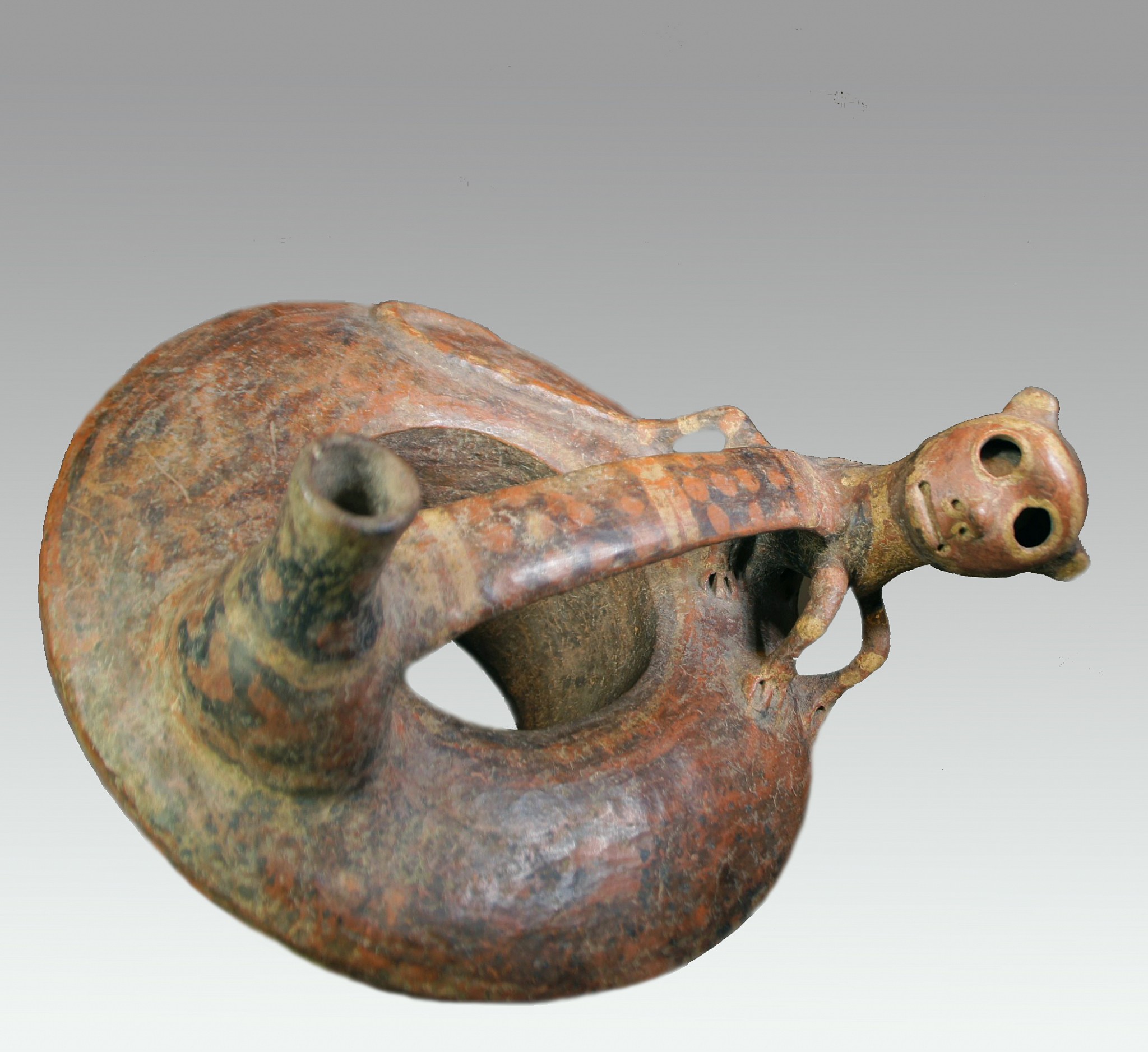
  • View all works
  • PLAY
  • I N Q U I R E
  • Share
  • Print
  • More Works
I N Q U I R E Share Print
Peru, Two Miniature Nose Ornaments Demonstrating Early Goldwork Techniques
This beautiful set of miniature gold nose ornaments features two early Pre-Columbian goldwork techniques.  The top ornament is from the Chavin culture and was formed using a combination of heating and annealing the gold.  The bottom ornament is from the pre-Moche Salinar culture and features both granulation and filigree techniques.
Period: Peru, c. 100 BC - AD 300
Media: Metal
Dimensions: Chavin: Width:1 1/2" Weight: 4.2 grams.Salinar: Width: 1 1/4" Weight: 4.6 grams.
$1,850
90400
Peru | Two Miniature Nose Ornaments Demonstrating Early Goldwork Techniques | | David Bernstein Pre-Columbian Art. Extensive inventory of Pre-Columbian art from South America, including ancient objects in ceramic, textiles, bronze, copper and gold.
98 / 108

Peru, Two Miniature Nose Ornaments Demonstrating Early Goldwork Techniques

This beautiful set of miniature gold nose ornaments features two early Pre-Columbian goldwork techniques. The top ornament is from the Chavin culture and was formed using a combination of heating and annealing the gold. The bottom ornament is from the pre-Moche Salinar culture and features both granulation and filigree techniques.

Period: Peru, c. 100 BC - AD 300

Media: Metal

Dimensions: Chavin: Width:1 1/2" Weight: 4.2 grams.Salinar: Width: 1 1/4" Weight: 4.6 grams.

$1,850

90400

  • View all works
  • PLAY
  • I N Q U I R E
  • Share
  • Print
  • More Works
I N Q U I R E Share Print
Peru, Vicús Donut-shaped Whistle Vessel with Monkey
This donut-shaped whistle vessel has a monkey figure one side of its bridge spout and the mouthpiece at the other end. The monkey sits on top of the vessel, with its head slightly tilted, hunched on its hind legs and placing his front legs forward and spread apart. The design motif consists of negative resist decoration. There is a whistle inside the monkey (not working) and would operate when the fluid inside the vessel moved the air out through it. A similar example can be found in Lapiner's "Pre Colombian Art of South America" pls.456 & 459.  The piece has a crack on the bottom, which has been restored.
Period: Peru, Vicus, Far North Coast, c. AD 200 - 400
Media: Ceramic
Dimensions: Diameter 8 1/2 x h.7 in.
$3,300
92233
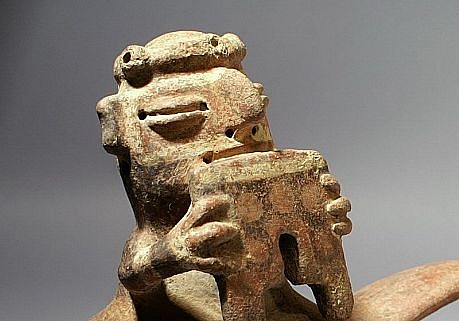
Peru | Vicús Donut-shaped Whistle Vessel with Monkey | | David Bernstein Pre-Columbian Art. Extensive inventory of Pre-Columbian art from South America, including ancient objects in ceramic, textiles, bronze, copper and gold.
99 / 108

Peru, Vicús Donut-shaped Whistle Vessel with Monkey

This donut-shaped whistle vessel has a monkey figure one side of its bridge spout and the mouthpiece at the other end. The monkey sits on top of the vessel, with its head slightly tilted, hunched on its hind legs and placing his front legs forward and spread apart. The design motif consists of negative resist decoration. There is a whistle inside the monkey (not working) and would operate when the fluid inside the vessel moved the air out through it. A similar example can be found in Lapiner's "Pre Colombian Art of South America" pls.456 & 459. The piece has a crack on the bottom, which has been restored.

Period: Peru, Vicus, Far North Coast, c. AD 200 - 400

Media: Ceramic

Dimensions: Diameter 8 1/2 x h.7 in.

$3,300

92233
  • View all works
  • PLAY
  • I N Q U I R E
  • Share
  • Print
  • More Works
I N Q U I R E Share Print
Peru, Vicus Double Chambered Whistling Vessel of a Figure Playing a Panpipe
This is the most published image of a whistling vessel from the early Vicus culture, but in actuality very few exist.
Period: Peru, Vicus, North Coast, circa 300 BC - AD 300
Media: Ceramic
Dimensions: Length: 11 1/2 in. x Height: 7 in.
$4,500
M2096
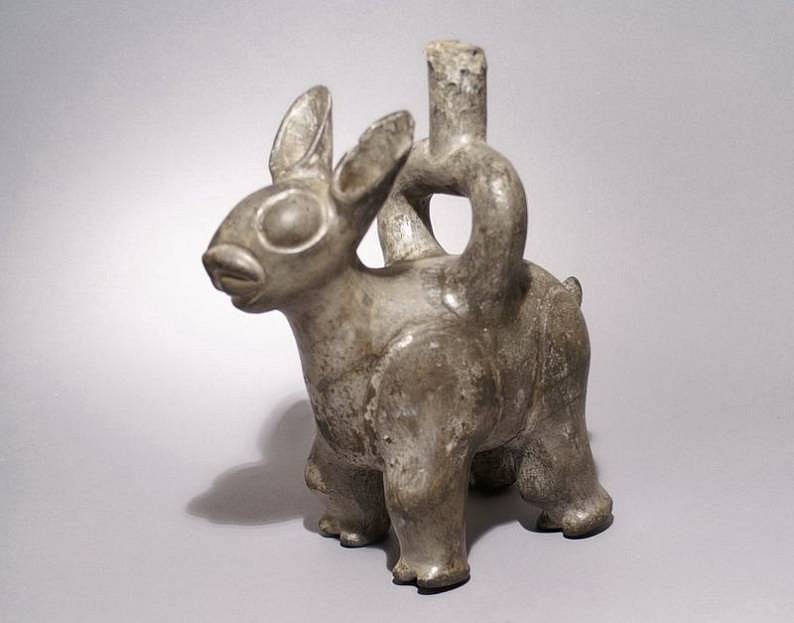
Peru | Vicus Double Chambered Whistling Vessel of a Figure Playing a Panpipe | | David Bernstein Pre-Columbian Art. Extensive inventory of Pre-Columbian art from South America, including ancient objects in ceramic, textiles, bronze, copper and gold.
100 / 108

Peru, Vicus Double Chambered Whistling Vessel of a Figure Playing a Panpipe

This is the most published image of a whistling vessel from the early Vicus culture, but in actuality very few exist.

Period: Peru, Vicus, North Coast, circa 300 BC - AD 300

Media: Ceramic

Dimensions: Length: 11 1/2 in. x Height: 7 in.

$4,500

M2096
  • View all works
  • PLAY
  • I N Q U I R E
  • Share
  • Print
  • More Works
I N Q U I R E Share Print
Peru, Viru ceramic greyware single spout vessel in the form of a Viscaya
A ceramic single spout vessel in the form of a standing Viscay, a large member of the rabbit family, noted by its long ears.
Period: Viru, North Coast Peru, c. 200 B.C. - 200 A.D.
Media: Ceramic
Dimensions: H. 9 1/2
$7,500
92047
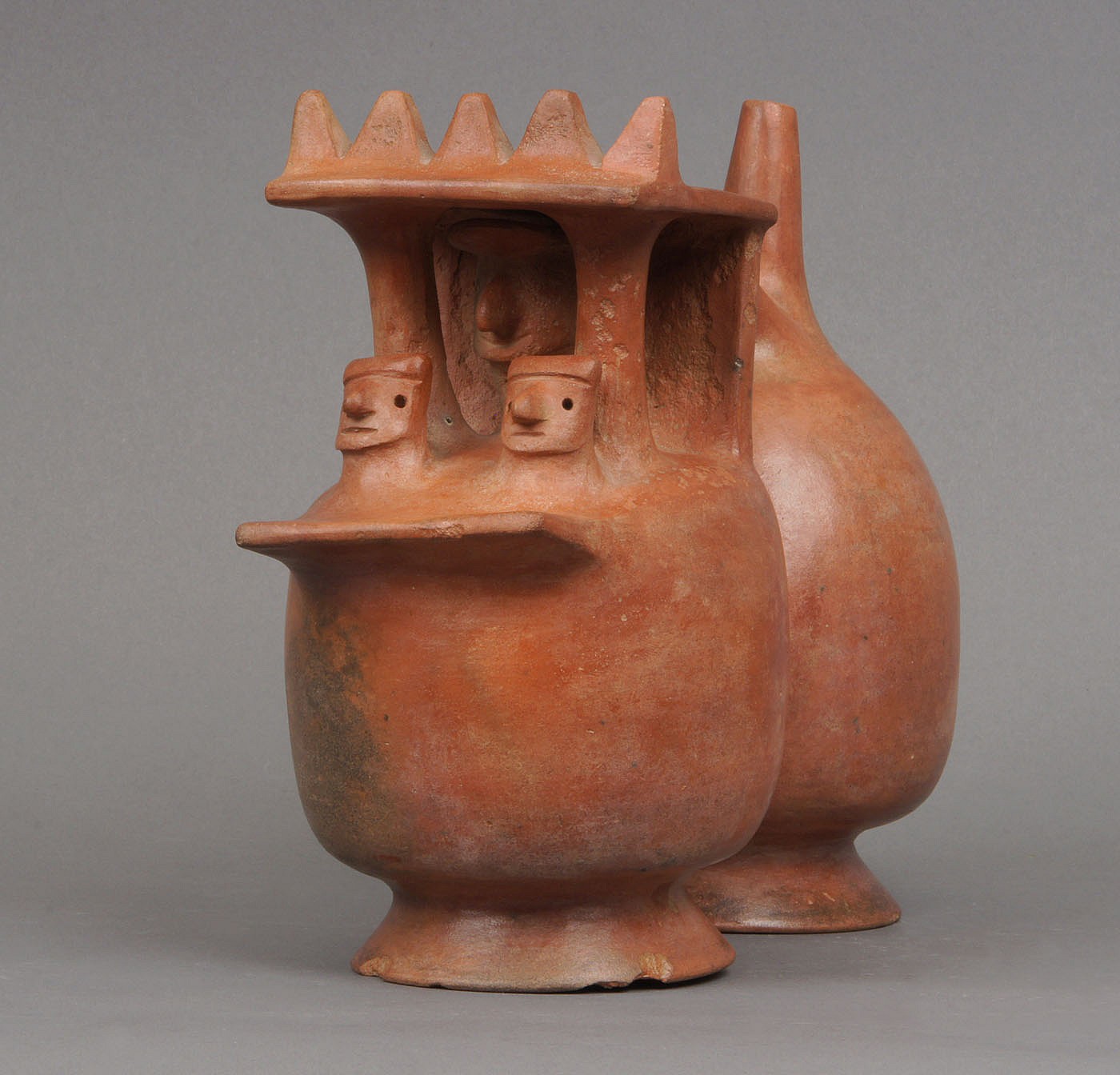
Peru | Viru ceramic greyware single spout vessel in the form of a Viscaya | | David Bernstein Pre-Columbian Art. Extensive inventory of Pre-Columbian art from South America, including ancient objects in ceramic, textiles, bronze, copper and gold.
101 / 108

Peru, Viru ceramic greyware single spout vessel in the form of a Viscaya

A ceramic single spout vessel in the form of a standing Viscay, a large member of the rabbit family, noted by its long ears.

Period: Viru, North Coast Peru, c. 200 B.C. - 200 A.D.

Media: Ceramic

Dimensions: H. 9 1/2

$7,500

92047
  • View all works
  • PLAY
  • I N Q U I R E
  • Share
  • Print
  • More Works
I N Q U I R E Share Print
Peru, Virú Double Chambered Single Spout Whistling Vessel in the Form of a Temple
A strap handle orangeware vessel of a temple with lord and two attendants.  The two heads could also be architectural elements or trophy heads. There are traces of negative resist decoration. Larco Hoyle describes and llustrates similar shaped vessels in his monograph "Cronologia del Norte de Peru, La Cultura Virú" (1945: 4 and 8).
Period: Peru, Virïº, North Coast,circa 300BC-AD200
Media: Ceramic
Dimensions: Height 8" Length 7 1/2"
$4,500
92080
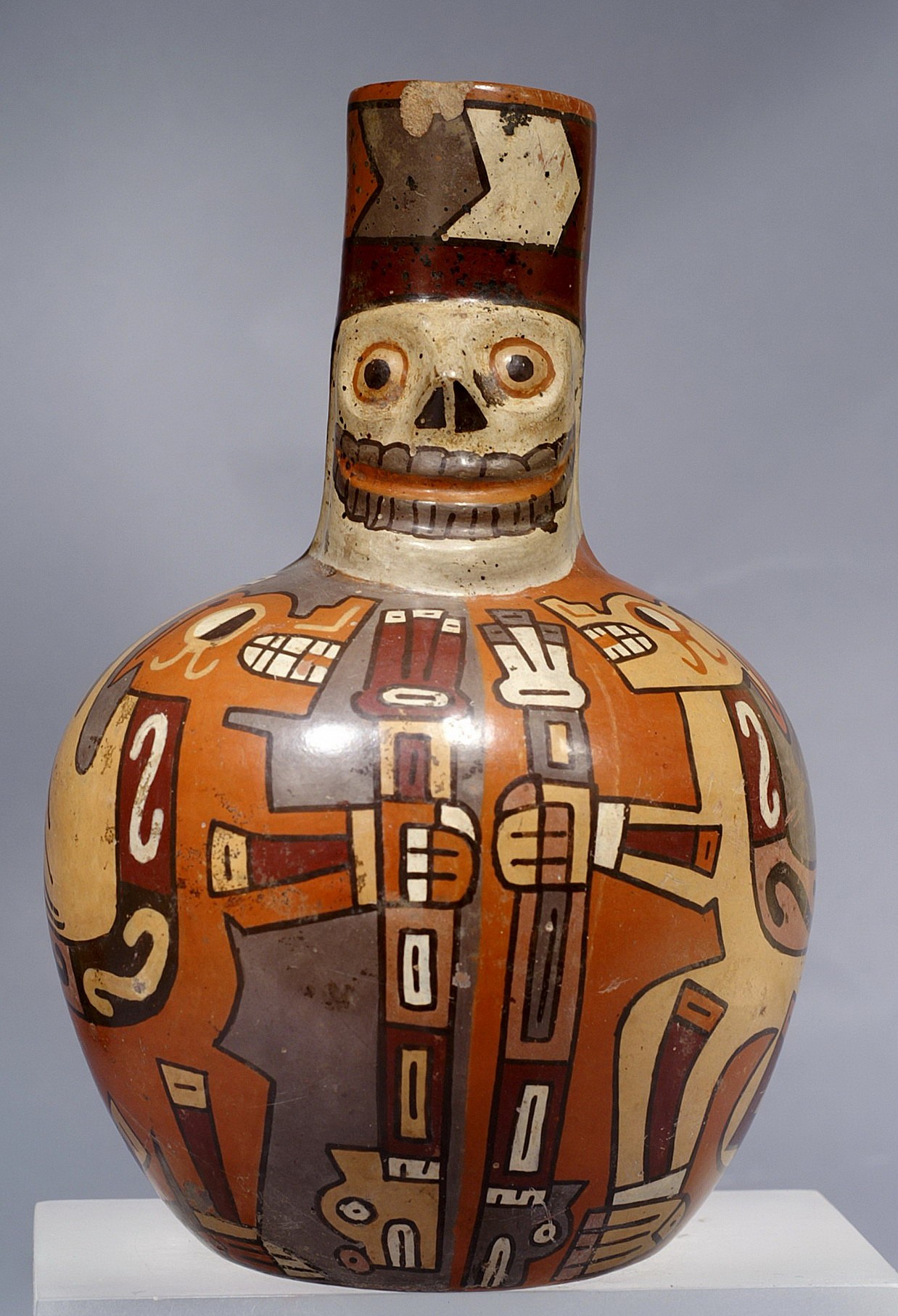
Peru | Virú Double Chambered Single Spout Whistling Vessel in the Form of a Temple | | David Bernstein Pre-Columbian Art. Extensive inventory of Pre-Columbian art from South America, including ancient objects in ceramic, textiles, bronze, copper and gold.
102 / 108

Peru, Virú Double Chambered Single Spout Whistling Vessel in the Form of a Temple

A strap handle orangeware vessel of a temple with lord and two attendants. The two heads could also be architectural elements or trophy heads. There are traces of negative resist decoration. Larco Hoyle describes and llustrates similar shaped vessels in his monograph "Cronologia del Norte de Peru, La Cultura Virú" (1945: 4 and 8).

Period: Peru, Virïº, North Coast,circa 300BC-AD200

Media: Ceramic

Dimensions: Height 8" Length 7 1/2"

$4,500

92080
  • View all works
  • PLAY
  • I N Q U I R E
  • Share
  • Print
  • More Works
I N Q U I R E Share Print
Peru, Wari Death-head Vessel with winged felines
This beaker with skeletal head in relief was painted with winged felines holding staffs. Both the skeletal relief and the mythical felines are characteristic of  Wari pottery. A smaller similar vessel in the American Museum of Natural History in New York is published in Alan Lapiner, "Pre-Columbian Art from South America (1976: #542) and Margaret Young-Sanchez, "Tiwanaku: Ancestors of the Inca" (2004: fig. 6.6) Height 6 3/4" compared to the above of 8".  The skeletal deity wears a class Wari tapestry tunic and a lovely hair-do on his black.  The crouching winged pumas holding staffs are classic features of  Wari Art & Iconography.  This vessel was formerly in a German collection collected prior to 1970.
Period: Peru, Wari, South Coast, circa AD900-1100
Media: Ceramic
Dimensions: Height: 8"
Price Upon Request
M7046
Peru | Wari Death-head Vessel with winged felines | | David Bernstein Pre-Columbian Art. Extensive inventory of Pre-Columbian art from South America, including ancient objects in ceramic, textiles, bronze, copper and gold.
103 / 108

Peru, Wari Death-head Vessel with winged felines

This beaker with skeletal head in relief was painted with winged felines holding staffs. Both the skeletal relief and the mythical felines are characteristic of Wari pottery. A smaller similar vessel in the American Museum of Natural History in New York is published in Alan Lapiner, "Pre-Columbian Art from South America (1976: #542) and Margaret Young-Sanchez, "Tiwanaku: Ancestors of the Inca" (2004: fig. 6.6) Height 6 3/4" compared to the above of 8". The skeletal deity wears a class Wari tapestry tunic and a lovely hair-do on his black. The crouching winged pumas holding staffs are classic features of Wari Art & Iconography. This vessel was formerly in a German collection collected prior to 1970.

Period: Peru, Wari, South Coast, circa AD900-1100

Media: Ceramic

Dimensions: Height: 8"

Price Upon Request

M7046

  • View all works
  • PLAY
  • I N Q U I R E
  • Share
  • Print
  • More Works
I N Q U I R E Share Print
Peru, Wari Effigy Vessel of a llama hoof
The llama hoof is decorated in three bands, the upper with two sets of  sun/moon heads facing each other. The middle band has an undulating serpent and the lower band is a black on white llama skin decoration.
Period: Peru, Wari, South Highlands/Coast, circa AD650-900
Media: Ceramic
Dimensions: Height 5"
Price Upon Request
M3079
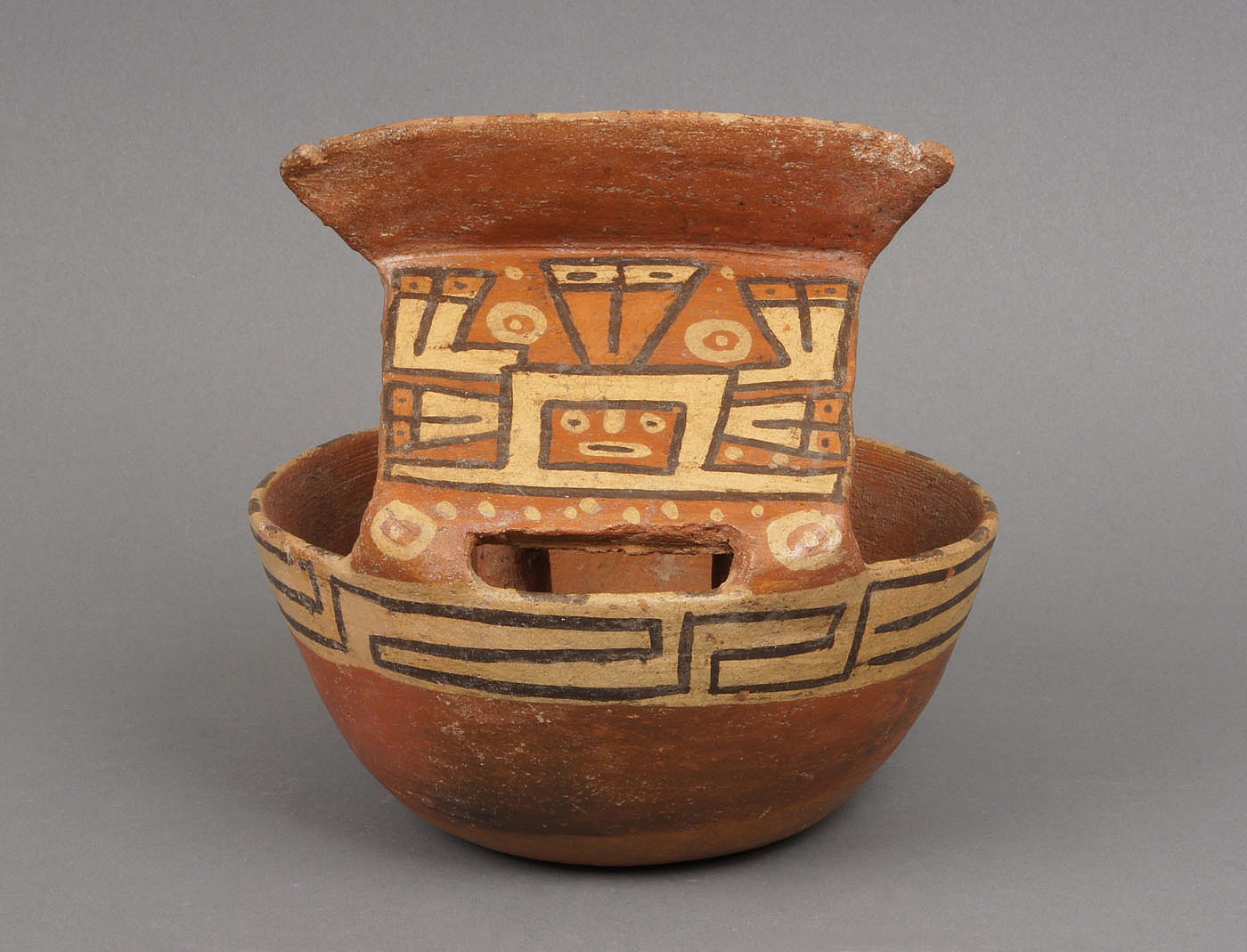
Peru | Wari Effigy Vessel of a llama hoof | | David Bernstein Pre-Columbian Art. Extensive inventory of Pre-Columbian art from South America, including ancient objects in ceramic, textiles, bronze, copper and gold.
104 / 108

Peru, Wari Effigy Vessel of a llama hoof

The llama hoof is decorated in three bands, the upper with two sets of sun/moon heads facing each other. The middle band has an undulating serpent and the lower band is a black on white llama skin decoration.

Period: Peru, Wari, South Highlands/Coast, circa AD650-900

Media: Ceramic

Dimensions: Height 5"

Price Upon Request

M3079
  • View all works
  • PLAY
  • I N Q U I R E
  • Share
  • Print
  • More Works
I N Q U I R E Share Print
Peru, Wari House Vessel with Overhanging Roof on Two Pillars
An effigy bowl in the form of a temple with a decorated roof.   The sloping roof supported by pillars was likely decorated with a fresco.  There are some temples in Southern Peru which still have traces of fresco decoration dating from the early Wari period.  The columns taper to the top and have a lentil support.   Photographed by Justin Kerr for Alan Lapiner, New York, June 1968.
Period: South Coast Peru circa 700-950A.D.
Media: Ceramic
Dimensions: H. 7 in.
$5,400
91993
Peru | Wari House Vessel with Overhanging Roof on Two Pillars | | David Bernstein Pre-Columbian Art. Extensive inventory of Pre-Columbian art from South America, including ancient objects in ceramic, textiles, bronze, copper and gold.
105 / 108

Peru, Wari House Vessel with Overhanging Roof on Two Pillars

An effigy bowl in the form of a temple with a decorated roof. The sloping roof supported by pillars was likely decorated with a fresco. There are some temples in Southern Peru which still have traces of fresco decoration dating from the early Wari period. The columns taper to the top and have a lentil support. Photographed by Justin Kerr for Alan Lapiner, New York, June 1968.

Period: South Coast Peru circa 700-950A.D.

Media: Ceramic

Dimensions: H. 7 in.

$5,400

91993

  • View all works
  • PLAY
  • I N Q U I R E
  • Share
  • Print
  • More Works
I N Q U I R E Share Print
Peru, Wari Miniature Effigy of a Man with Large Hands
This is a common style of figurative vessel painted by the Wari and most likely represents a feasting man with a full belly.  The Wari held large communal feasts where food was served along with chicha, corn beer, which was spiked with psychoactive plants such as Peruvian pepper – as found at Wari archaeological sites.  This vessel is one of a set that was found at the same gravesite. 
Period: Peru, Wari, South Coast, c. AD 650 - 900
Media: Ceramic
Dimensions: Height 4 3/4"
Price Upon Request
n3024
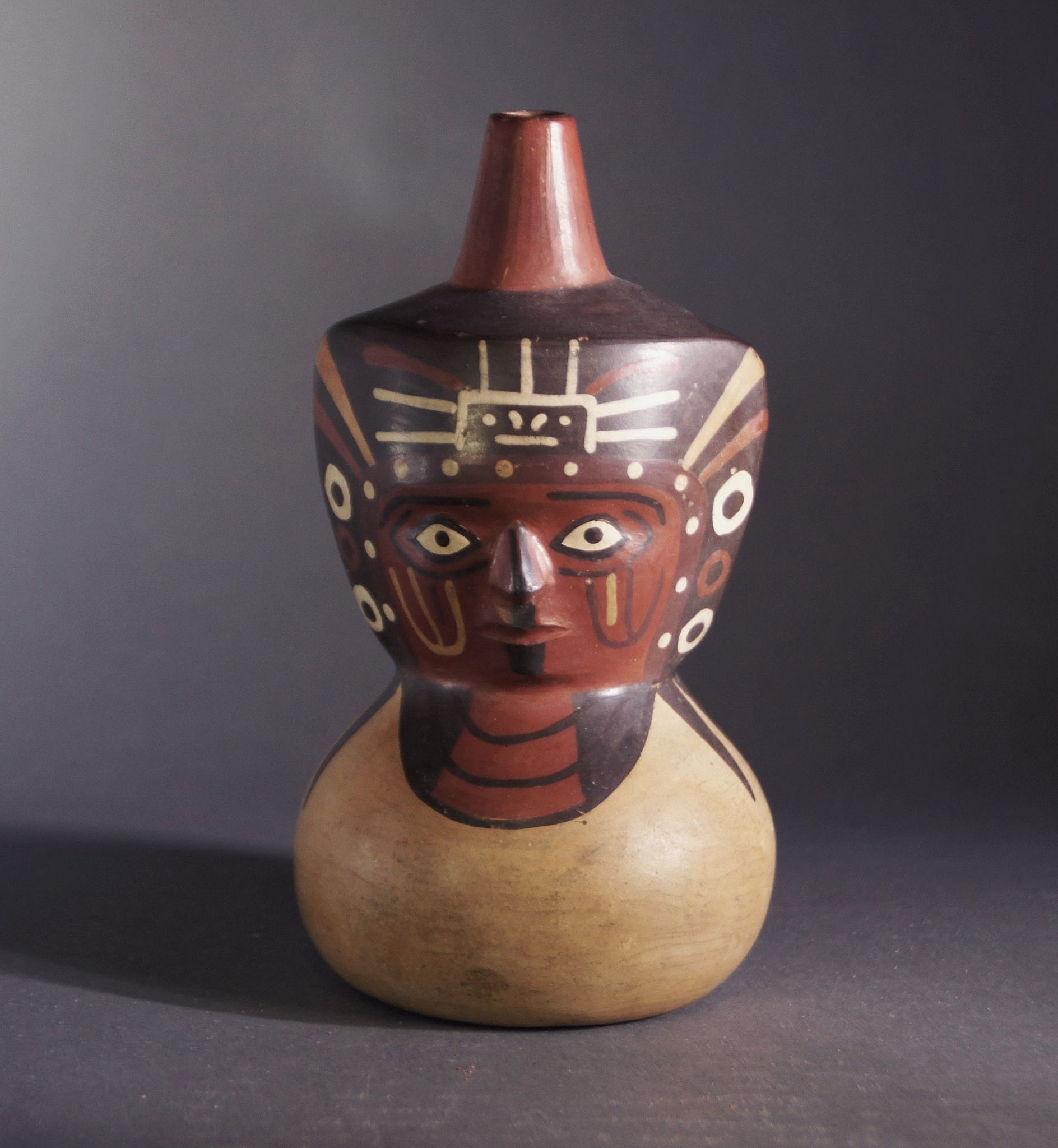
Peru | Wari Miniature Effigy of a Man with Large Hands | | David Bernstein Pre-Columbian Art. Extensive inventory of Pre-Columbian art from South America, including ancient objects in ceramic, textiles, bronze, copper and gold.
106 / 108

Peru, Wari Miniature Effigy of a Man with Large Hands

This is a common style of figurative vessel painted by the Wari and most likely represents a feasting man with a full belly. The Wari held large communal feasts where food was served along with chicha, corn beer, which was spiked with psychoactive plants such as Peruvian pepper – as found at Wari archaeological sites. This vessel is one of a set that was found at the same gravesite.

Period: Peru, Wari, South Coast, c. AD 650 - 900

Media: Ceramic

Dimensions: Height 4 3/4"

Price Upon Request

n3024
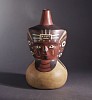
  • View all works
  • PLAY
  • I N Q U I R E
  • Share
  • Print
  • More Works
I N Q U I R E Share Print
Peru, Wari Single Spout Figural Bottle with Elaborate Facial Decoration
This effigy vessel is painted with an individual wearing a diadem on his headdress and as well as a triple-strand necklace, indicating that he is a shaman or other important personage. He wears a black head covering, which is depicted draped around the shoulders.  Ex. collection Anton Roeckl, Munich. T/L tested in Berlin.
Period: Peru, Wari, South Coast, c. AD 600 - 900
Media: Ceramic
Dimensions: 6 in.
Price Upon Request
94114A
Peru | Wari Single Spout Figural Bottle with Elaborate Facial Decoration | | David Bernstein Pre-Columbian Art. Extensive inventory of Pre-Columbian art from South America, including ancient objects in ceramic, textiles, bronze, copper and gold.
107 / 108

Peru, Wari Single Spout Figural Bottle with Elaborate Facial Decoration

This effigy vessel is painted with an individual wearing a diadem on his headdress and as well as a triple-strand necklace, indicating that he is a shaman or other important personage. He wears a black head covering, which is depicted draped around the shoulders. Ex. collection Anton Roeckl, Munich. T/L tested in Berlin.

Period: Peru, Wari, South Coast, c. AD 600 - 900

Media: Ceramic

Dimensions: 6 in.

Price Upon Request

94114A

  • View all works
  • PLAY
  • I N Q U I R E
  • Share
  • Print
  • More Works
I N Q U I R E Share Print
Peru, Wari Single Spout Owl Effigy Vessel in tan with black highlights
The effigy has black dashes representing feathers along its body. The chest of the owl is painted a lighter shade of tan with two feet protruding from the base. A very similar vessel is illustrated in José Antonio Lavalle "Nazca" (1986: 158). Ex-Collection Monheim (Achen, Germany).
Period: Peru, Wari, Coastal, circa  AD650-1100
Media: Ceramic
Dimensions: Height 8" (20cm) x Length 8.5" (21.5cm)
Price Upon Request
M4093
Peru | Wari Single Spout Owl Effigy Vessel in tan with black highlights | | David Bernstein Pre-Columbian Art. Extensive inventory of Pre-Columbian art from South America, including ancient objects in ceramic, textiles, bronze, copper and gold.
108 / 108

Peru, Wari Single Spout Owl Effigy Vessel in tan with black highlights

The effigy has black dashes representing feathers along its body. The chest of the owl is painted a lighter shade of tan with two feet protruding from the base. A very similar vessel is illustrated in José Antonio Lavalle "Nazca" (1986: 158). Ex-Collection Monheim (Achen, Germany).

Period: Peru, Wari, Coastal, circa AD650-1100

Media: Ceramic

Dimensions: Height 8" (20cm) x Length 8.5" (21.5cm)

Price Upon Request

M4093
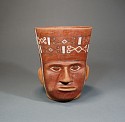
  • View all works
  • PLAY
  • I N Q U I R E
  • Share
  • Print
  • More Works
I N Q U I R E Share Print
Tip: You must first enter a valid email address in order to submit your inquiry

Inquiry regarding:

This site is protected by reCAPTCHA and the Google Privacy Policy and Terms of Service apply.

David Bernstein Pre-Columbian Art

355 East 72nd Street

New York, NY 10021

Tel 212-794-0389

Fax 212-794-0389

dbfinearts@gmail.com

We ask that you send photos via email before we can discuss your artifacts. 

Newsletter Signup


© 2026 David Bernstein Pre-Columbian Art
Accessibility Statement