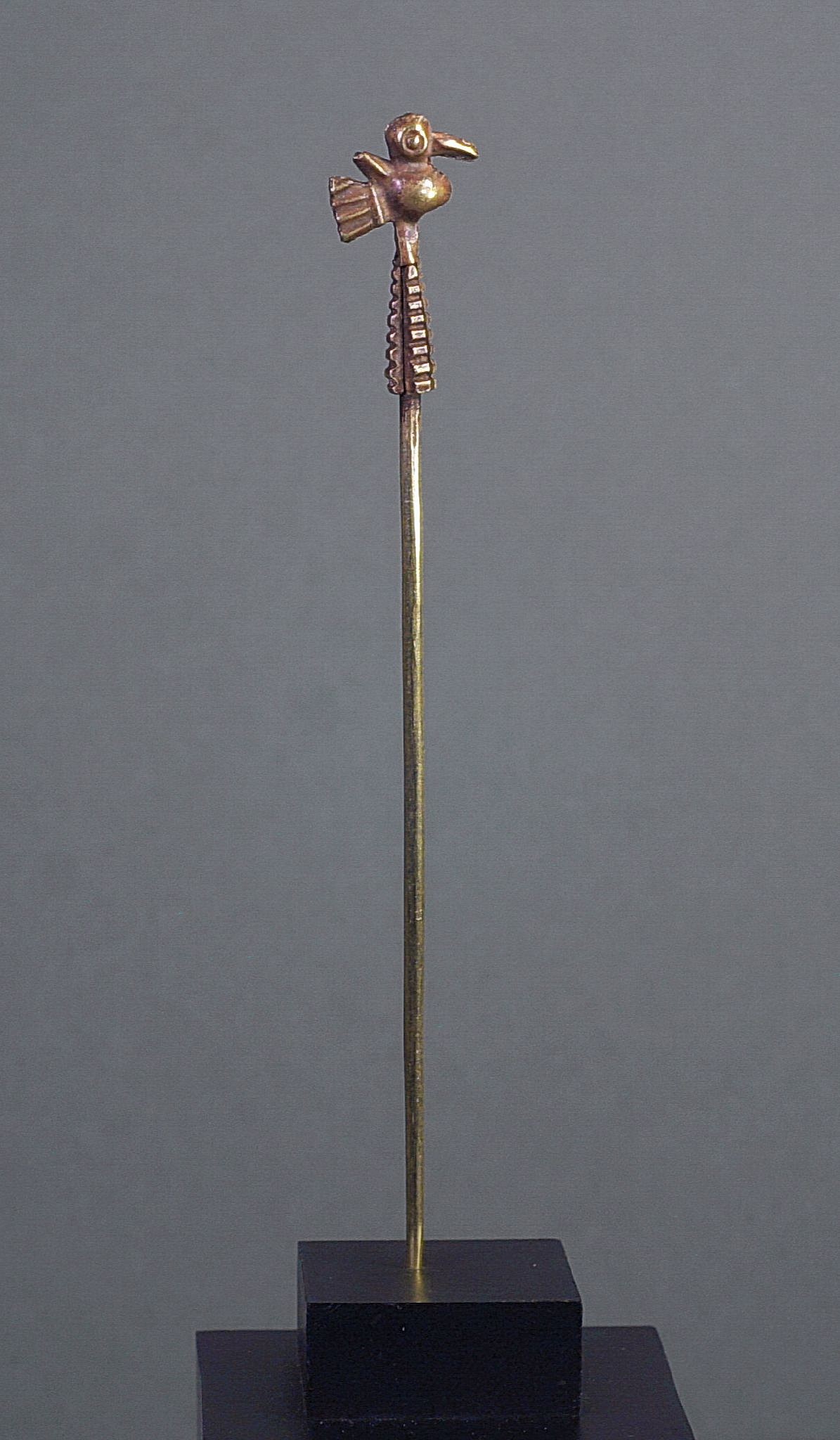




Peru, Inca Gold Fastening Pin Topped with Bird Perched on Corn Cob
Gold works of art from the Inca period is rare, as most Inca gold was confiscated and melted down by the Conquistadores during colonization. This apparently simple cast pin is quite complicated in its manufacture. The pin and the corn cob were cast, whereas the bird is made of a separate stamped sheet - designed head-to-head, bent, and soldered to itself. The bird was then fitted over the top to create the appearance of a single cast object. A similar piece appears in Kunst Und Kultur von Peru (Art and Culture of Peru) by Max Schmidt, page 396. From a private Florida collection, acquired prior to 1980.
Period: Peru, Chimu, North Coast, c. AD 900 - 1350
Media: Metal
Dimensions: Length: 5" Weight: 4.7 grams.
$1,950
MM625
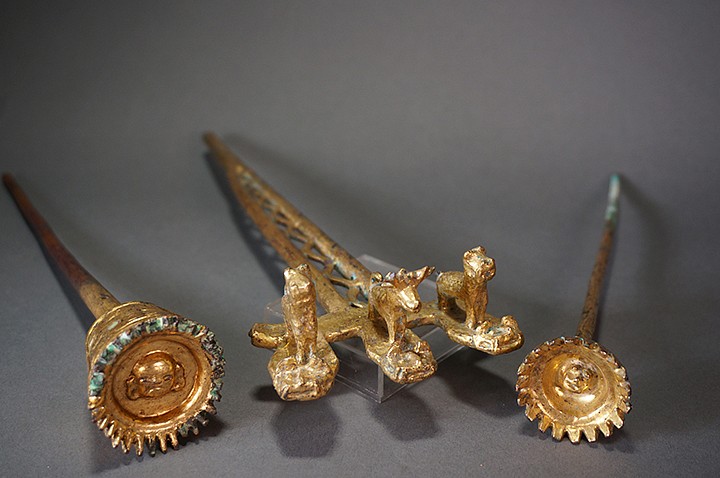
Peru, A Rare Recuay Gilt Scepter
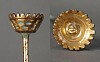
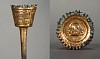
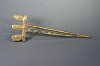
This scepter is very rare with an unusual motif of three animals standing on three flayed feline skins. The central animal is a deer flanked by an unknown four-legged animal. The shaft of the scepter has two channels attached by a series of triangular soldered stock. Each channel has a suspension hole towards the top. This scepter must have belonged to a high status individual as its manufacture is very elaborate and technically sophisticated. Only one other known similar Recuay scepter is illustrated in Kultur Von Peru by Max Schmidt, pg. 392. The accompanying two tupus with decorated tops (longer and shorter) each have a different motif.
The longer tupu is decorated with a band of four stooping animals in low relief, each with a serpent emanating from its head. The inside of the the longer tupu’s upper cup is decorated with a frowning face, perhaps a mask. This is one of the largest known intact tupus. The smaller tupu has a rich gilt surface and is decorated with a band of two face masks. Inside the upper cup of the small tupu is the head of the same animal flanking the deer on the scepter. Both tupus have finials that are decorated with both an outside band and an inside head. The larger one has a band of 3 double headed serpents with a fox head inside. The smaller one has a band of a double-headed arched feline and a face inside.
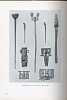
Four tupus excavated at Pashash, the earliest known Recuay site, are illustrated in The Art and Archaeology of PSAHASH by Terence Grieder, figs. 114-117, and fig. 7. These tupus were originally sold by Alan Lapiner in the early 1970s along with a classic Recuay vessel of a lord flanked by arched felines on each side.
Period: Peru, Recuay, North Highlands, c. 300 BC - AD 700
Media: Metal
Dimensions: Scepter Length 9" x Width 3"
Longer Tupu Length 8 ½ x diameter 1 ½â€
Shorter tupu: Length: 7 ½†x diameter 1"
Price Upon Request
M3023
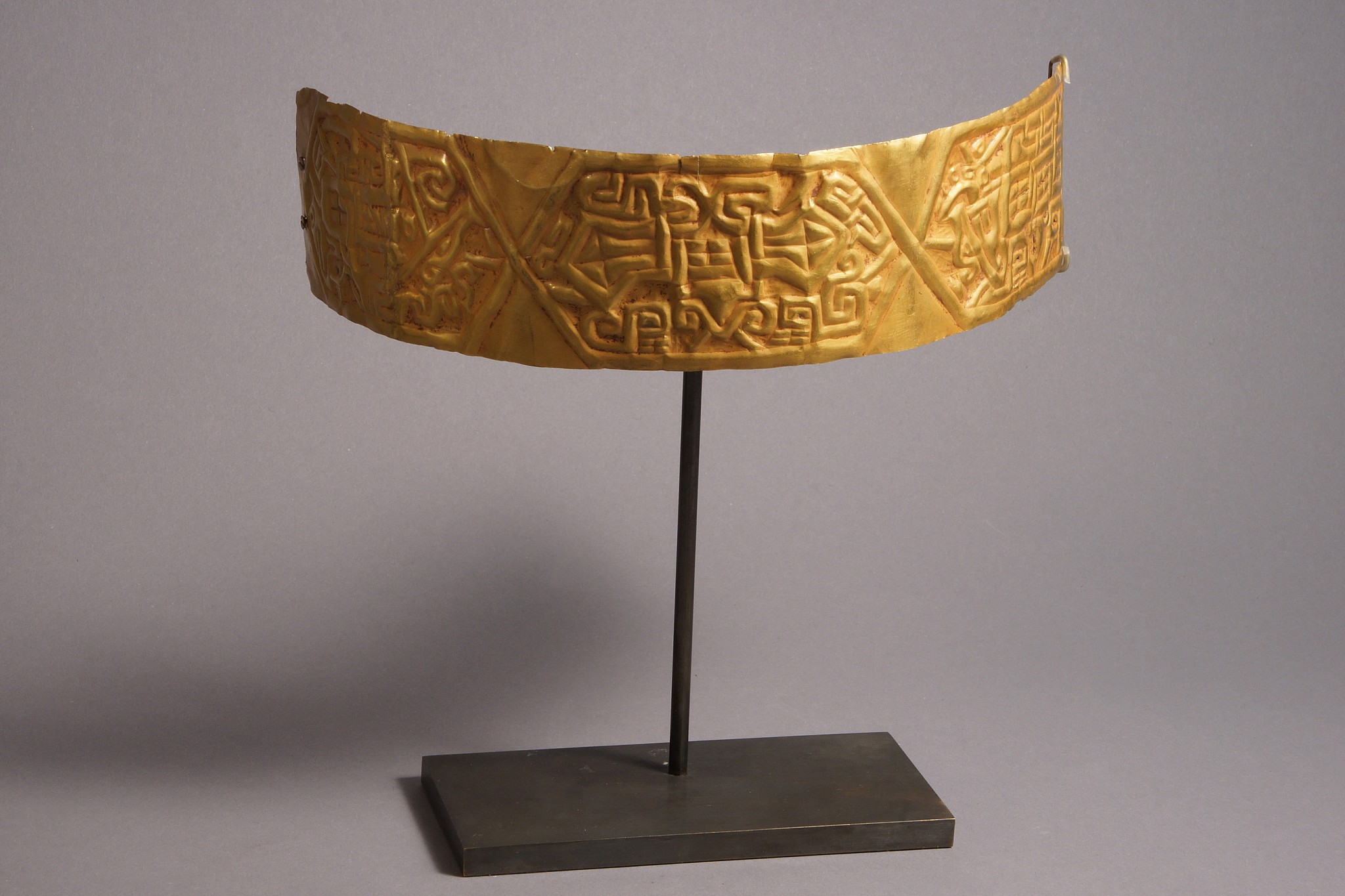


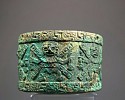
Peru, Chavin Gold Crown With Embossed Design
Chavin artists hammered gold sheets over wooden molds to make crowns and pectorals for the ruling elite. This crown was cut down and repaired in antiquity, but it originally had two profile faces on the sides and two frontal images of the feline deity so often seen in Chavin art. A cuff from the same grave lot is on display at the Houston Museum of Fine Arts with faces separated by diagonal designs. This crown is published in Jose Antonio Lavalle "Oro Del Antiguo Peru" (1992: pl. 10). Samuel K. Lothrop was the first scholar to analyze gold crowns and plaques that came from two tomb lots in Chongoyape, "Gold Artifacts of Chavin Style" (American Antiquity 1951, 3: 226 - 240). His work and other tomb finds are reviewed by Richar L. Burger in "Chavin and The Origins of Andean Civilization" (1992: 204 - 206) A number of crowns similar to this one are known to have come from these tombs, which also yielded gold cuffs, ear spools, nose pendants, chest plaques and tweezers. Examined and approved by Robert Sonin and Henri Reichlin in 1976. Ex-collection Marcel Ebnother, Switzerland.
Period: Peru, Chavin, North Coast Peru, Late Initial Period, circa 1200-200BC
Media: Metal
Dimensions: Length 11. 1/2" x Height 2"
Price Upon Request
M6075


Peru, Chavin Gold Pin with Simple Twisted and Hammered Diamond Design
This unusual diamond-shaped pin was made from one flat sheet that was hammered and twisted.
Period: Peru, Chavin, North Coast, c. 200 - 500 BC
Media: Metal
Dimensions: Length: 5 1/8" x Weight: 3.1 grams.
$1,200
N5041
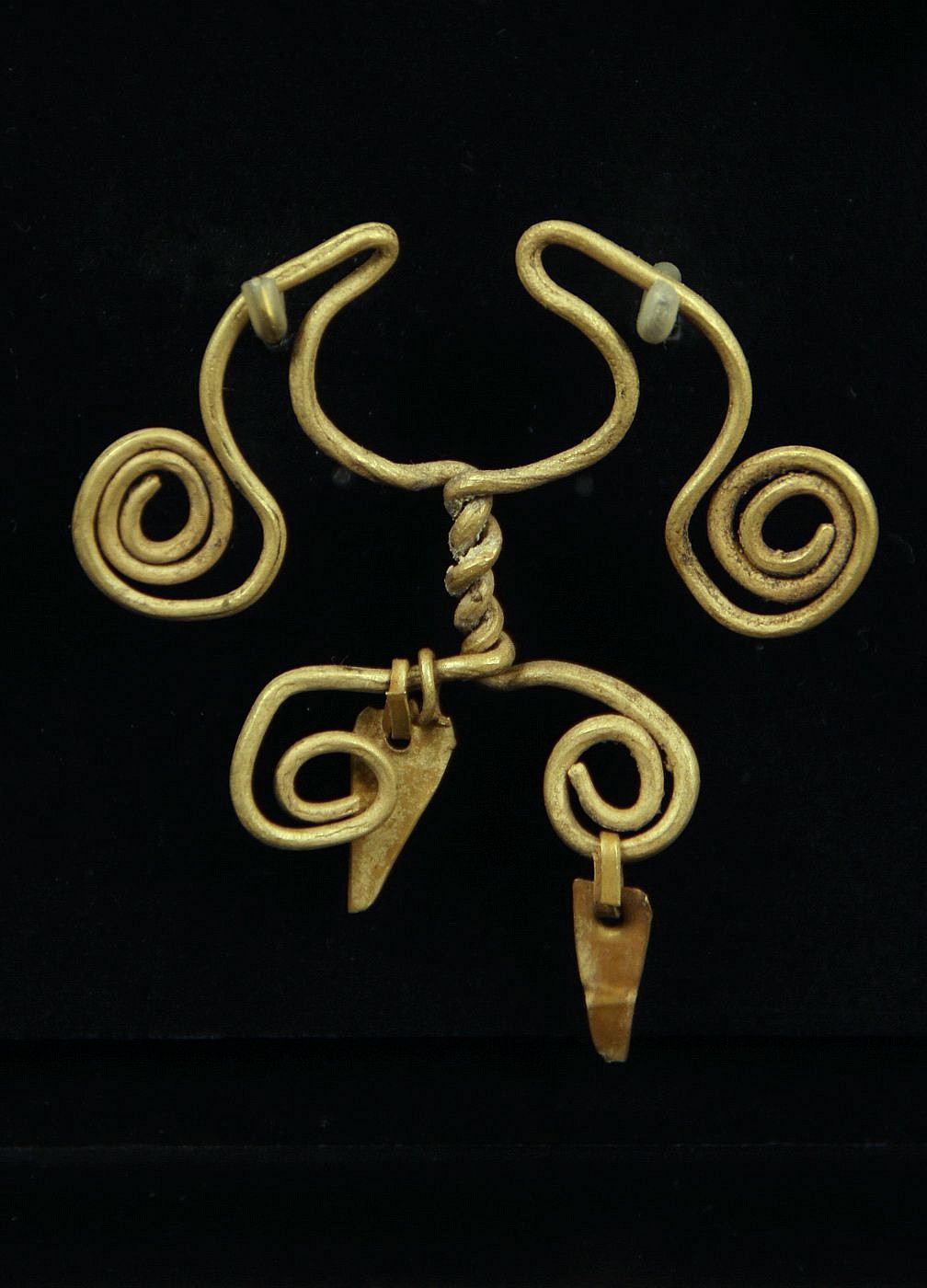


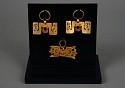
Peru, Chavin Pair of Gold Ear Ornaments and a Gold Nose Ornament with double chevron
The pair of gold ornaments, each with a double headed serpent with cut-out facial details, suspended by a twisted wire loop, and a suspension plaque dangleA gold nose ornament with cutout design and a central suspension plaque. The single nose ornament has a cut-out design sign in an abstract avian face or that of opposing chevrons, suspended by a twisted gold wire loop. pl. 15.
Period: Peru circa 500-300AD
Media: Metal
Dimensions: Widths 1 1/2 inches each; Width 1 3/4 inches
Price Upon Request
94157
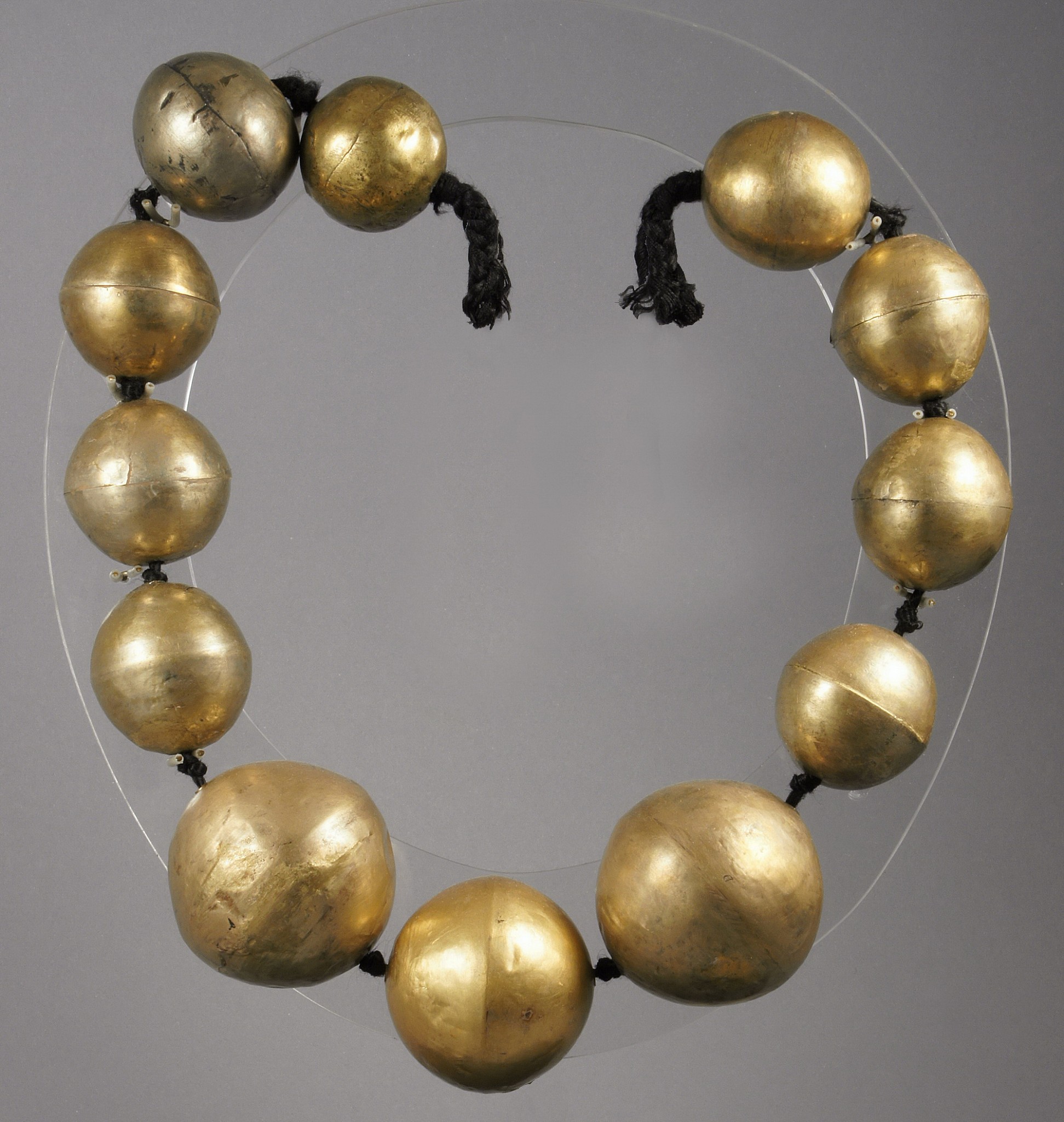
Peru, Chimú Gold 29" Necklace of Large Hollow Beads
The Chimú inherited a taste for hollow gold bead necklaces from their Moche predecessors. In both cultures, each bead was cast and hammered in two halves that were then joined together by soldering. In the Chimú technique, the edges of the two halves were nested together. These beads are extremely light with a greater percentage of silver than gold. They used depletion gilding to bring the gold to the surface by using of heats and salts. This allowed the Chimu to make the gold available for a large and growing ruling class. Private Florida collection prior to 1980.
Period: Peru, Chimu, North Coast, c. AD 900 - 1350
Media: Metal
Dimensions: Necklace Length: 29"; largest bead 2 1/4" diameter - smallest 1 1/2"
$27,000
M7991


Peru, Chimu Gold Cuff with Three Bands of 4 Repousse Stars Each
This gold cuff would have been worn as an adornment by a high-status male warrior. It features three rows of repousse starts, with four stars in each row, and two tie holes. A cuff with a similar star design is illustrated in the catalog of the Gold Museum of Peru on page 127. Formerly in the collection of Camilla Deitz Bergeron, New York antiquaire, acquired prior to the 1980s.
Period: Peru, Chimu, Early Phase, North Coast, c. AD 900 - 1100
Media: Metal
Dimensions: Height 4 1/2" Weight: 65.5 grams.
$9,500
N2064
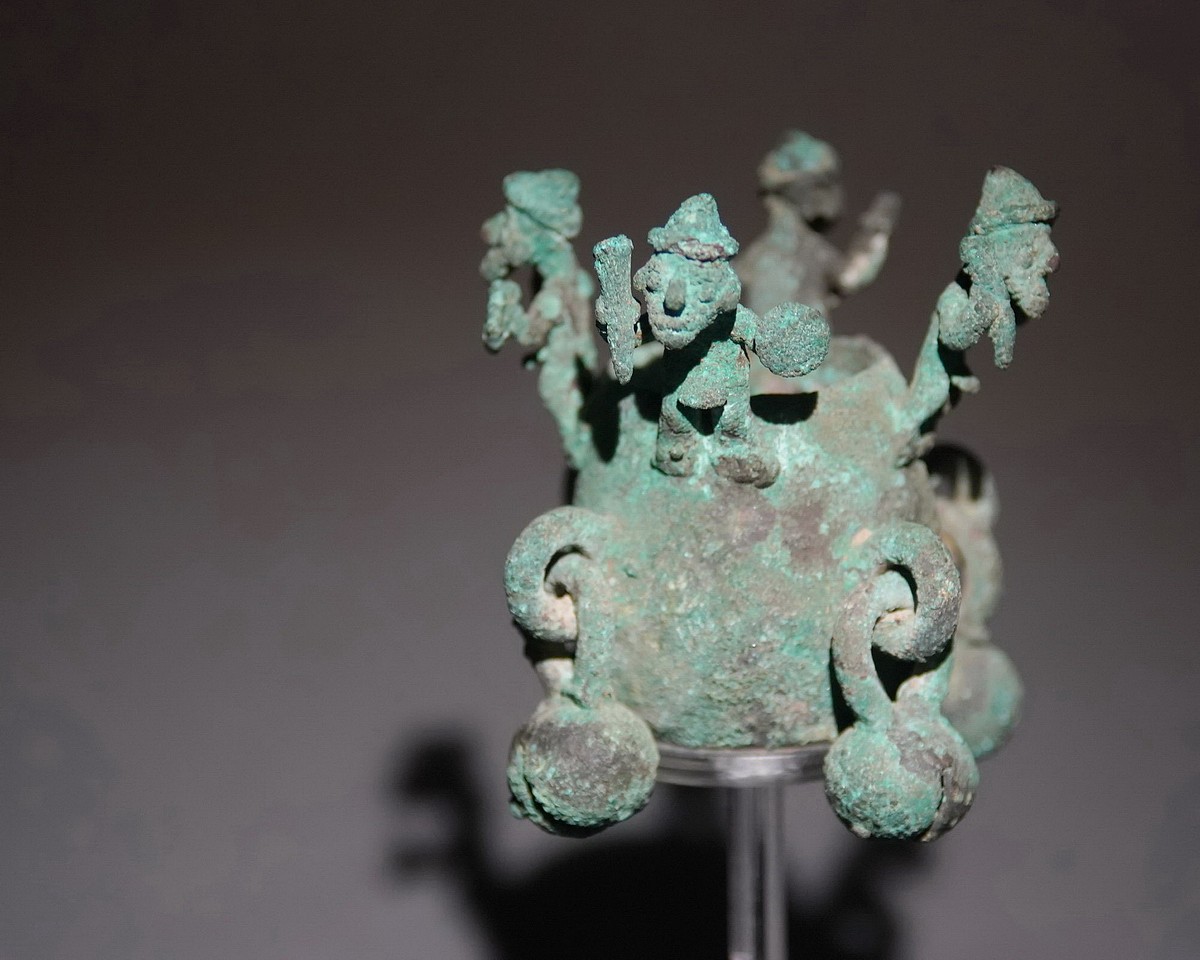
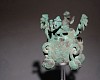
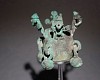
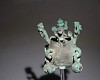
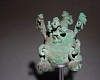
Peru, Chimu Lost Wax Cast Bronze Finial with Four Warriors
Metal objects that are cast with rings or bells that move to make a sound are known as idiophones. Each warrior wears a loincloth and holds a club in one hand and a shield in the other. Each of the loops around the shaft holds a bell, which when moved, clanks against the shaft.
Period: Peru, Chimu, North Coast, c. AD 900 - 1350
Media: Metal
Dimensions: Height: 2 3/4" x Width: 3:
$5,500
P1038
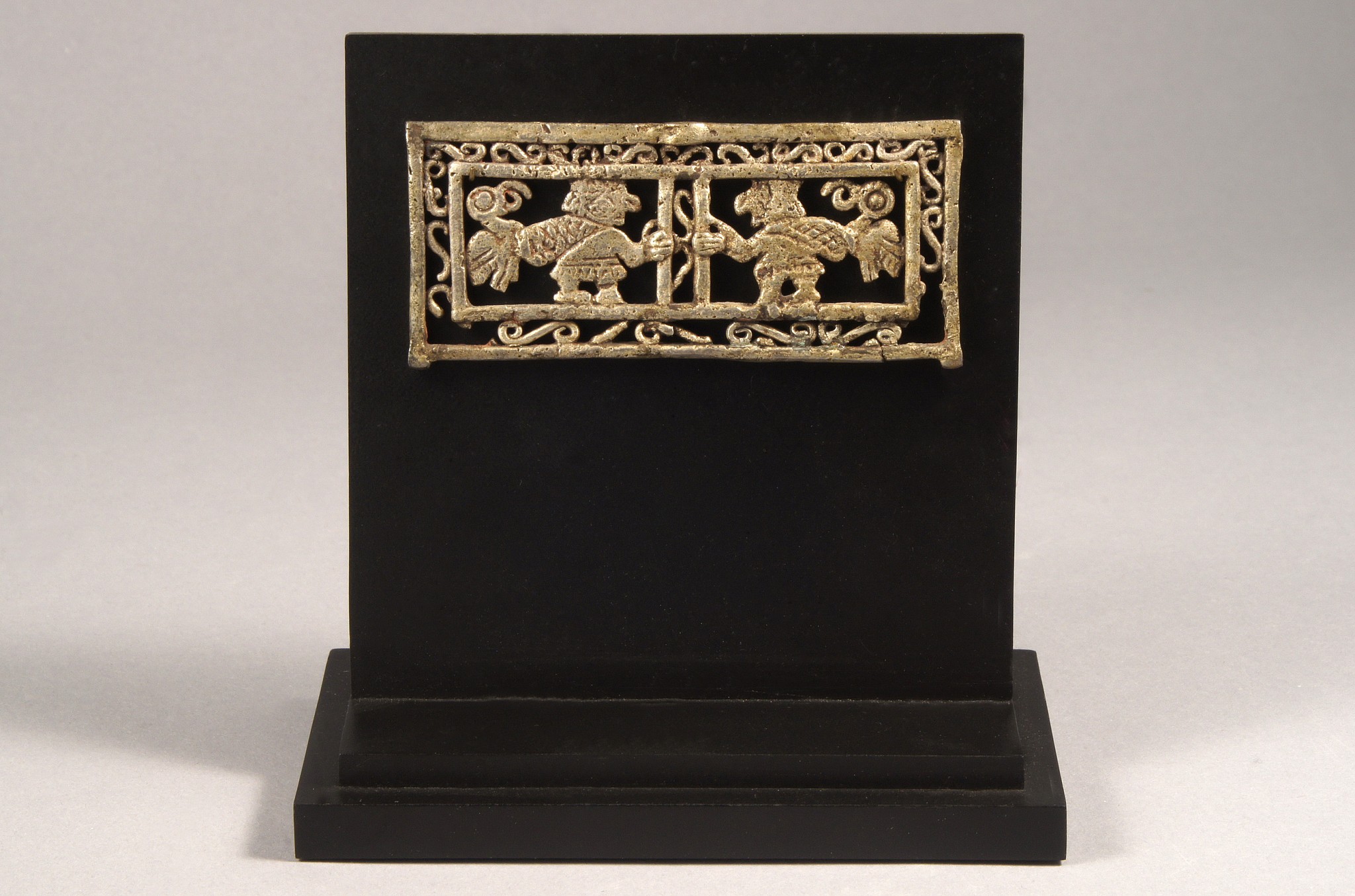
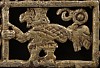
Peru, Chimu silver balance with 2 warriors
A rare Chimu silver balance beam decorated with two bag carrying individuals followed by a perched bird. This depiction could explain how the balance beams were used by exchanging feathers of different birds of equal weight. Trade across long distances of exotic materials was a key element in the ancient economy. The balance beam is made of both cast and soldered elements. It is true soldered filigree work of curls decorating the edge. The individuals and birds were cast. It is also extremely rare to find balance beams in silver, as most of them are of wood or bone. There is a single suspension hole in the top bar center and one hole for a net on each side of the lower bar.
Period: Peru, Chimu, North Coast, circa 900 - 1350 AD
Media: Metal
Dimensions: H: 2" W:3.5"
$4,500
98361
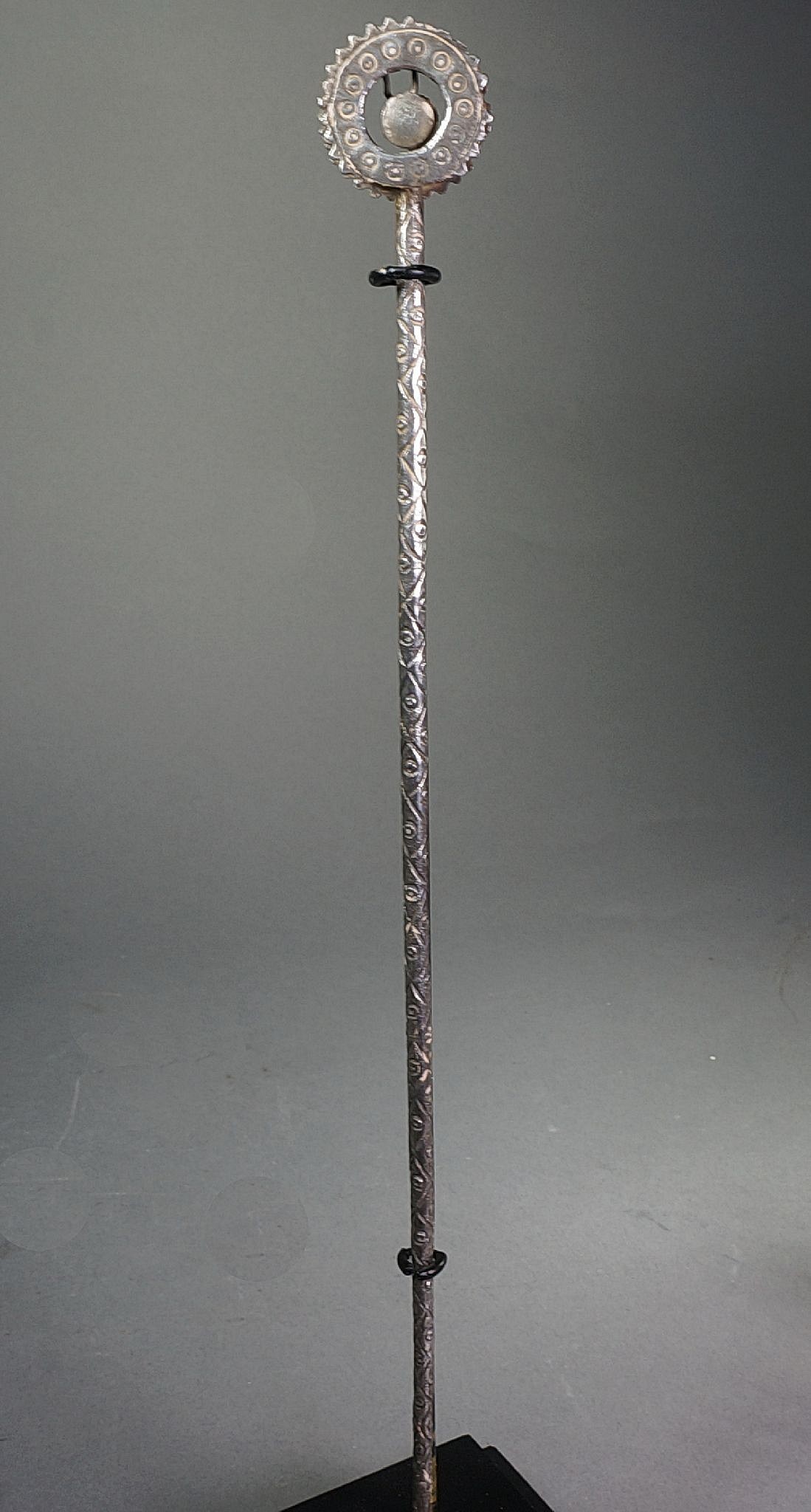
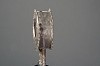
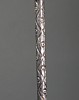
Peru, Chimu Silver Tupu with Ornate Rattle
Tupu pins were used by high status individuals to fasten their garments. The level of fine detail and craftsmanship indicates that this silver tupu would have belonged to an extremely important person. The shaft is completely incised with a repeating diamond motif. The rattle at the top is constructed with two incised discs, soldered to a curved band. Inside is a delicate suspended cylinder. This rare tupu is in good condition and has been professionally cleaned and stabilized.
Period: Peru, Chimu, North Coast, c. AD 900 - 1350
Media: Metal
Dimensions: Length:10" x Weight: 25 grams
$2,650
MM615
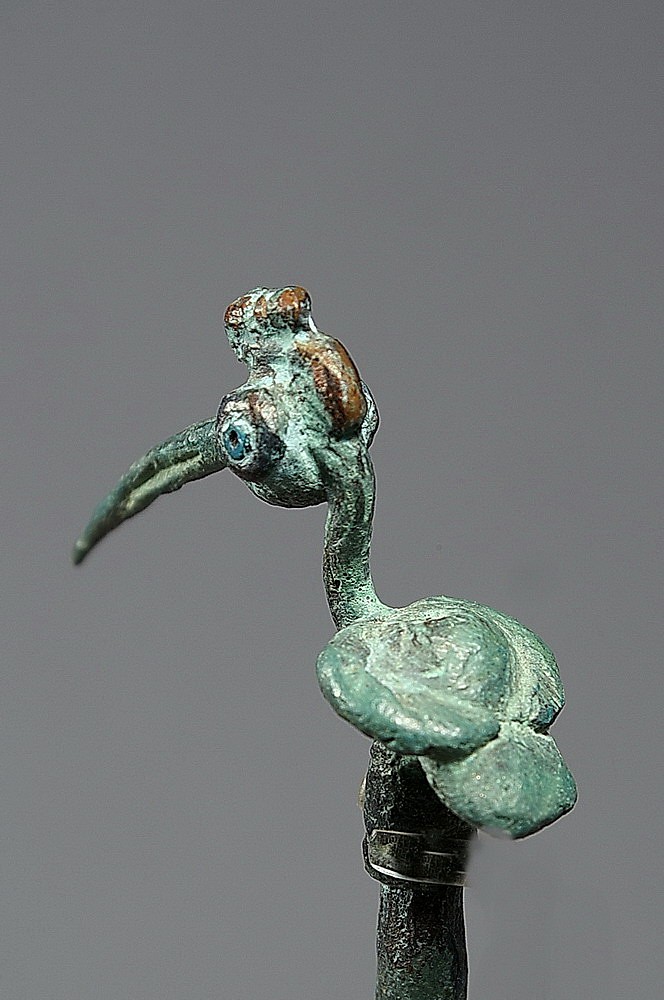


Peru, Chimu/Inca Copper Lime Spoon with Long-Billed Bird
An unusually large lime spoon decorated with a cast long-billed marine bird on top. The bird has turquoise beads for eyes. Lime spoons were used to extract powdered lime from containers for participants in coca rituals. The lime (powdered burned limestone or shell) was the catalyst that released the cocaine alkaloids from the coca leaves chewed during these ceremonies. Coca rituals were important to Andean cultures, but were restricted to elite, high-ranking lords. Birds represented souls flying to the otherworld to communicate with the supernatural. For similar examples, see Baessler (1906: pl. 13; Nordenskiold 1921: fig. 19, c; Carcedo de Mufarech 1985: fig. 89; and Schindler 2000: 202 and 203).
Period: Peru, Chimu, North Coast Peru, circa 1100-1350
Media: Metal
Dimensions: Height: 4 3/4"
Condition: Good. The tip of the spoon has been restored.
Price Upon Request
95102
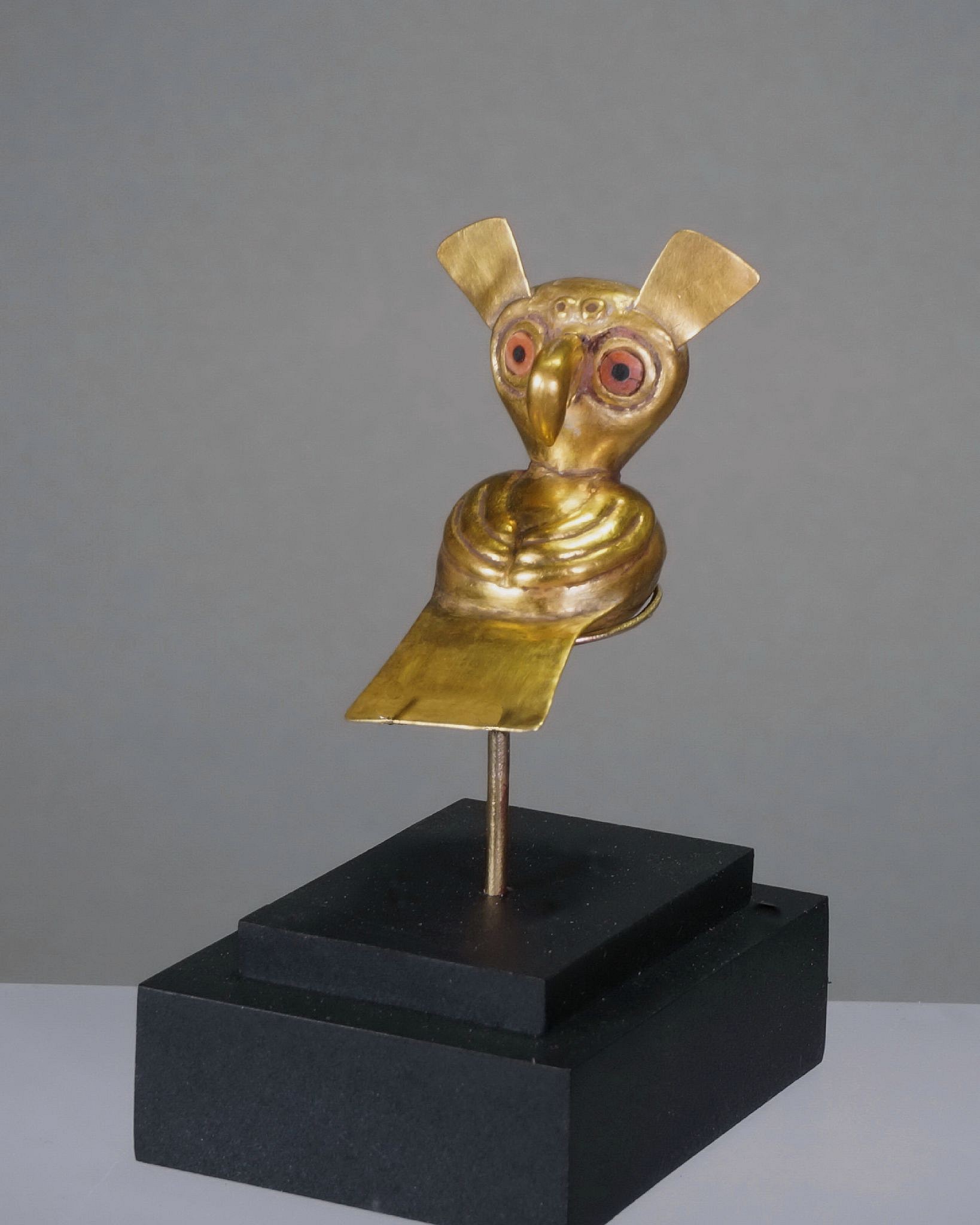
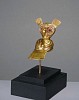
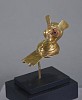
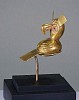
Peru, Early Moche Gold Owl Ornament or Necklace Element
This ornament portrays a stylized horned owl. The owl was revered by the ancient people for its special characteristics, such as silent flight, strong talons, and its ability to rotate its head 180 degrees. This gold owl has two suspension holes to the lower rear, which would have allowed it to hang looking downward. It is constructed from flat pieces of sheet gold that were hammered and beaten into repoussé parts, and then soldered together. Such three-dimensional forms were characteristic of the Transitional phase of gold work on the North Coast after the collapse of the ChavÃn culture. The eyes are made from Spondylus beads.
Period: Peru, Late Chavin/Early Moche, Transitional Phase, North Coast, c. 200 BC - AD 200
Media: Metal
Dimensions: Height: 1 1/4" X 1 1/4"/ Weight: 10 grams
Price Upon Request
M7015
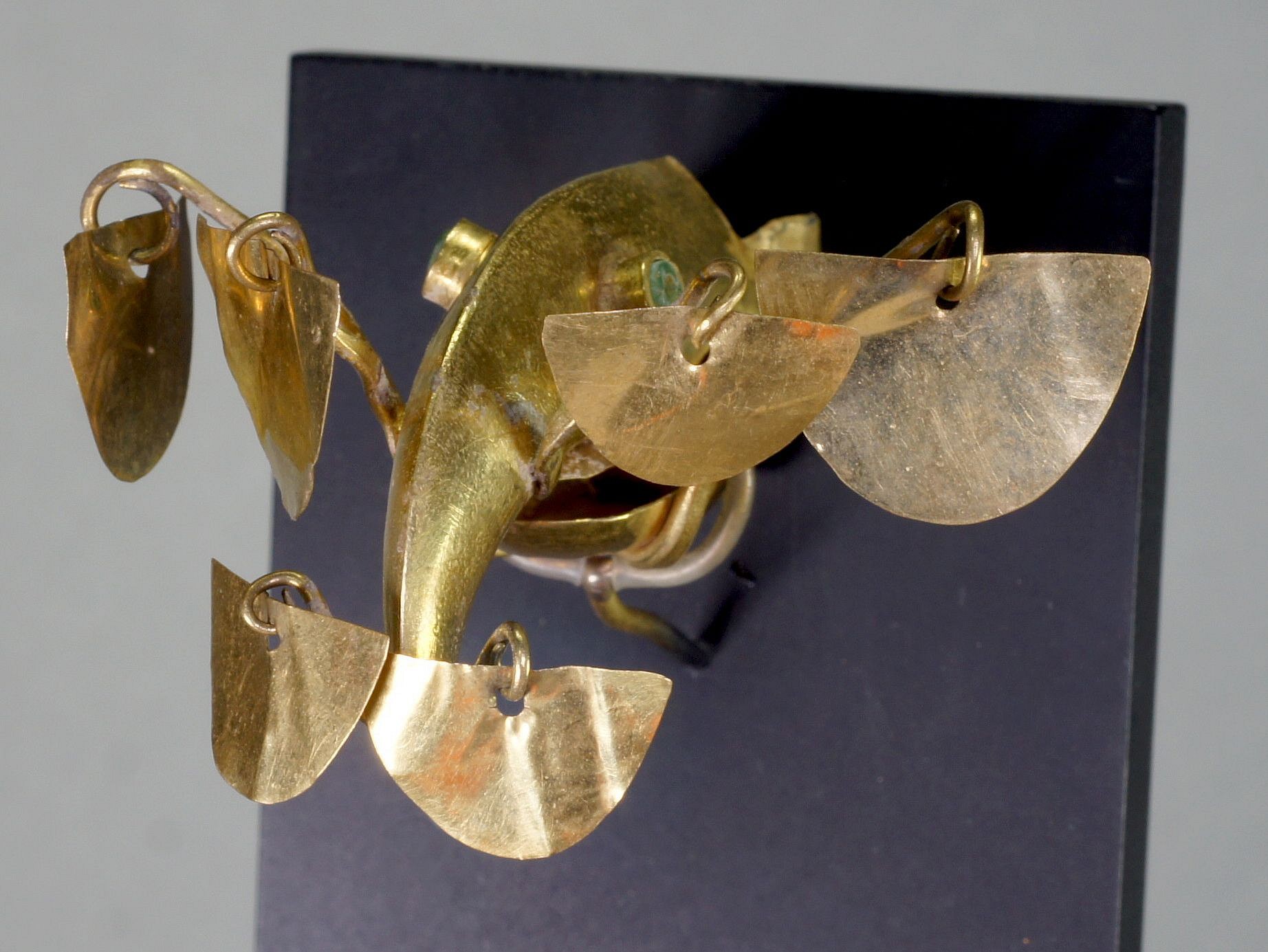
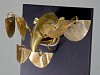
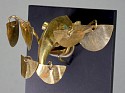
Peru, Early Moche/Vicus Head of a Tucan with Dangles
This object is quite rare and is from Northern Peru, by the Maranon river valley where other Vicus style objects have come from. It is fashioned from a heavy sheet, bent, soldered, and has dangles. It would have fit front and center onto a headdress, attached using the tabs at the back. The rods that hold the dangles are soldered, along with the bottom of the beak. The eyes are soldered rings with turquoise inlays. A similar object is illustrated in the GOLD OF PERU, Mujica Gaillo collection.
Period: Peru, Vicus, Far North Coast, c. 300 BC - AD 300
Media: Metal
Dimensions: Length 3 3/4" Weight 32.8 grams
$8,500
91055


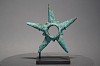

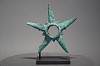
Peru, Inca Bronze Star Mace
This mace was well cast with a lost wax method. The Andean cultures utilized clobbering technology for their weapons, as opposed to swords and knives used in battle by their ancient European counterparts. The star motif was an Inca design and quite effective as a weapon. This mace was from the North Coast of Peru where they had arsenical bronze as opposed to Tin bronze found in the Southern highlands of Peru and Bolivia. Similar 5-pointed bronze maces are illustrated in Copper of Ancient Peru pg 425. Original patina, and intact in most places. Mounted on a custom-made base.
Period: Peru, North Coast, c. AD 1350 - 1530
Media: Metal
Dimensions: Height: 4 1/2" x Width: 4 1/2"
$1,350
96120
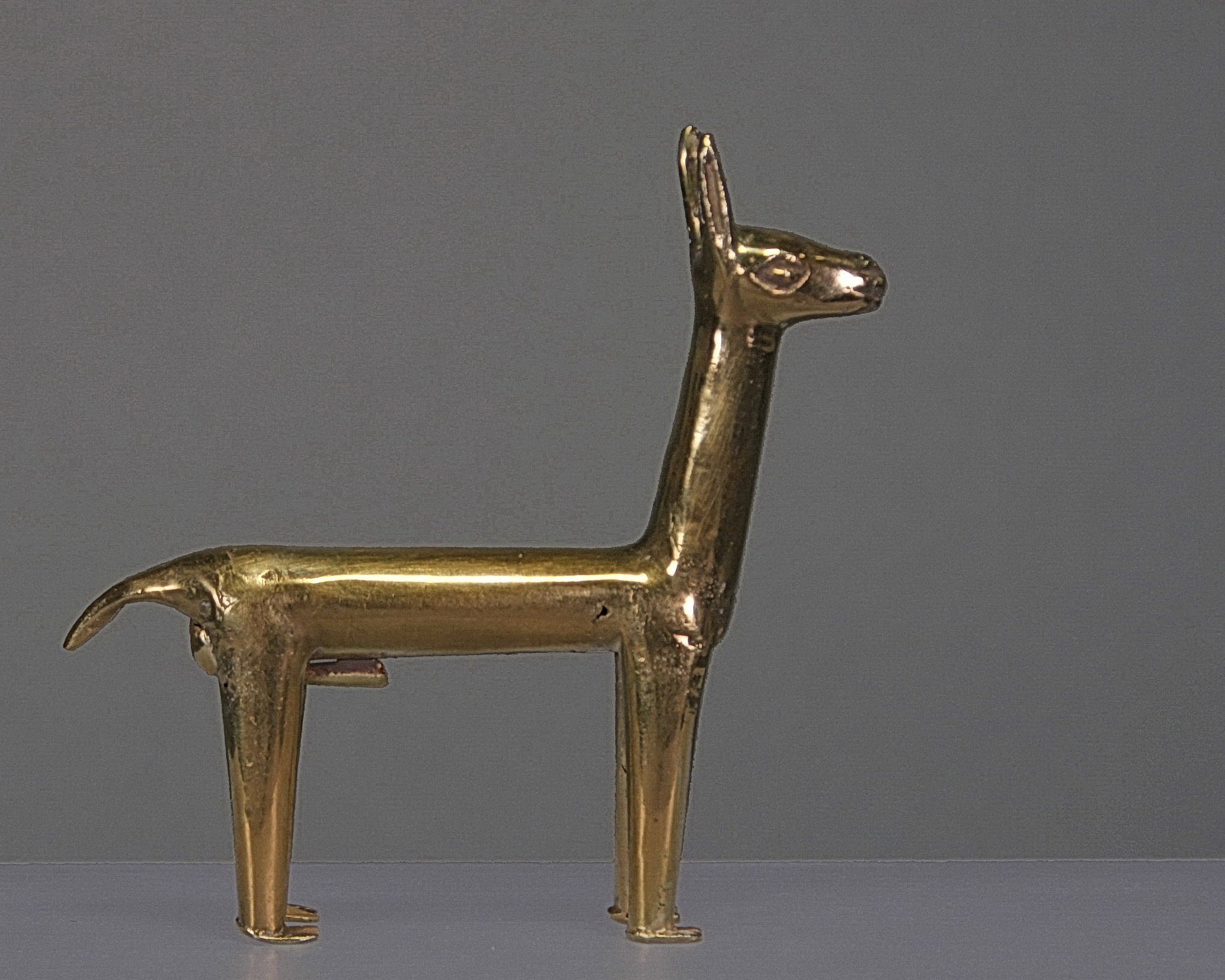
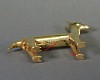
Peru, Inca Gold Hollow Llama
These Llamas, along with other miniatures in gold, silver and spondylus were found at high altitude sacrificial burials sites, used in a ceremony known as the Capac Hucha ceremony to praise the Inca. A similar llama is illustrated in ANCIENT AMERICANS, Art From Sacred Landscapes p. 362. This hollow llama was assembled from hammered gold sheets which were soldered together. One seam can be easily seen along the underside. Ex. New York collector, prior to 1970.
Period: Peru, Inca, Early Phase, South Highlands, c. AD 650 - 1250
Media: Metal
Dimensions: Height: 2.5" Weight: grams 9.6
XRF: Au. 66.4%, Ag. 24.6% , Cu8.8%
Price Upon Request
n7053


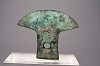
Peru, Inca Large Bronze Axe with Curved Blade
This blade exhibits classic Inca style, which employed crisp, clean, artistic lines, even for simple tools. It has a cast hole for attachment to the side of a shaft which it would have been lashed to. These axes were forged from tin bronze, the official metal of the Inca realm, in a process called slush casting. Molten bronze was poured into open molds. For more examples of lunate axes see Carcedo de Mufarech (1999: figs. 164 and 165).
Technical Features
The blade was annealed after casting to sharpen the cutting edge.
Period: Peru, Inca, North Coast, c. AD 1350 - 500
Media: Metal
Dimensions: Height 5" x Width: 5.75
XRF Data
Base: Ag 0.100 ,As 1.530 Cd 0.01, Cu 96.270, Mn 0.020, Ni 0.010, Pb 0.010, Sb 0.110, Se 0.100, Zn 0.01.
$1,200
MM228B


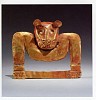
Peru, Late Chavin Hammered and Soldered Gold pendant with a Feline Head
This is a rare Chavin gold work that has been soldered - the ears to the head and the head to the body. There are two sets of suspension holes on each side of the mouth. There are two more suspension holes for danglers by each paw. There is repousse depicting the mouth and nose and on each paw. Estate of Bill Simmons, acquired at Sotheby's Sale # 7996, May 2004, lot 107.
Period: Africa, Cameroon
Media: Metal
Dimensions: Height: 7cm x Width: 8.3cm Wt. 24.3 grams.
XRF Au 85%, Ag 13.3%, Cu 1.08%.
Price Upon Request
n8011
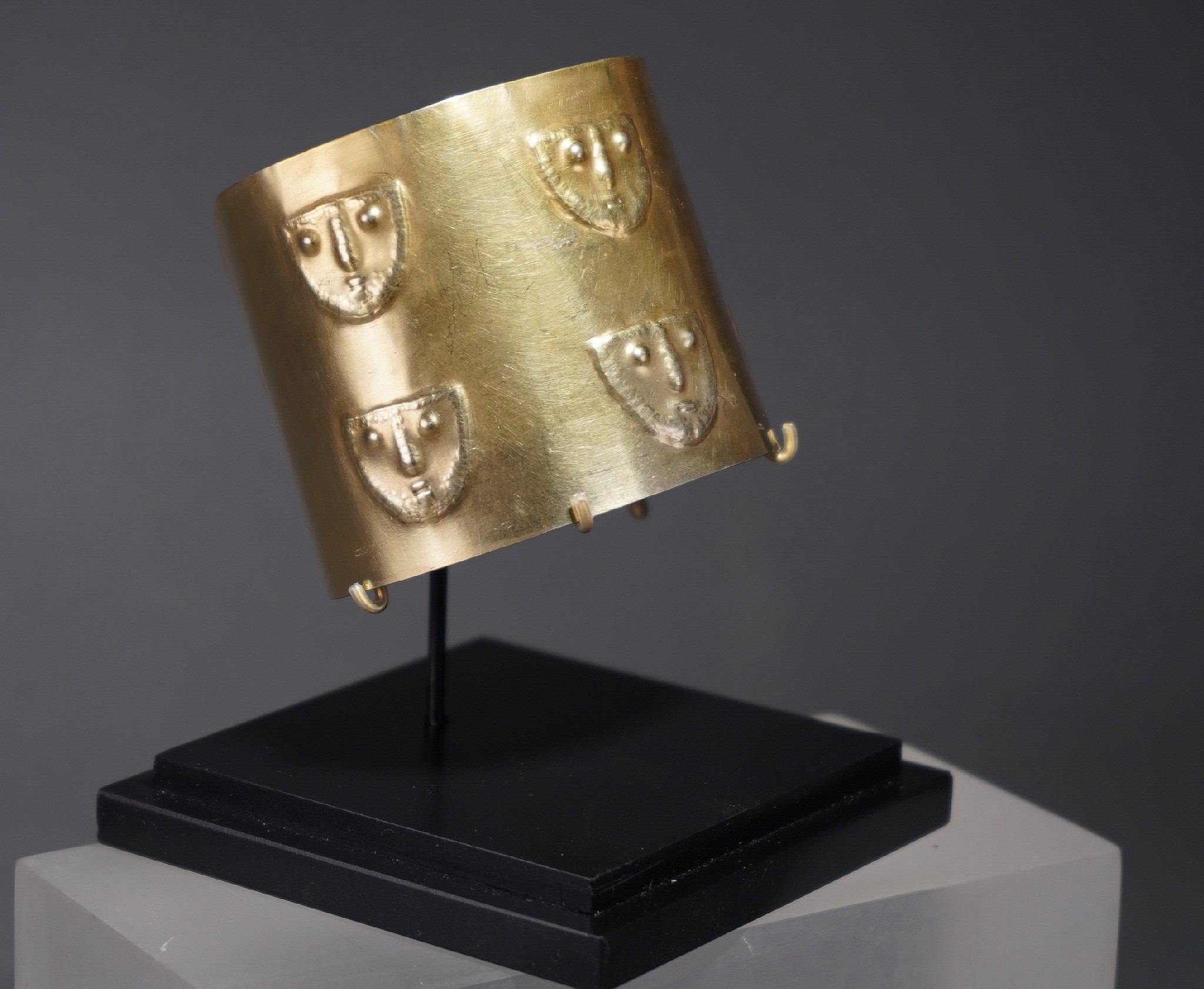
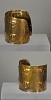
Peru, Late Nasca Gold Cuff with Embossed Faces
A hammered and repousse gold cuff decorated with two rows of faces, probably representing masks. I have not seen many cuffs embossed, as most Late Nasca art consists of simple wrought gold, occasionally with a geometric pattern. These embossed masks are quite rare. There are two tie holes on each edge of the cuff. Similar Nasca gold cuffs are illustrated in the THE GOLD OF PERU, MUJICA GAILLO COLLECTION. Ex-Collection Jean Eugene Lions, St. Tropez, since 1970.
Period: Peru, Nasca, South Coast, c. AD 400 - 800
Media: Metal
Dimensions: Height 2 1/4' Weight 40 grams
Alloy: Au.32.7, Ag. 55.3 & Cu.11.6 = 99.6%
$6,750
M5078

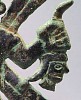


Peru, Loma Negra Copper Applique of the Decapitator
Appliques of this supernatural were sewn in series on woven textiles such as tunics and banners. The figure is known as the Decapitator, who has a distinctive mouth and often fangs, and whose right hand holds a tumi knife (blade lost) and a trophy head in the left. There are two holes in each diagonal of the ornament for attachment to a garment. A similar example is on display at the Metropolitan Museum of Art (New York, NY); more are illustrated in Lapiner (1976: figs. 350 and 382) and Carcedo de Mufarech (1999: 364). Loma Negra was a royal cemetery discovered about 1968 near the modern day city of Piura on the far north coast of Peru. From the tombs came exquisite Moche works in metal, mostly copper, with silver and gold objects as well, in sets of different sizes. The Decapitator is also called Ai Apec, the god who took off the heads of captives with his crescent bladed tumi knife. In another guise, he is Wrinkle Face, an aged deity with the same open mouth and fangs. The plaques seem to have been specific to the Loma Negra region, although the theme of the Decapitator dates back to the Chav�n period (Bawden 1999: 150-151). Scholarly research indicates that the overall form of the Decapitator on Loma Negra plaques was based on the body of an outstretched spider.
Period: Peru, Moche, Loma Negra, North Coast, circa AD100-300
Media: Metal
Dimensions: Height: 5 1/2" x Width: 6"
Price Upon Request
98249
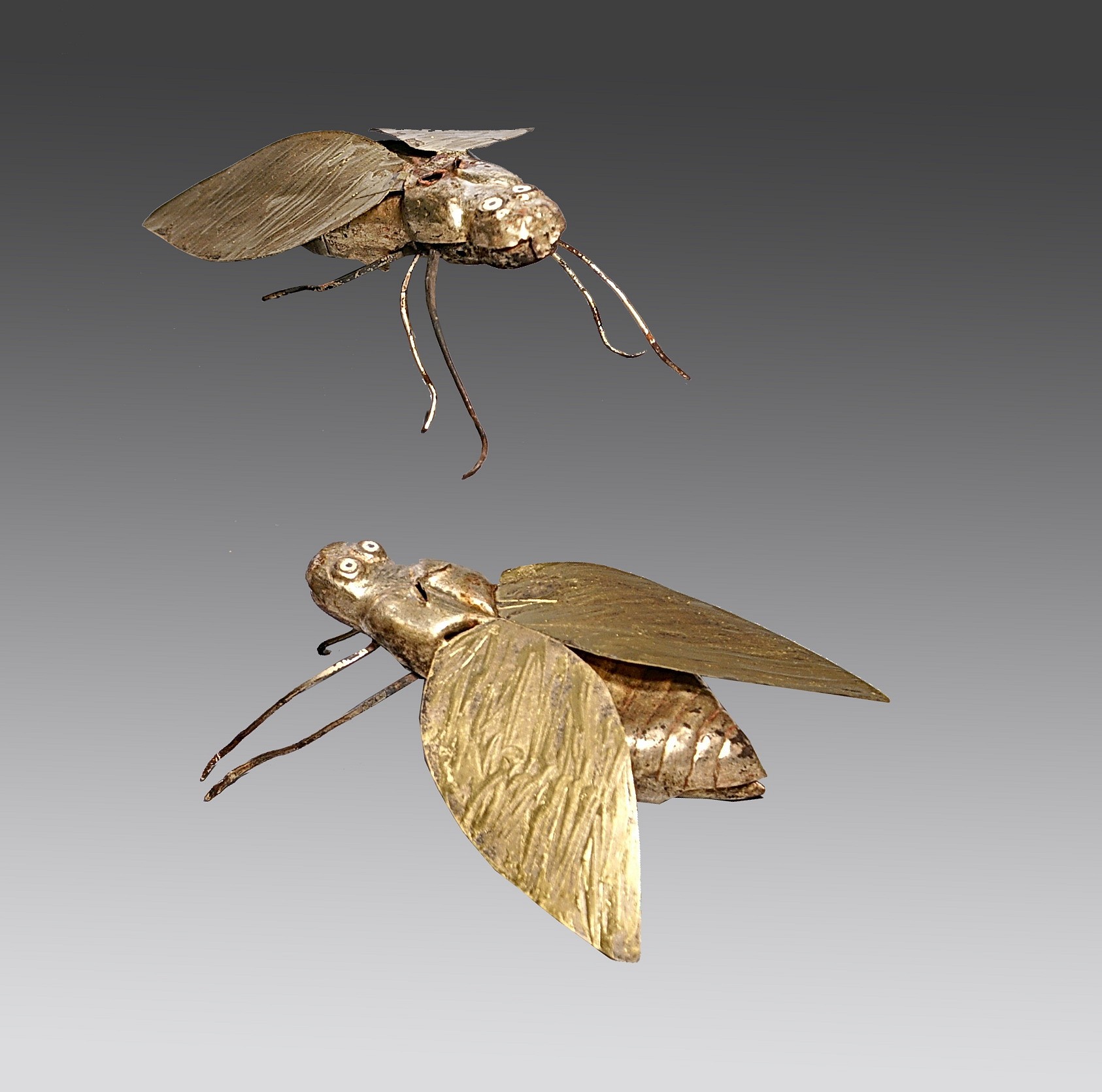
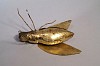
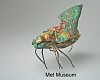
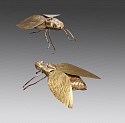
Peru, Loma Negra Gilt Copper Pair of Hoverflies
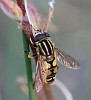
The flies are examples of a highly skilled gilding technique over copper. The construction is of tab and hammered and shaped parts to create a three-dimensional body. This was preferred in Peru over lost wax casting. Loma Negra Royal tombs were found in Northern Peru in the 1960's. The largest holdings of this material are in the Metropolitan Museum of Art. Other examples of critters are illustrated in PRE-COLUMBIAN ART of South America by Alan Lapiner, fig 376. There is a Loma Negra fly in the Met Museum ref 1981.459.28 in poor condition. Hoverflies are among the largest flies and have colorful bodies and are harmless. They often imitate bees or wasps as a survival technique to appear dangerous to their predators. The Peruvian favored animals that metamorphose, (eggs, large, maggots to flies) as proof that humans can transcend into spirits. Since hoverflies have colorful yellow and black bodies they connect with gold of the sun. These flies are considered large for Loma Negra creatures and have no apparent function.
Period: Peru, Moche, Loma Negra, North Coast, c. AD 100 - 400
Media: Metal
Dimensions: Length 4 1/2" x Width with wings 4" Height :1 1/2"
$15,000
M9067


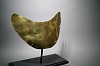
Peru, Loma Negra Gold Crescent-Shaped Headdress Frontis Piece
The headdress ornament has two sets of attachment points which would have been used to attach it to an elaborate headdress for an important personage. The Loma Negra archaeological site was discovered in the early 1960s and was later understood to be an early royal Moche tomb complex. Acquired by descent from Jan Mitchell to his sons, prior to the 1980s.
Period: Peru, Moche, Loma Negra, North Coast, c. AD 100 - 400
Media: Metal
Dimensions: Height: 7 1/8 " x Width: 9 " Gram Weight: 50.8
$7,500
p3064
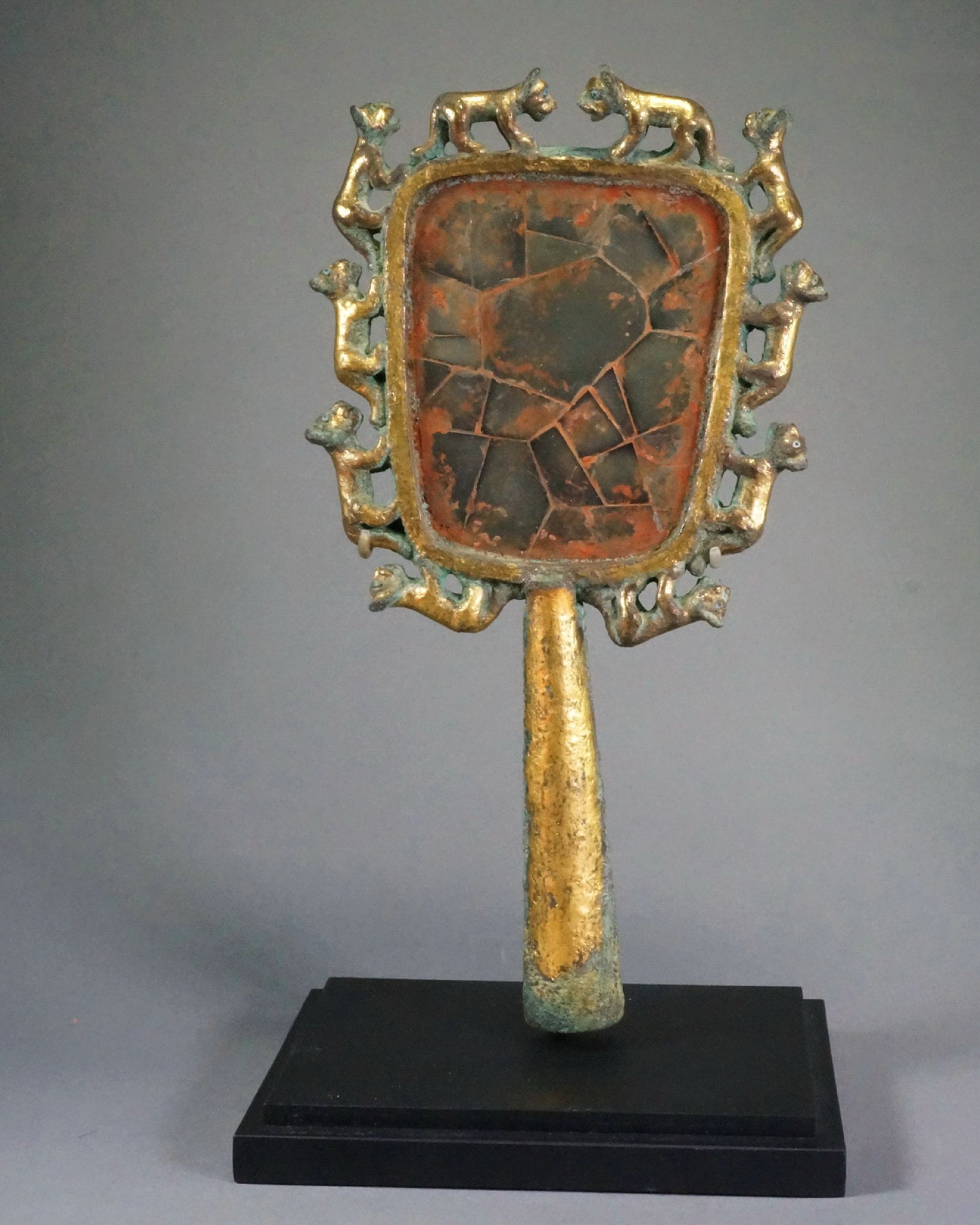
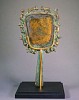
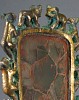
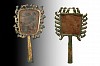
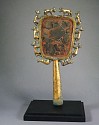
Peru, Moche Cast Copper Gilt Handled Mirror Surrounded by Ten Pumas
Hand-held mirrors are rare from any Peruvian cultures, and those few that are known are carved from wood, except one other gilt copper one that is in the Metropolitan Museum of Art. Mirrors were important objects for high status individuals and symbolized the power of the sun. Both mirrors were found at the Loma Negra site of far North Peru, excavated in the 1960’s, and were made by the same workshop. The mirrors have different themes: the Met’s with birds, and this one with felines.
Both mirrors were constructed in the same manner - cast frames are mechanically attached to the handle with a separate sheet of copper backing to hold pyrite mirror fragments in place. The Met’s mirror has lost most of its original gilding. This mirror has more of the original gilt surface intact and has a reconstructed mirror of ancient pyrite, whereas the Met’s mirror was restored with wax and coated with silver foil. The felines surrounding the frame were individually modeled and cast as one with the frame, an extremely difficult technical accomplishment. Each puma has carved turquoise eyes. The few other known mirrors with handles which have been found were carved from wood. There are no other known mirrors with metal frames according to Dr. Christopher Donnan formerly at UCLA and the world expert on Moche Art.
To read an essay about this mirror, click here.
Period: Peru, Loma Negra, North Coast, c. AD 100 - P300
Media: Metal
Dimensions: Height: 9 1/4"(23.5cm) x Width: 5"(12.6cm)
Price Upon Request
n7005

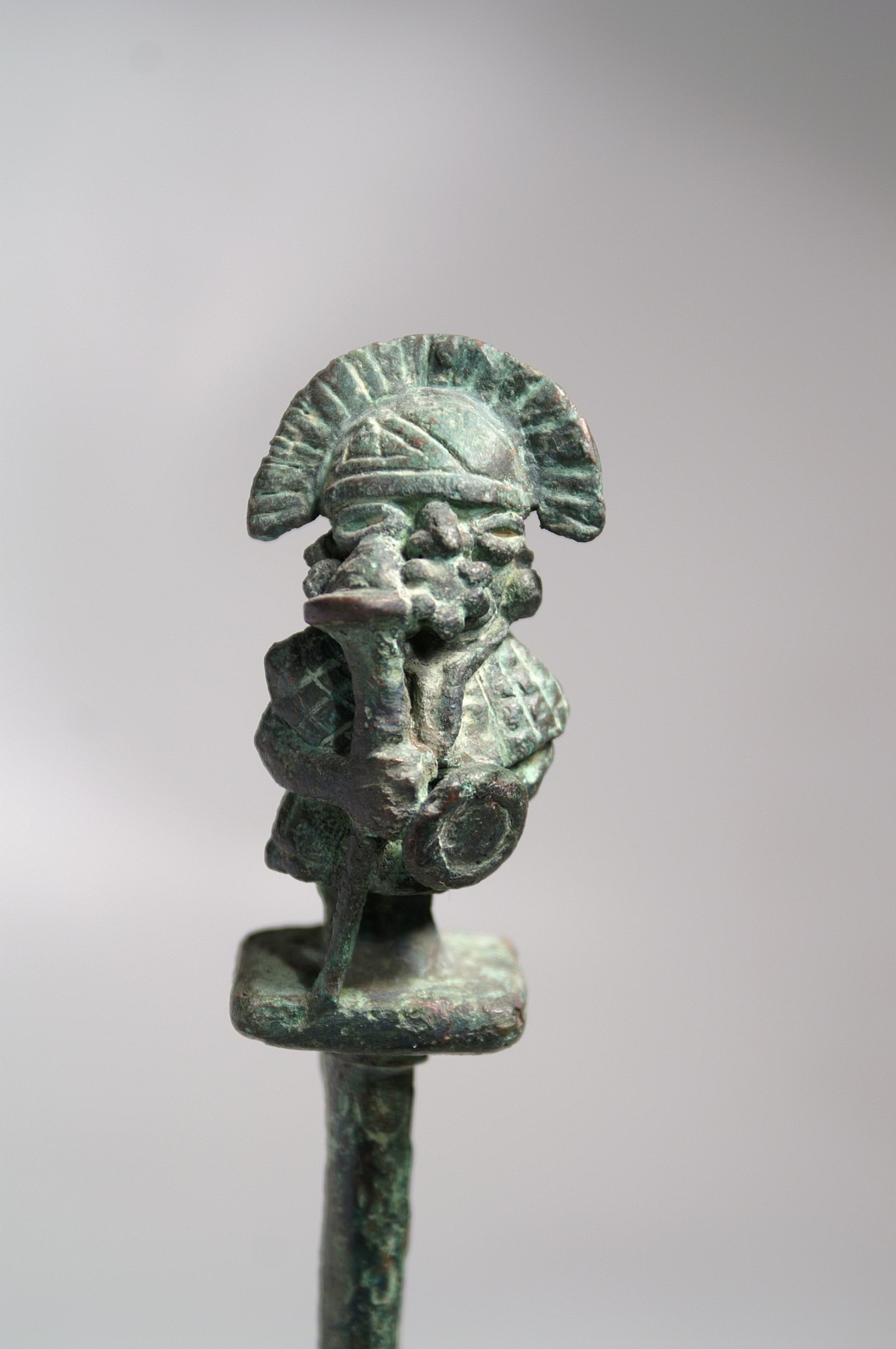
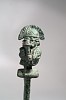
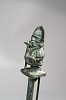
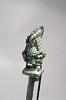
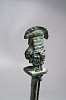
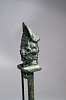
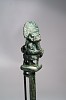
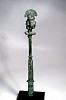
Peru, Moche Copper Spatula of a Warrior-lord with staff and shield
A warrior lord is spledidly dressed in full regalia wearing a helmet with feather crescent headdress, woven tunic, semi-circular nose ring and ear ornaments. He holds the standard long war club and round shield, such as appear in scenes of battle on fineline painted vessels. A small feline is splayed across the figure's back, wearing a necklace or belt of small owl heads. This work was cast in one piece in the lost-wax process. Spatulas were symbols of power for the high status Moche and were used in coca rituals to communicate with the ancestors and spirits of the otherworld. There is a suspension loop under the upper platform to be hung from a belt or the neck.
Period: Peru, Moche, North Coast, circa AD100- 600
Media: Metal
Dimensions: Height 8 1/2"
$5,500
98343
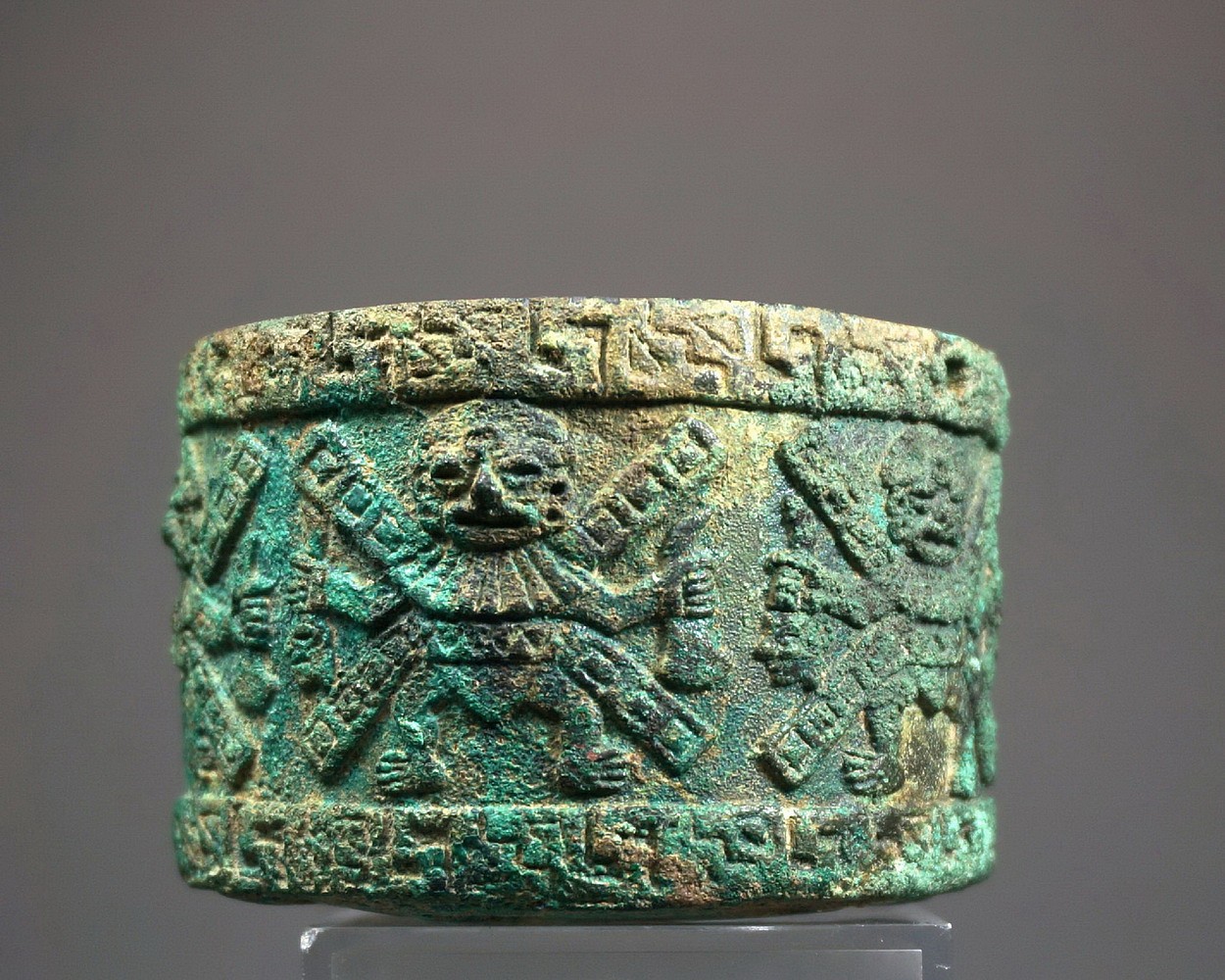
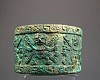
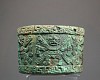
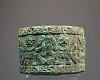
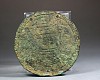
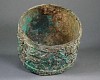
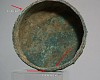
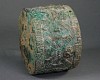
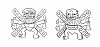
Peru, Moche Cylindrical Container with 6 Decapitators in High Relief
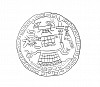
The container has a cover with an incised drawing of a weapons bundle. It’s a very rare object and is constructed with a complicated double wall technique. The outer wall was embossed by hammering the thin copper sheet against a wooden form carved with the figures. The inner wall is a plane sheet and annealed to the outer sheet and hammered around a form in the shape of bottom disc.
Period: Peru, Moche IV/V, North Coast, c. AD 400 - 700
Media: Metal
Dimensions: Height: 2 1/4" x Diamerter: 3" Circumfrence: : 10"
$12,000
n4013


Peru, Moche Gold Bead in the Form of a Tree Snail
The emergence of snails signals the start of the rainy season, indicating prosperity and abundance. The tree snail, Strophoceheilus, is featured in fineline drawings on the sides of Moche ceramic vessels depicting "snail hunters" in the foothills of the Andes. This bead is made in two parts, with the bottom expertly soldered to the spiral cone-shaped shell. The snail's foot is exposed inside the shell. The shell also functions as a bell, with two copper beads inside that rattle when worn. Originally from a larger necklace of snail beads, each with two sets of suspension holes on the bottom. Illustrated in Oro del Antiguo Peru, lam.183. Ex. collection Benno Mattel, by descent to his daughter Karin Ashburn.
Period: Peru, Moche, Loma Negra, North Coast, c. AD 100 - 400
Media: Metal
Dimensions: Height: 2" x Width: 2 1/2" Weight: 36.4 gm.
$27,500
n8018


Peru, Moche Gold Nose Ornament Surrounded with 18 Spheres
Each of the spheres are individually soldered to the base. Illustrated in Oro del Antiguo Peru, plate 134. From a Texas collector, acquired prior to the 1970s.
Period: Peru, Moche, Loma Negra, North Coast, c. AD 100 - 400
Media: Metal
Dimensions: Height: 2 1/4" x Width: 2 3/4" Weight: 27.3 grams.
$18,000
n8020

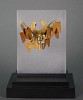

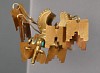
Peru, Moche Gold Nose Ornament with Hummingbird in a Tree
This delicately crafted hummingbird figure features inlaid turquoise eyes and geometric danglers. This is an excellent example of Moche soldering and filigree workmanship
Period: Peru, Moche, North Coast, c. AD 100 - 300
Media: Metal
Dimensions: Width: 1 1/2" x Depth: 1 1/2" Weight; 8 grams.
•SOLD
90166

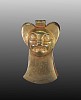

Peru, Moche Gold Pincer with Embossed Large-Eared Bat Face
Pincers have been found from as early as the Vicus period (pre-Moche), circa 300 BC and were thought to be used to pluck facial hair. Few are known from the Moche period and most of the pincers that have been found were from the Chimu and Inca periods. This pincer has an embossed face of a bat with fanged teeth. The bottom of the pincher features a beautiful, flared design, representing a Moche back-flap. It was made from one single hammered sheet of high carat gold and then embossed twice on a carved wood form, then bent at the middle to create an identical front and back. There is a suspension hole in the middle. Ex. collection Magret Brenner, Zurich.
Period: Peru, Moche, North Coast, c. AD 200 - 700
Media: Metal
Dimensions: Height: 2 1/4" x Width: 1 1/4" Weight: 16.5 grams.
$9,750
n7012
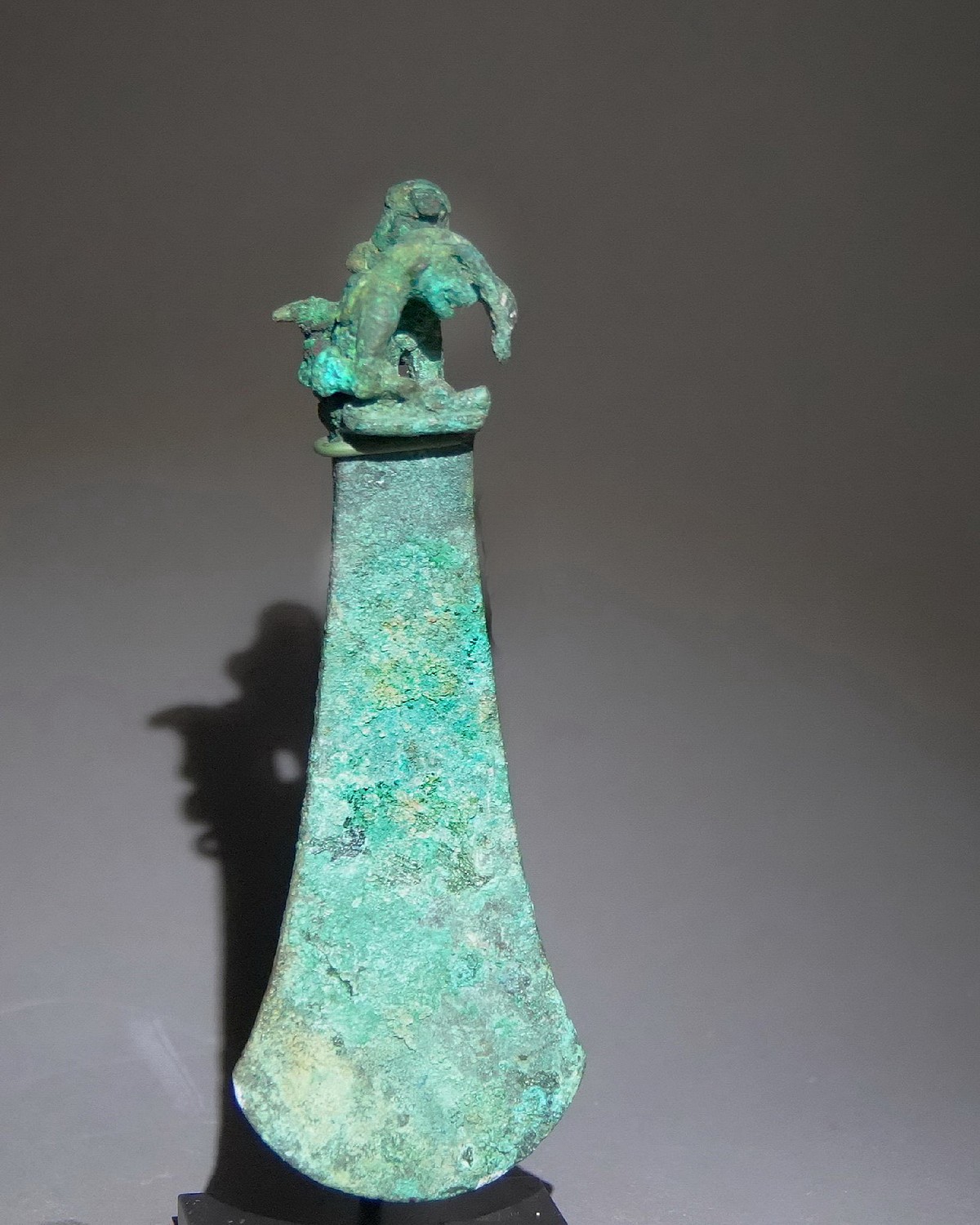
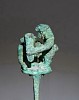
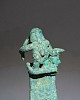
Peru, Moche Lost Wax Cast Bronze Tumi of a Warrior Capturing a Feline Deity
This classic tumi was lost wax cast using a single mold. There are two figures: a warrior and his victim, whom he holds by the hair. The victim, a feline deity, holds a tumi in one hand and a trophy head in the other.
Period: Peru, Moche IV, North Coast, c. AD 200 - 500
Media: Metal
Dimensions: Height: 7 1/4" x Width: 2 1/2"
$6,000
P1037
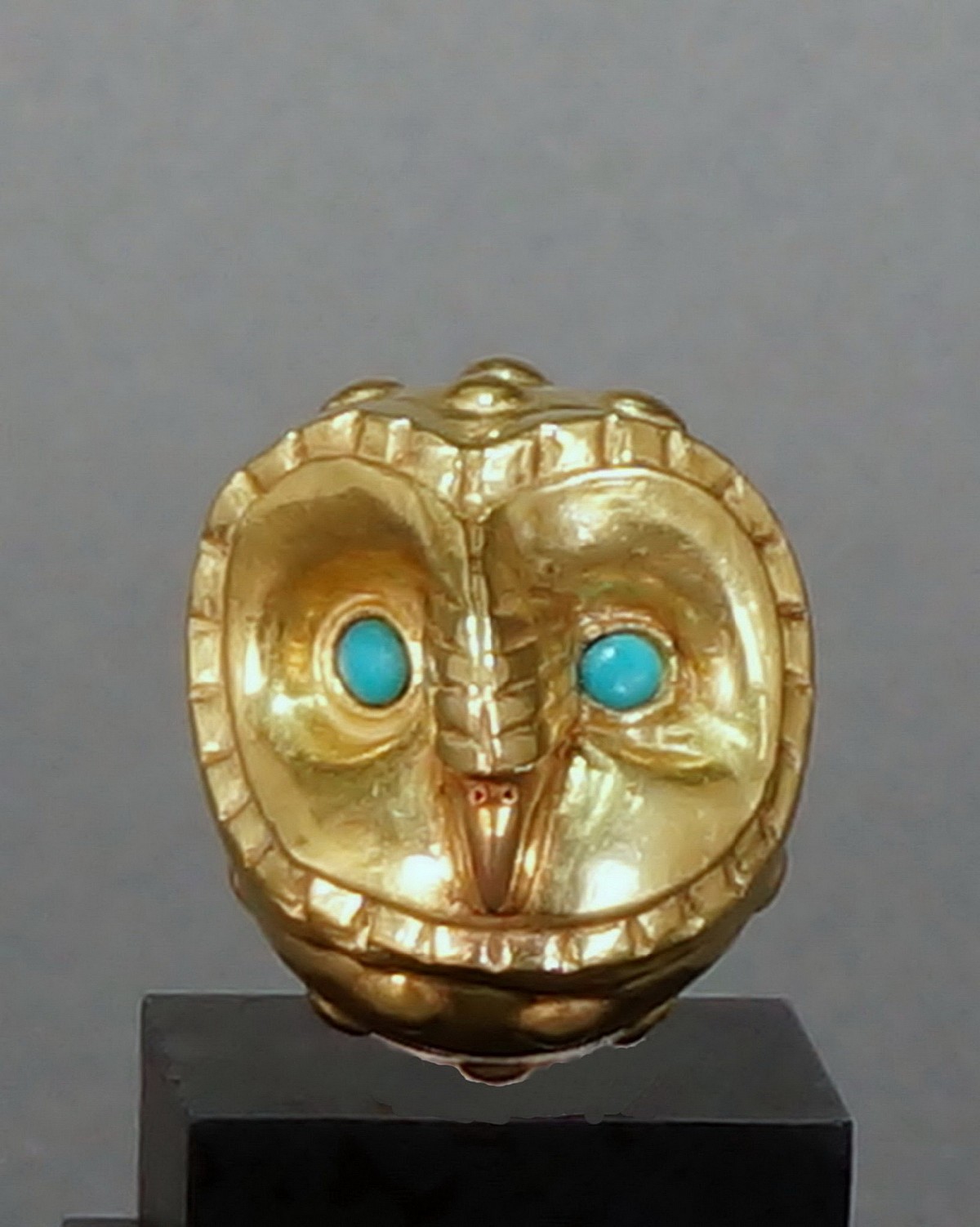
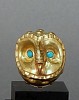
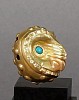
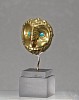
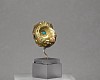
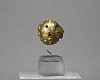
Peru, Moche Small Gold Male Condor Bead with Turquoise Eyes
This gold bead is identifiable as a male eagle by the caruncle on the beak. The beak itself is crated in a slightly reddish colored gold. It is made in two parts, expertly soldered. There are four suspension holes that allow for the bead to be hung upright. Ex Collection Benno Mattel, prior to 1970, by decent to his daughter Karin Ashburn.
Period: Peru, Moche, North Coast, c. AD 450 - 550
Media: Metal
Dimensions: Height: 3.3cm x Depth: 3.2cm x Weight:10.2 grams
$5,000
n8021
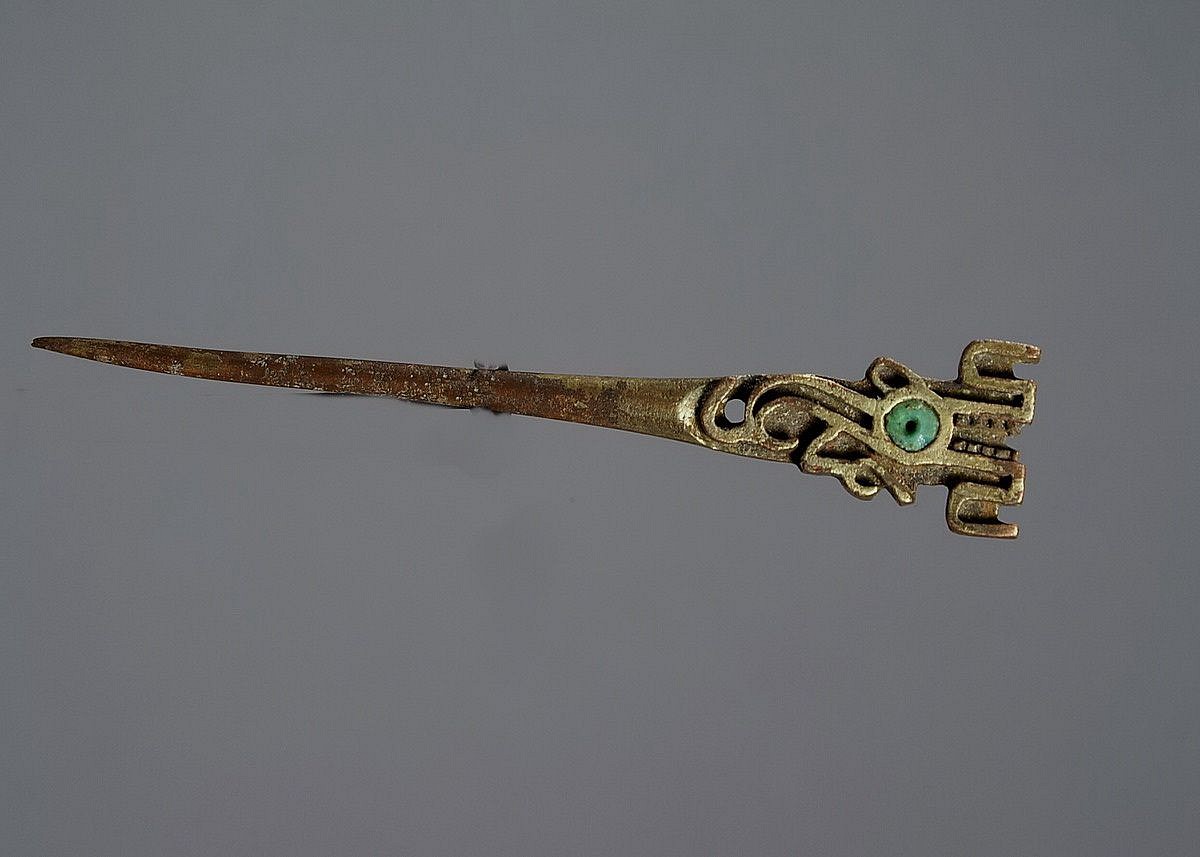
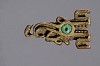
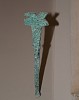
Peru, Recuay Gilt Copper Pin Decorated with the Moon Animal
This is a short tupú with a filigree design of the Moon creature, a North Coast deity invented by the Recuay and adopted by later societies. The creature may have been modeled after the Pampas Cat or the Andean Mountain Cat, a small feline that inhabits the region. The Recuay and Moche associated the Moon Animal with the crescent moon, stars and human sacrifice. There is a turquoise bead in the eye; other recessed areas of the casting also had inlays, which have been lost. Few Recuay gilded works have survived because the gilt tends to fall off over time. The Recuay had sophisticated techniques of metalworking, and this example is extremely well crafted. The gilding is thick (about 1mm). A similar pin was found at a Recuay site, and is on display at the American Museum of Natural History.
Period: Peru, Recuay, North Highlands, c. 300 BC - AD 700
Media: Metal
Dimensions: Length: 3 1/2" x Width at top: 5/8"
$1,700
M2029


Peru, Salinar Group of Fourteen Gold Filigree Ear Ornaments
A group of 14 Salinar gold filigree nose ornaments of various designs and sizes. The Salinar people preceded the Moche on the North Coast of Peru in the Trujillo region. Ancient coastal Peruvians did not have access to bees or beeswax due to the dry coastal desert environment and were unable to use the lost wax casting method employed in ancient Colombia. Instead, they used soldering to create elaborate filigree ornaments. Soldering is technically complex, requiring carefully controlled temperatures along with the right mix of flux. This group of 14 individual gold filigree ear ornaments demonstrates the great level of skill and artistry achieved by the Salinar metalsmiths. Many of these filigree works are similar those illustrated in Trujillo Precolombino, by Jose Antonio de Lavalle, page 297. Three similar nose rings from the same region are also illustrated in RAIN OF THE MOON: Silver in Ancient Peru, published by The Metropolitan Museum of Art, 2001, fig. 1. Acquired in 2000 from a private New York collector.
Period: Peru, Salinar, North Coast, c. 300 BC - AD 100
Media: Metal
Dimensions: Range: 7/8" to 1 1/2" Width
$8,000
MM087


Peru, Salinar-Early Moche Gold Nose Ornament With Dangles in the Form of Bird Feathers
Unusual and rare nose ornament from the Salinar culture with stylized bird heads at each end and six dangles imitating feathers. A similar example is illustrated in "Oro del antiguo Peru" by José de Lavalle (1992: pl. 94).
Period: Peru, Viru, North Coast , c. 200 BC - AD 200
Media: Metal
Dimensions: Width 4" x Height 1 3/4"
Price Upon Request
96164
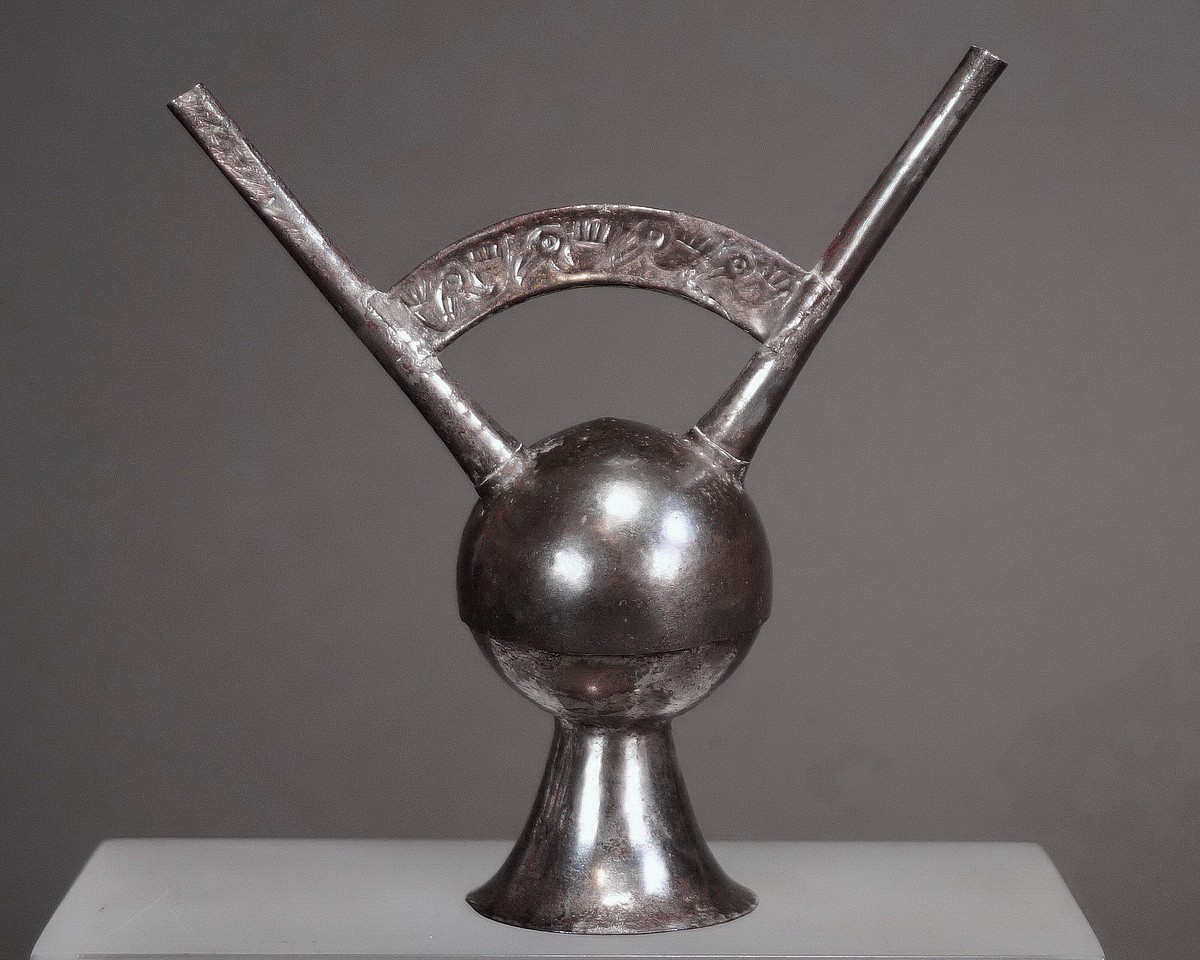
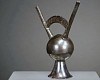
Peru, Sican Gilt Silver Miniature Double Spouted Vessel
The vessel was made for a child's tomb. It has an arched bridge with four marine birds embossed on each side and is made from 6 components that are soldered together. The base metal is copper, and there is a thin outer layer of silver, which is worn in a few places. Gilding, the method used to create this vessel, was a much more difficult process then sculpting with pure silver.
Period: Peru, Sican, Batan Grande (Upper Leche River Valley), North Coast, c. AD 850 - 1150
Media: Metal
Dimensions: Height: 5" x Width: 4 3/4"
Price Upon Request
n8036
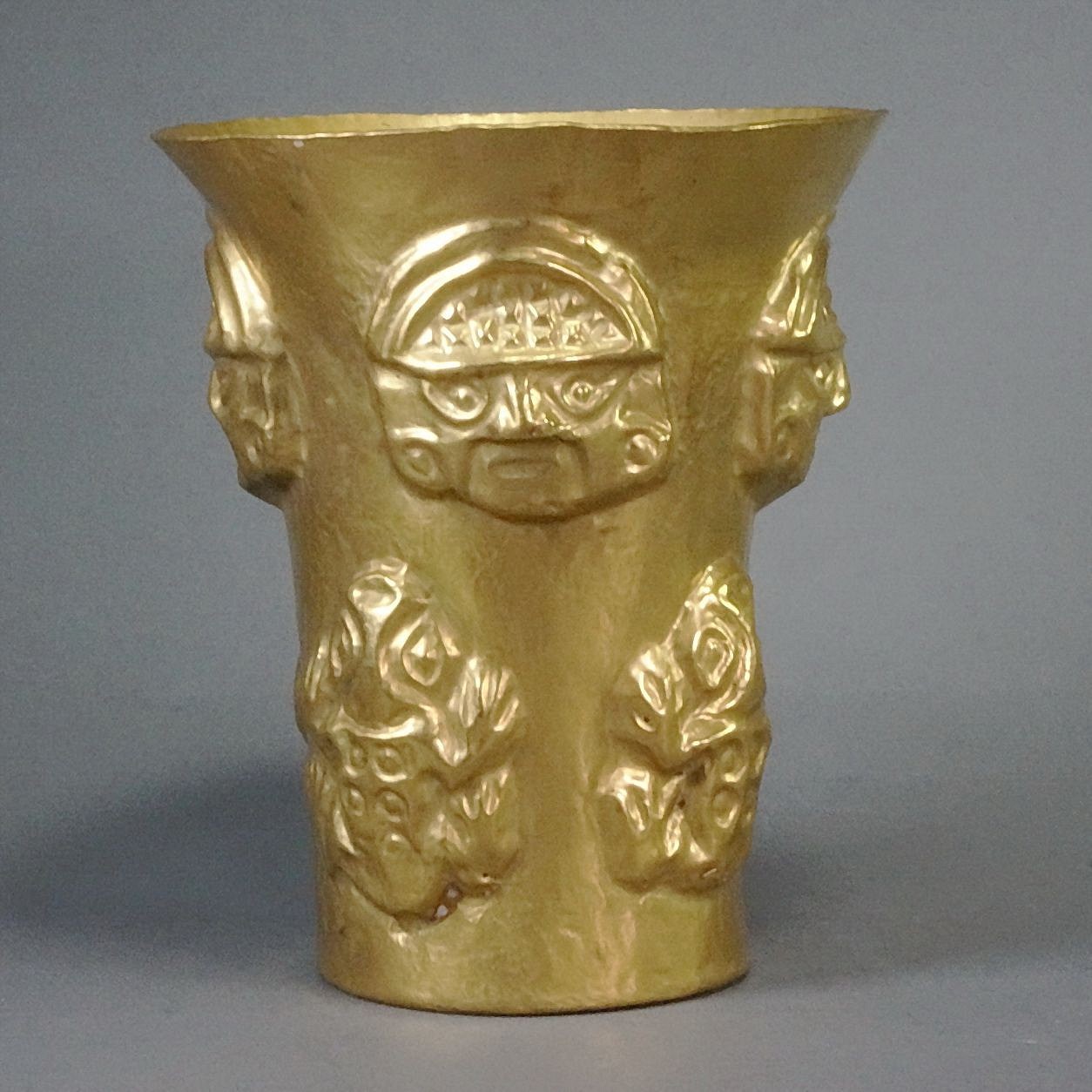
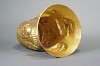
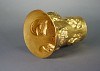
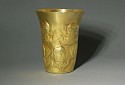
Peru, Sican Gold Beaker with Mask and Frog Motif
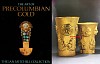
The Sican cache of gold came from the largest burial in the Americas at hacienda Batan Grande near the Chimu City of Chan Chan. These beakers were used to drink the ceremonial Chicha (Corn Beer). The masks and flared beakers were the most notable objects from this burial. The beakers came in various designs from frogs to Warriors. This beaker is unusual in that it has both masks and frog motifs. Illustrated in THE ART OF PRECOLUMBIAN GOLD, pg.227 the on the right. Exhibited in 1964, Los Angles # 202. Ex-Jan Mitchell collection, prior to 1980.
Period: Peru, Sican, Batan Grande (Upper Leche River Valley), North Coast, c. AD 850 - 1150
Media: Metal
Dimensions: Height: 5. 1/8" Diameter at top: 4 3/8" Weight: 184 grams
Price Upon Request
n7054


Peru, Sican Gold Flared Beaker with Embossed Toads
Bufo Marinus toads, depicted on this vessel beaker, are found on the dry coastal desert coast of Northern Peru. These toads are identifiable by their highly textured skin, represented by six sets of incised circles. Acquired from a private Texas collector, prior to the 1970s. Some traces of cinnabar.
Period: Peru, North Coast, Sican, Batan Grande,
Media: Metal
Dimensions: Height: 51/2" x Width: 4.2" Weight: 118 grams.
$32,000
N6001
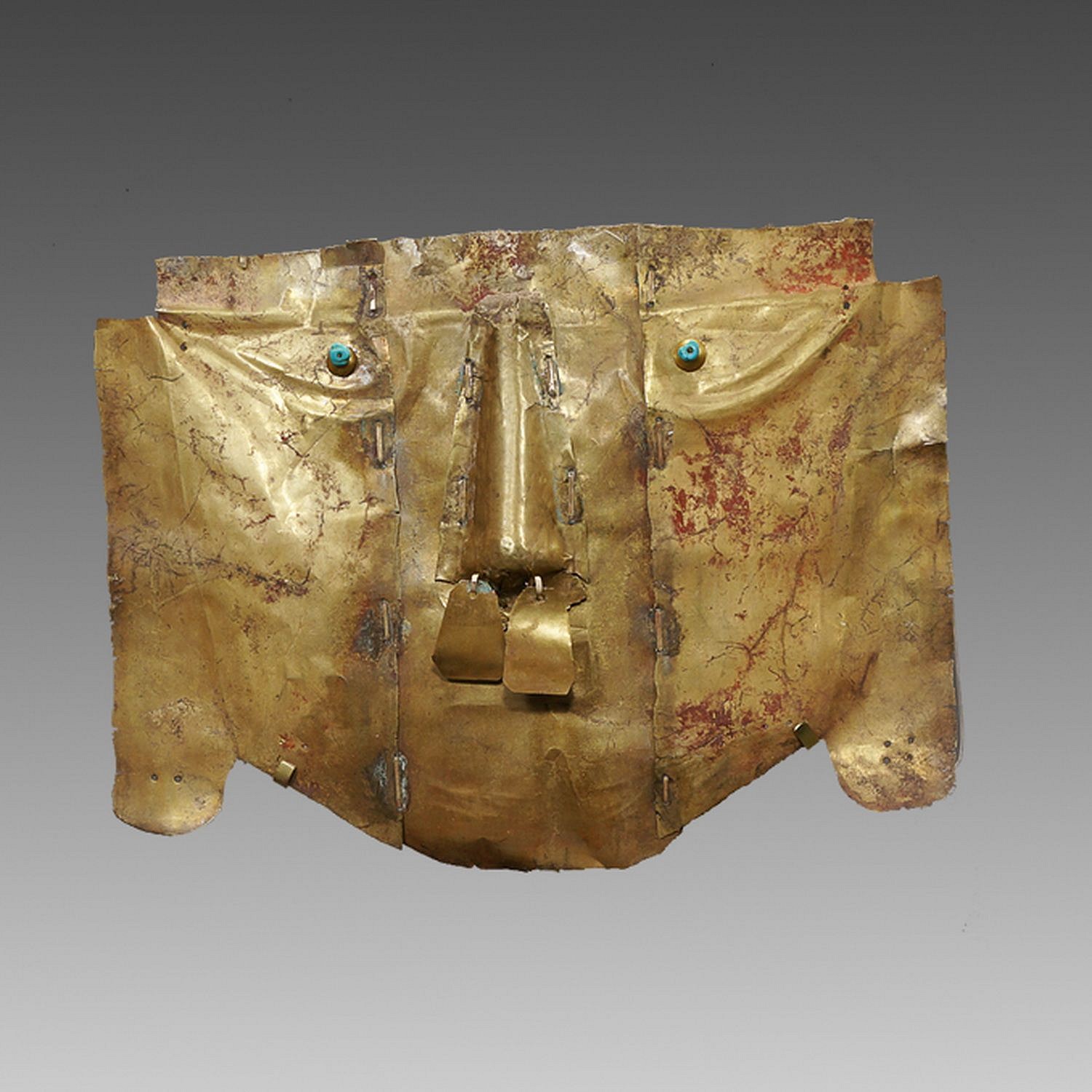
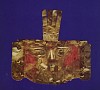
Peru, Sican Gold Mask of the Third Type
A classic type of mask from the 3rd Phase, constructed in 3 parts and held together by ancient gold staples. The eyes have turquoise bead pupils with gold hemispheres. Traces of the original cinnabar remain. Sicán masks are discussed in THE ART OF PRECOLUMBIAN GOLD - The Jan Mitchell Collection, page 66 - see example(s). The Sicán culture was extremely wealthy and was known to have built the largest city in the Americas, Chan- Chan, outside of the modern city of Trujillo. The Sicán were excellent gold workers, and when the Incas conquered them, they brought the metalsmiths to the Inca capital of Cuzco. Similar masks are illustrated in THE GOLD OF PERU-MUJICA GAILLO Collection. Ex. Private New York Collector.
Period: Peru, Sican, c. AD 800 - 1100
Media: Metal
Dimensions: Height: 7.75" x Width 10 1/8"
Price Upon Request
n4001
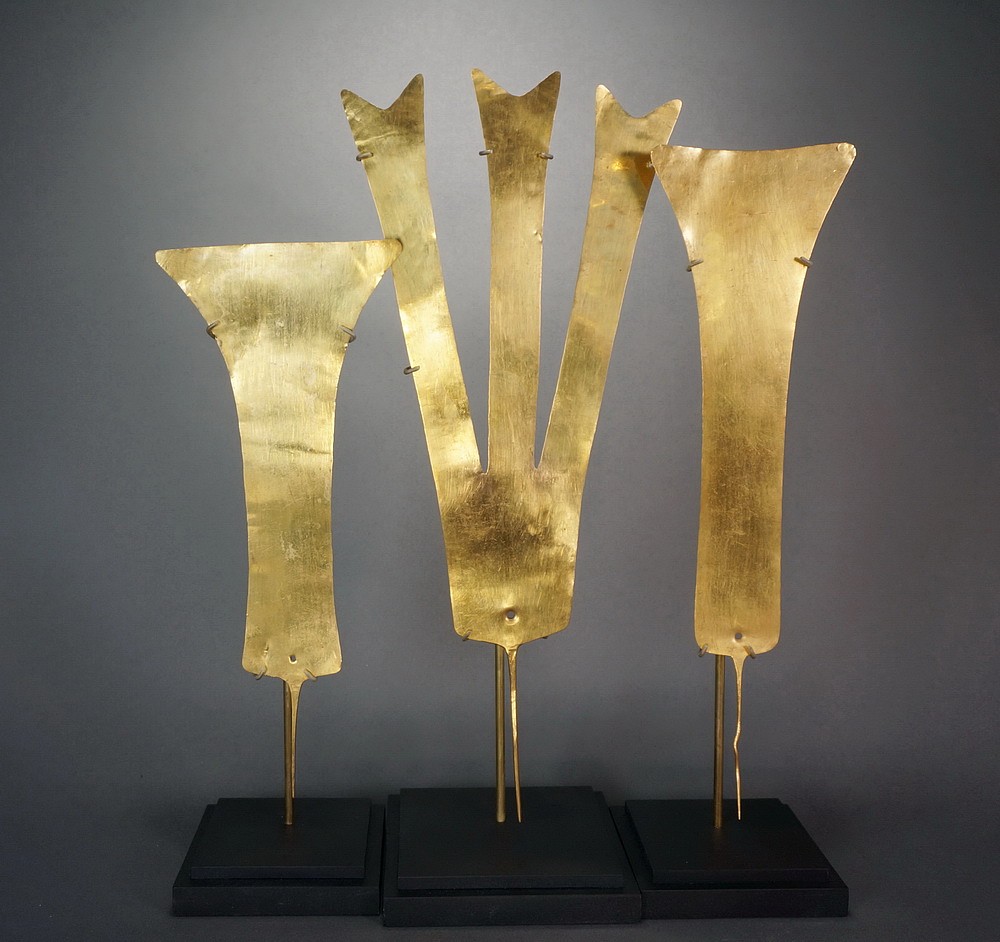



Peru, Three Chavin Gold Plumes for Headdress
Three hammered gold plumes were used as headdress or turban ornaments with tapering shafts. They were each fabricated from an individual nugget by repeatedly hammering and annealing. They are illustrated in TRUJILLO Precolumbino, Odebrecht-Lavalle, Editores 1990, pg 293. Other similar examples are illustrated in Oro del Antiguo Peru, pl. 51. These plumes are considered very large for early Peruvian goldwork.
Period: Peru, Chavin, Tembladera, Late Phase, North Coast, c. 900 - 200 BC
Media: Metal
Dimensions: Height: 9", 11", 12" Weight for the three 90 grams
XRF: Au.81, Ag. 9.5%, Cu. 10.1% average for the 3
Price Upon Request
94192


Peru, Three Moche Bi -Metallic Nose Ornaments
These ornaments are excellent examples of the Moche metalsmiths’ ability to use depletion gilding to vary the surface area with both gold and silver decoration. The Moche believed that metal possessed sacred power, and according to their cosmological myths, the process of bringing the silver and gold colors to the surface revealed the metal’s spiritual qualities. A similar nose ornament is illustrated in ANTIGUO ORO DEL PERU, pg. 15. Private collector, Florida, prior to 1980.
Period: Peru, Moche, North Coast, c. AD 100 - 600
Media: Metal
Dimensions: Width 4 3/4" Weight 24 grams.Width 3 5/8" Weight 13.8 grams.Width 3 7/16" Weight 14.8 grams.
$12,500
M5027
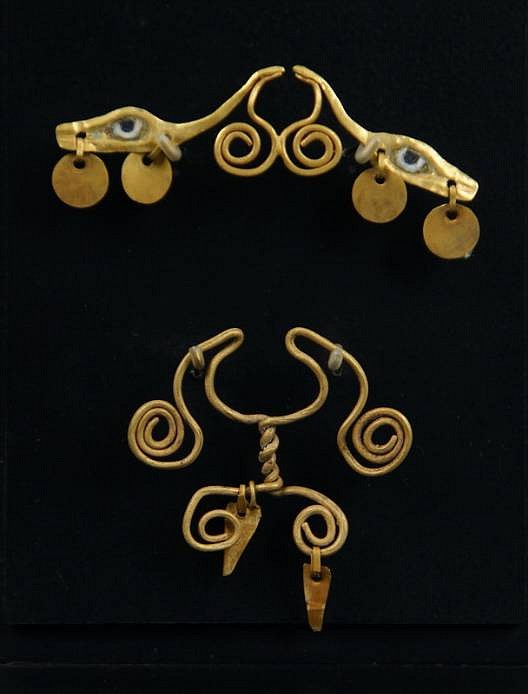


Peru, Two Chavin gold nose ornaments with openwork coils and dangles
One is fashioned from one continuous wire curled into double spirals and twisting into another set of doublle spirals flanking a central suspension plaque and two triangular dangles. The other has double spirals in the center framed by serpents heads, end to end, each with two suspended circular dangles. A similar one is illustrated in Oro Del Antiguo Peru, plate 42.
Period: Peru, Chavin, Tembladera, Late Phase, North Coast, circa 600 - 400 BC
Media: Metal
Dimensions: Height 1 3/4 inches; Width 2 1/2 inches
Price Upon Request
94154
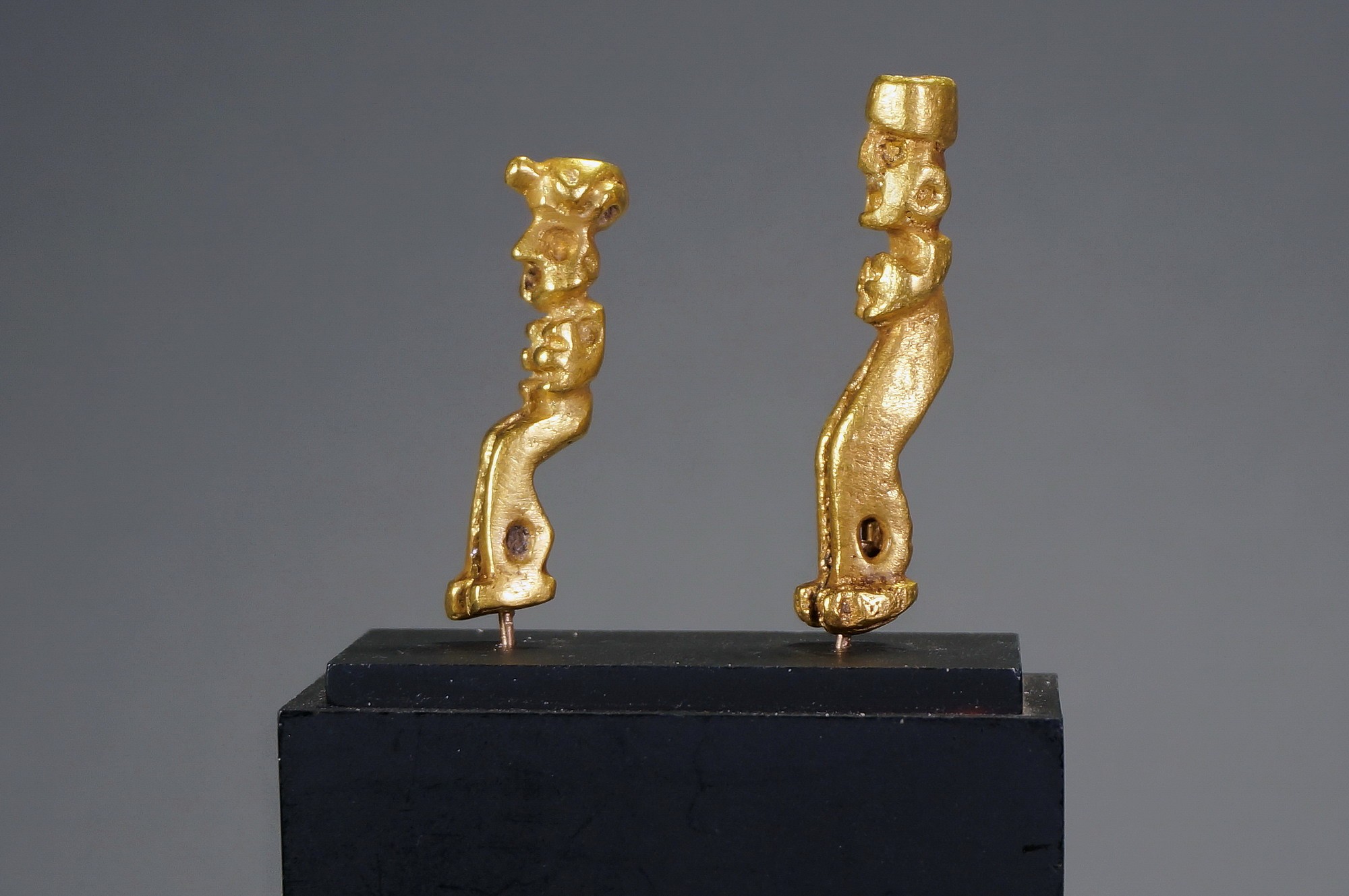
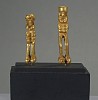
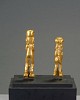
Peru, Two Inca Miniature Cast Gold Standing Figures
These two solid cast gold figures are highly unusual subjects. Each figure has exaggerated hands and elongated legs. Both figures have cast suspension holes above the ankles. The top of each figure has a hollow shape that could have been used to insert feathers. The only other example illustrated is in Oro del Antiguo Peru, lamina 210 (7 cm or 2.75"). One figure is wearing a headdress with a feline motif and the other one with a simple cylindrical shape. Ex. New York collector, prior to 1970.
Period: Peru, Inca, c. AD 1400 - 1532
Media: Metal
Dimensions: Height:1.5" and 1.75"; Weight: 24 grams for pair.
Price Upon Request
n7028


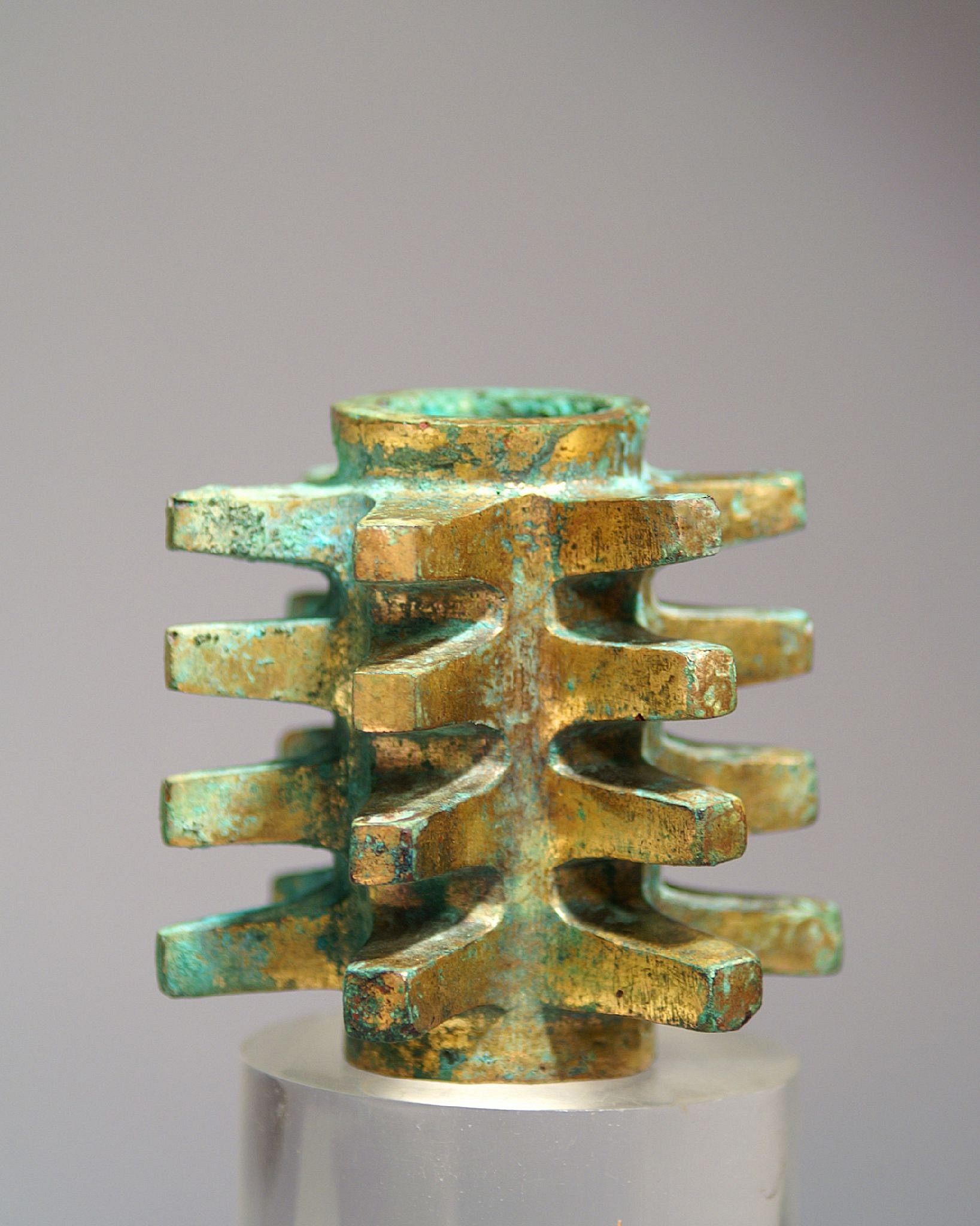
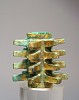
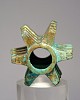
Peru, Vicús Gilt Copper Mace Head with four Levels of Six Pointed Stars
The mace has a richly gilded surface with traces of malchite corrosion inside and out. A similar mace with only three layers of stars and less intact gilt is illustrated in Mufareche (1999: #132). Mace heads were attached to wooden shafts and used as weapons. This is a particularly fine example from the early Vicús culture.
Period: Peru, Vicus, Far North Coast, c. 300 BC - AD 300
Media: Metal
Dimensions: Diameter 3" x length 3 5/8"
Price Upon Request
M3053
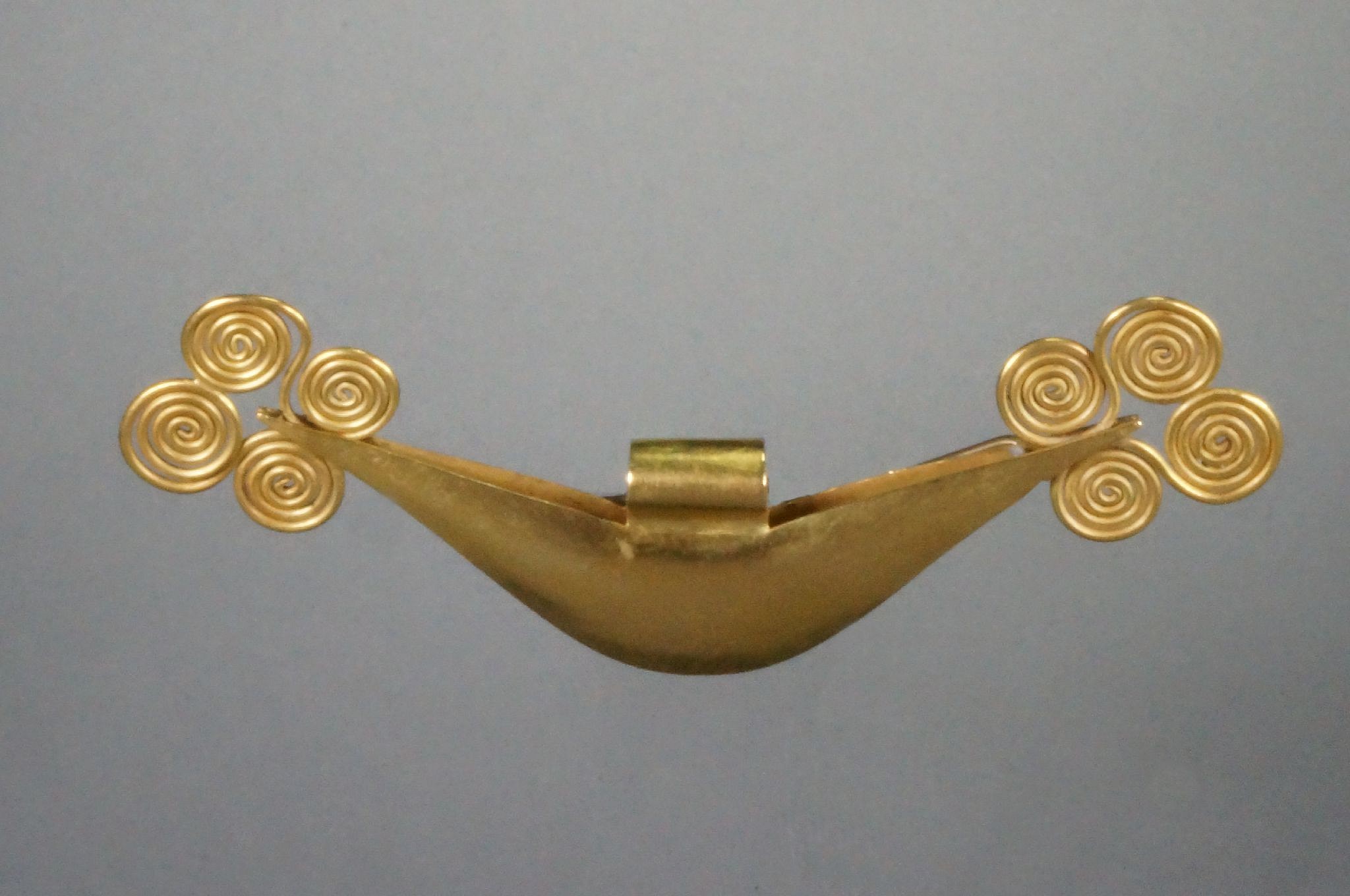

Peru, Vicús Gold Crescent Tweezers with Four Spirals on Each End
An elegant gold nose ornament with four wire spirals expertly soldered on each end. Made of two oblong sheets of gold with soldered filigree spirals reveals a high degree of craftsmanship. Tweezers were status implements fabricated in copper, silver and gold, with gold reserved for the highest level of status. Tweezers are often confused with nose ornaments, however they are spring loaded by annealing the metal, and were used to pluck the thick facial hairs of the Andean people. Shaving was not done in the New World, but was widely practiced in Europe and the Middle East.
Period: Peru, Vicus, Far North Coast, c. 300 BC - AD 300
Media: Metal
Dimensions: Width 6" Weight: 36.5 grams
XRF: Au. 83.8%, Ag. 20.0%, Cu.5.1%
Price Upon Request
96050


Peru, Vicus Gold Necklace of Soldered Discs and Rolled Oblong Beads
The necklace has been restrung to resemble the original ancient necklace. The beads were strung so that the necklace hangs flat. The roundels each have two sets of holes on either edge. The oblong beads are made from hemispheres and rolled, creating an elongated oblong shape. A necklace with similar shaped beads was found at the early Vicus site of Ayabeca in the far north of Peru.
Period: Peru, Vicus, Ayabeca, North Coast, c. 100 BC - AD 300
Media: Metal
Dimensions: Length: 23" without clasp. Height: 12" atcenter. Weight: 88 grams.
$17,000
88121
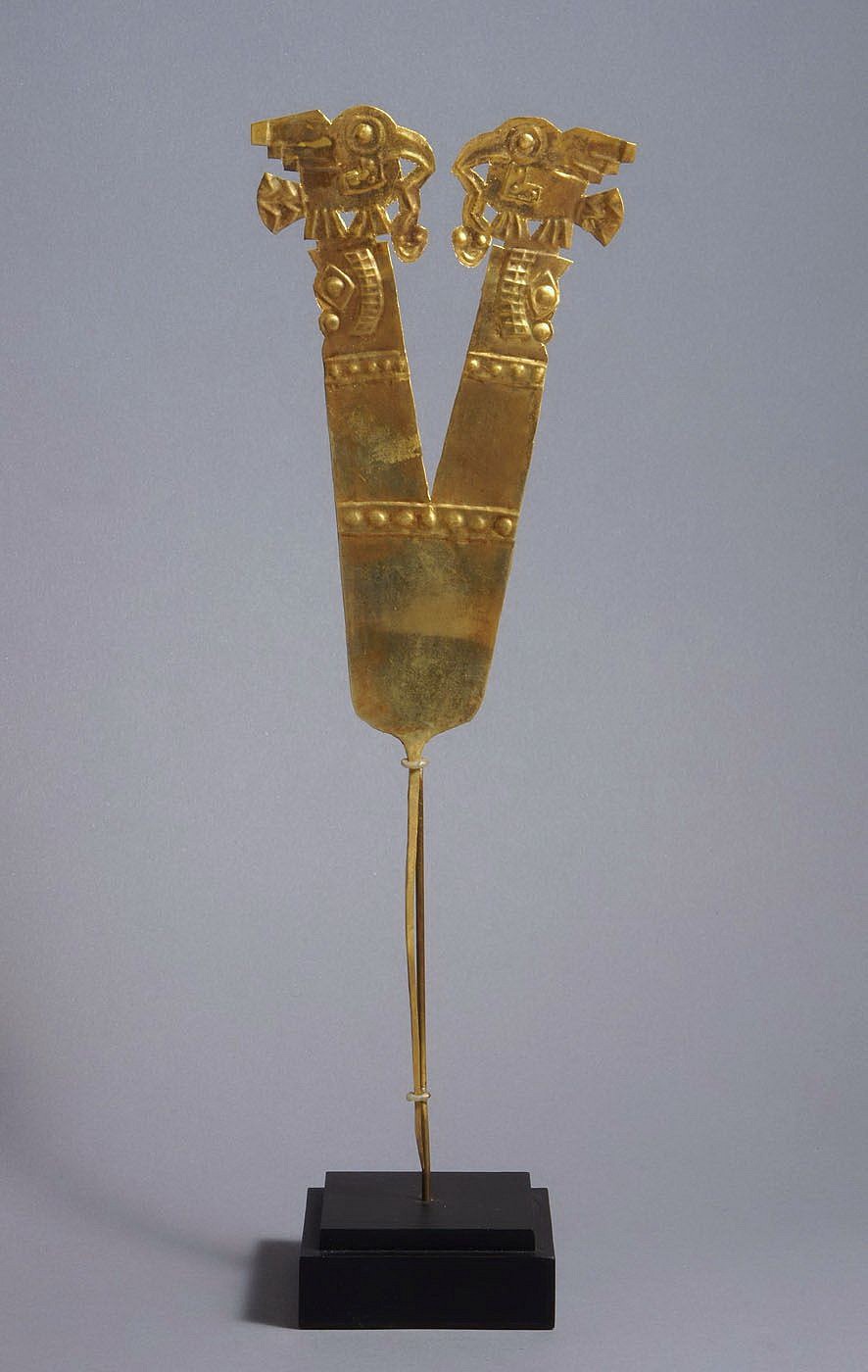
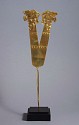
Peru, Wari Double-headed Gold Feather Plume with Embossed and Cutout Decoration
The feather plume is worked with embossed designs of two cutout birds standing on Puma heads and holding serpents in their beaks. The Puma Head can also be seen as a Condor head facing in the downward direction and seen in the classic Wari Tunics. The surfaces are beautifully burnished. A similar plume in the Berlin Museum measures 8 ¾†and is illustrated in WARI - Lords of the Andes, fig. 216. This plume is unusual in that it has two "branches" and is worked with both cutout and embossed designs while the others only have embossed work. Formerly in the collection of Robert Sonin.
Period: Peru, Wari, Central Coast, c. AD 650 - 1100
Media: Metal
Dimensions: Height 10 1/2"
$12,500
M7122b


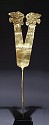
Peru, Wari Embossed Gold Feather Plume Decoration Depicting a Pair of Vultures
This double-headed design features two cutout birds of prey holding serpents in their beaks. This style of gold plume would have been attached to the headdress of a high-status individual, signifying strength and power. A less elaborate gold plum by the same artist is illustrated in WARI: Lords of the Ancient Andes, page 227. Acquired from a New York collector prior to 1990.
Period: Peru, Wari, Central Coast, c. AD 650 - 1100
Media: Metal
Dimensions: Height 11 1/4" Weight: 26 grams.
Price Upon Request
m7122


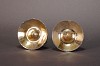

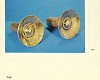
Peru, Wari Pair of Gold and Silver Ear Plugs
This pair of ear plugs has gilt gold fronts attached to silver plugs. The silver plugs were made using a wood matrix, which can be seen in a few exposed areas on the back. It is quite rare to see the wooden matrix intact underneath the gold as it usually disintegrates within a few hundred years. Similar ear spools are illustrated in PRE-COLOMBIAN ART OF SOUTH AMERICA by Alan Lapiner, plate 566.
Period: Peru, Wari, South Coast, c. AD 600 - 750
Media: Metal
Dimensions: Diameter: 2 5/8" x Depth: 3 1/8"
$7,500
n8032